The Complete Guide to Funeral Photography in the UK

By Shaun Foulds — UK Funeral Video Services

Professional funeral photography is still something many families haven't encountered before. Unlike wedding photography, which is expected and planned for years in advance, funeral photography is often something families discover when they're already in the middle of arranging a service — wondering whether it's appropriate, whether it would feel intrusive, and whether it's something their loved one would have wanted.

I'm Shaun, and I've photographed funerals across the UK for over ten years, covering more than 2,500 services for families of every faith, culture and background. This guide answers the questions I'm asked most often — what funeral photography actually involves, how I work on the day, what it costs, and how to decide whether it's right for your family.

If you'd like to go straight to a specific question, this guide covers:

What Is Funeral Photography and Why Does It Matter?

Funeral photography is the sensitive, documentary-style capture of a funeral or memorial service — the people who came, the moments that happened, the details that made the day particular to that person and that family.

It matters for a simple reason: the day passes faster than anyone expects, and in a fog of emotion that makes it almost impossible to take in everything that's happening. Many families tell me, in the weeks after a funeral, that they can barely remember specific details — the words of the eulogies, who was standing next to whom, how the flowers looked, the expression on a grandchild's face. Grief does this. The photographs give it back.

A good set of funeral photographs becomes a visual record of the love that was in the room — the community that gathered, the tributes that were made, the final goodbye. For many families, they also become something they share with relatives who couldn't be there, show to children who were too young to remember, or look at on anniversaries when they want to feel close to the person they lost.

For more on the decision itself — whether funeral photography is right for your family — see my dedicated guide on is funeral photography right for our family?

A videographer filming a funeral service inside a chapel with stained glass windows and candles, focusing on the preacher at the altar.

How Funeral Photography Differs from Other Event Photography

Funeral photography is unlike any other kind of event photography, and photographers who haven't specialised in it often struggle — not because of a lack of technical skill, but because the emotional and contextual demands are so different.

At a wedding, the photographer is expected and celebrated. People pose, smile, look at the camera. The day is structured around being photographed. At a funeral, the opposite is true. The camera should be almost invisible. Nobody should be asked to stop, pause, or repeat anything. The photographer's job is to observe and record — not to direct or interrupt.

This requires a completely different approach to positioning, timing, and moment selection. It also requires an understanding of grief — of knowing when to move closer and when to step back entirely, of recognising which moments are too private to photograph and which are the ones families will treasure most.

My style is documentary and storytelling-led throughout. I use longer lenses so I can stay at the edges of what's happening rather than in the middle of it. I arrive early, learn the running order, understand the venue, and plan how I'll move through the day without drawing attention to myself. And once the service begins, I work quietly and stay in the background so the family can be fully present — and so the photographs, when they see them, feel like an honest record of what the day was really like.

You can see this approach in practice in my funeral photography portfolio.

What to Expect on the Day

Before the Service

I typically arrive at the venue well before guests, often 60 to 90 minutes early. This gives me time to:

  • Walk the space and understand where key moments will happen

  • Speak with the funeral director and officiant about the running order

  • Identify any sensitivities — areas or moments the family has asked me to avoid

  • Set up any equipment quietly, before anyone arrives

This preparation makes everything smoother on the day. By the time guests begin arriving, I know exactly where I'll be and what I'm looking for. I'm not discovering the venue at the same time as everyone else.

During the Service

My coverage typically follows the natural sequence of the day:

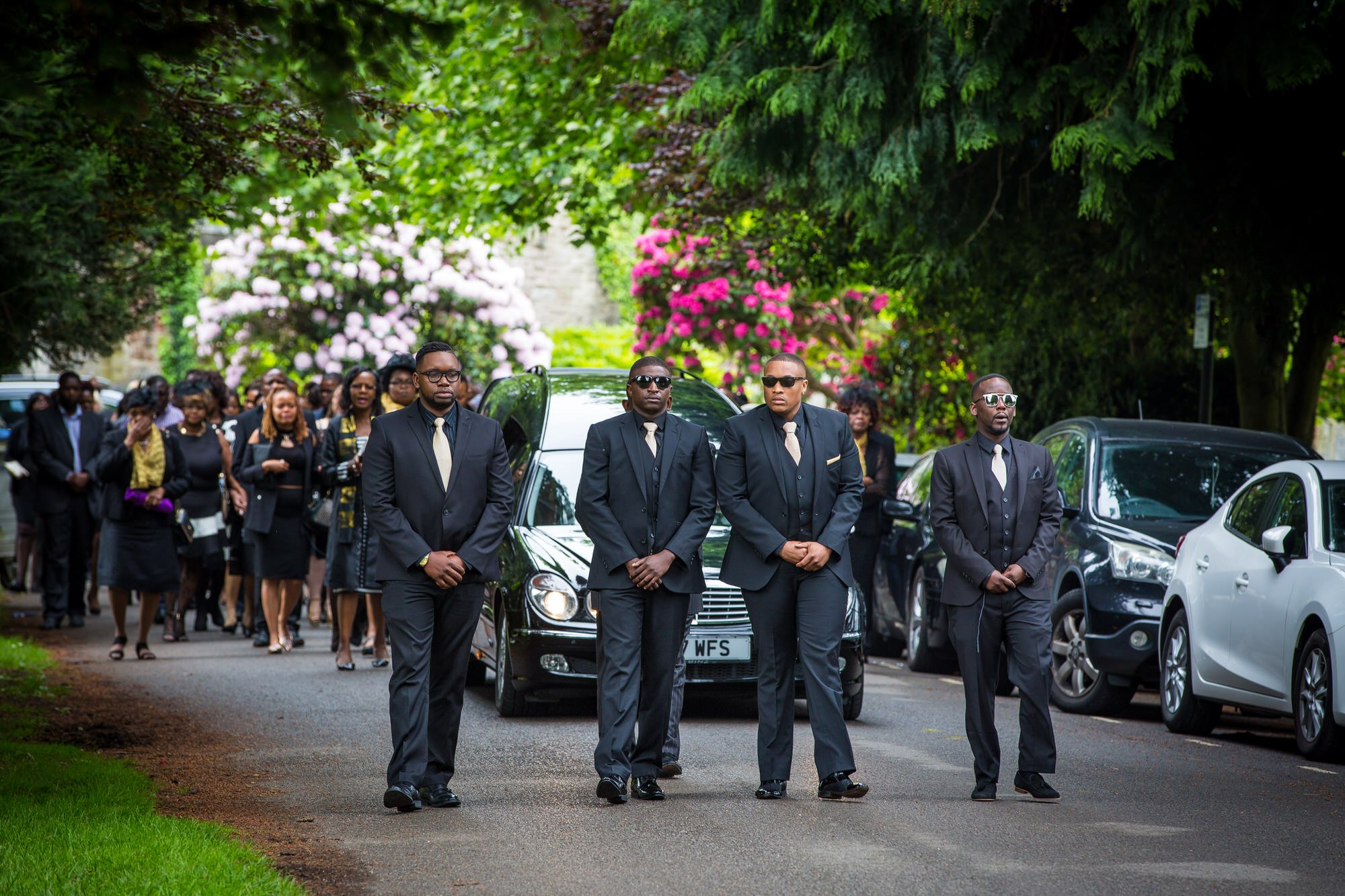
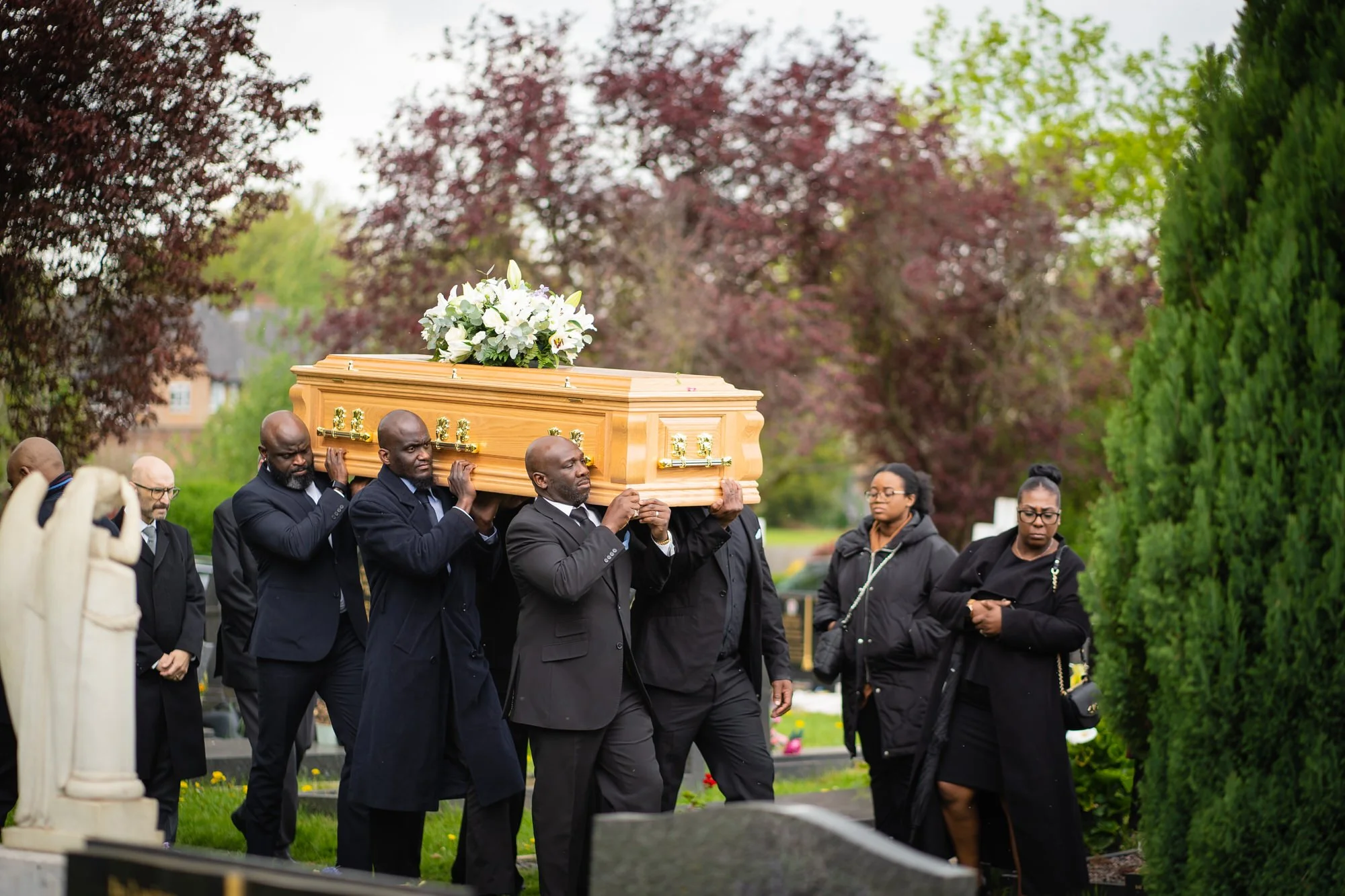
Arrival — guests arriving, the hearse, the coffin being carried in, family members greeting one another outside. These early moments often contain some of the most powerful images of the day — quiet, unguarded, honest.

The service itself — readings, eulogies, music, hymns, prayers. I work from the edges and the back, using longer lenses to capture expressions and reactions without intruding. I never cross in front of the coffin, never position myself between the family and the officiant, and never ask anyone to pause or repeat something.

Details — flowers, the order of service, personal items on display, candles, the coffin itself, small objects that carry meaning. These are the images families often say surprised them most — the things they'd forgotten were there until they saw the photograph.

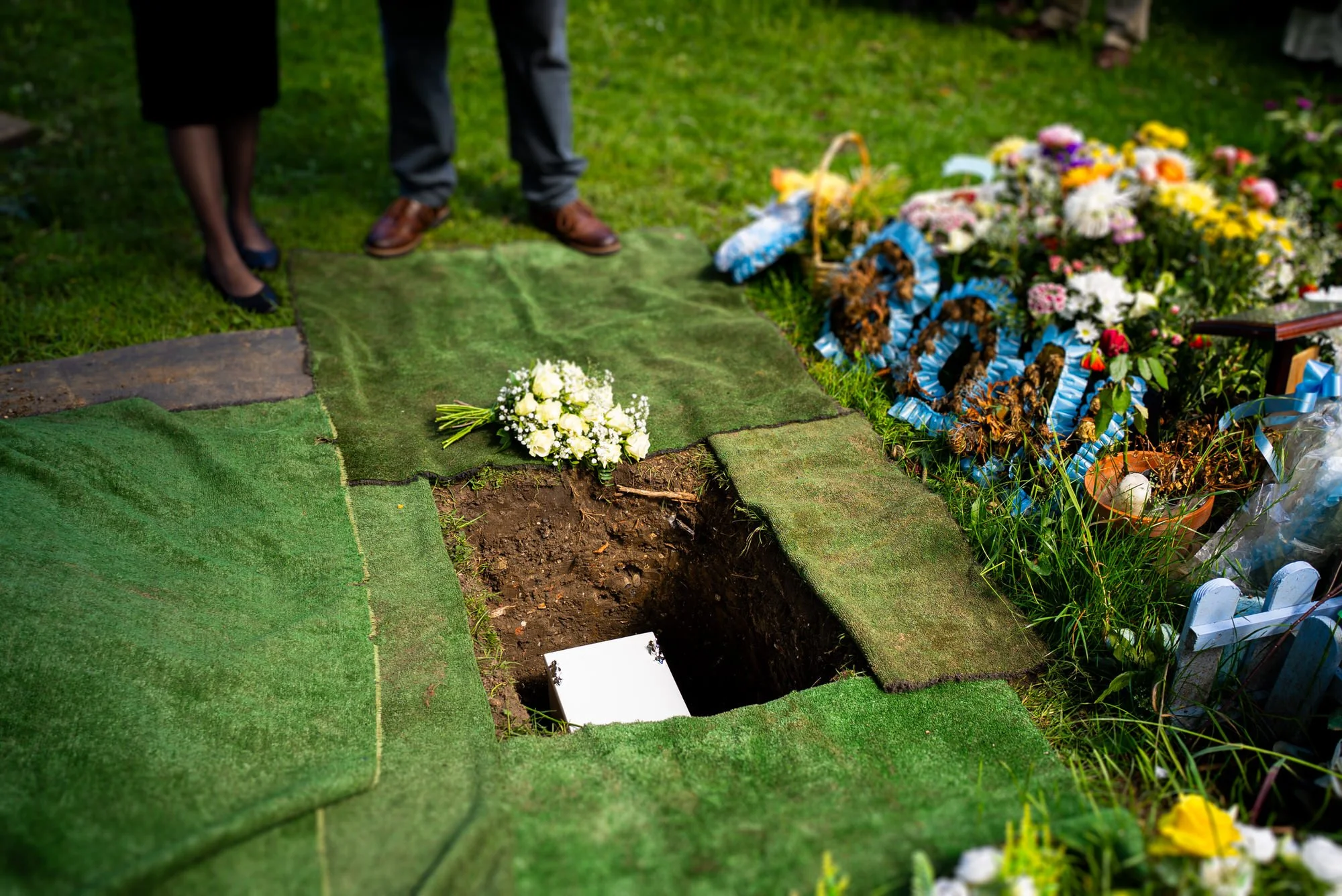
The committal or graveside — if the service continues at a crematorium committal or graveside burial, I move with the family and continue coverage there. The lowering of the coffin, the final prayers, flowers being placed — these moments matter deeply to families and I treat them with corresponding care.

After the service — the gathering outside, people embracing, children running between adults, conversations that nobody was writing down. The informal moments after the formal service are often where the grief and the love and the relief all appear together most honestly.

What I Don't Do

I don't stage, pose or direct. I don't use flash in most circumstances, as it draws attention and disrupts the atmosphere. I don't photograph anyone who has specifically asked not to be included. And there are moments — a parent holding a child's coffin, an open-coffin farewell in certain traditions, a family member overcome at the graveside — where I lower the camera entirely and simply let the moment be.

Cultural and Multi-Faith Funerals

The UK is one of the most culturally diverse countries in the world, and that diversity is reflected in the funerals I photograph. Each tradition has its own customs, rituals, atmosphere and visual language — and photographing them well requires both technical skill and genuine cultural understanding.

Hindu Funerals

Hindu funeral photography requires particular sensitivity around the sacred rituals — the chanting of mantras, the prayers led by the pandit, the use of flowers and sacred items, and where the cremation itself is accessible, the moments around the funeral pyre. I always speak with the family in advance to understand which elements are most important to them and where the camera should and should not go. You can see an example of this work in my Hindu and Asian funeral photography case study.

Sikh Funerals

The Sikh Antim Sanskar centres on community prayer, Kirtan — the singing of sacred hymns — and readings from the Guru Granth Sahib. The atmosphere in a gurdwara during a Sikh funeral service is unlike anywhere else: deeply devotional, communal, and spiritually focused. I remain especially unobtrusive during sacred readings and keep positioning respectful of the scripture throughout. See my Sikh funeral case study at Slough Gurdwara for a real example.

Caribbean and Jamaican Funerals

Caribbean funerals — Jamaican, Barbadian, Trinidadian and other West Indian services — are community gatherings in the fullest sense. Large churches, powerful choirs, family members who stand to testify, and graveside ceremonies that can last several hours with singing, drumming and the collective backfilling of the grave. There is grief here, but there is also celebration — and the photographs need to capture both. I've covered hundreds of Caribbean services and understand what families want to see when they look back at the images. For an example, see my Antiguan and Barbadian funeral case study.

Nigerian and West African Funerals

Nigerian funerals are often elaborate, multi-element events — powerful choral singing, prayers in English and local languages, traditional dress, and graveside drumming. The scale and energy of these services is significant, and the photographs need to reflect that. Families often share images widely within the community, so the quality of the final images matters enormously. See my Nigerian funeral case study for more.

Greek Orthodox Funerals

Greek Orthodox funerals follow a specific liturgical structure with incense, candles, chanted prayers and the veneration of the icon. The atmosphere is contemplative and traditional. I understand the importance of stillness during specific moments of the liturgy, and how to work within the constraints of a Greek Orthodox church without disrupting the spiritual character of the service. See my Greek Orthodox funeral case study from Crystal Palace.

Military Funerals

Military funerals demand an additional layer of preparation — security protocols, agreed camera positions, and a clear understanding of the ceremonial sequence so that nothing is missed and nothing is disrupted. I've covered funerals at Sandhurst, Wellington Barracks and other military settings, including a service commissioned by the Ministry of Defence. See my full military funeral filming and streaming guide for more detail.

Natural Burials

Natural burial grounds present a completely different visual environment — meadows, woodland, changing light, the absence of hard architectural lines. The photography at a natural burial has its own rhythm, shaped by the landscape and the more spacious, organic character of the day. See my detailed case study of funeral photography at Clandon Wood Natural Burial Ground in Surrey.

How to Choose the Right Funeral Photographer

The most important thing to look for is experience specifically with funerals — not just general event photography. A photographer who has covered hundreds of funerals will understand the emotional environment, know where to be at each moment without being told, and have the judgement to step back when that's the right thing to do.

Questions worth asking:

  • How many funerals have you photographed, and what kinds of services?

  • Can I see examples of your work from services similar to ours?

  • How do you handle moments you're not sure about — do you photograph first and ask later, or ask first?

  • What happens if there are family members who don't want to be photographed?

  • How do you work in low-light churches or at outdoor gravesides?

  • Do you have experience with our cultural or religious tradition specifically?

A short phone or video call before booking can tell you a great deal. Listen for how they talk about the work — whether their instincts feel calm and considered, or whether they're more focused on the technical side than the human side. Both matter, but in funeral photography, the human side comes first.

You can read more about this decision in my guide on is funeral photography right for our family?

Funeral Photography Costs in the UK

My funeral photography starts from £750, which includes full coverage of the service from arrival to the end of the committal or reception, all images individually edited, and a private online gallery for the family to download and share.

What affects the final cost:

Length of coverage — a service with just a church or crematorium element costs less than one that continues to a separate graveside or graveside and reception.

Travel — I cover the whole of the UK. Distance and travel time are factored into quotes honestly.

Combined services — many families combine funeral photography with live streamingvideography or AV support. Combining services with one operator means nothing is missed and there is a single point of contact for everything.

Editing and delivery — every image I deliver is individually edited. There is no batch processing. Skin tones, light, colour and background distractions are all worked on carefully so the final gallery reflects the day as it actually felt.

For a clear quote based on your specific arrangements, call or text me on 07772 509101.

  • "Shaun's Service is second to none. Great coverage and beautiful details like the holding page and even including the order of service. Just took control of all the livestream elements so we didn't have to worry about anything."

    Susan Maxwell - 2nd April 2026

  • ”My friend George Richmond, the Director of Photography for the Marvel movie Deadpool, took on the responsibility of selecting a videographer for my husband's funeral. He chose you out of everyone he looked at, and I am immensely grateful for that decision. Your work is truly remarkable!”

    Lady M

  • "Shaun gave us very good and clear advice at the start. Worked tirelessly to make sure everything was just as we wanted it. Completed the videos in a very short window. Also completed extra videos and dealt with the funeral directors on our behalf. Has answered a million questions along the way with good grace and patience. The outcome has been amazing."

    Alison - April 2025 ⭐️⭐️⭐️⭐️⭐️

Etiquette, Consent and Privacy

Is It Appropriate to Have a Photographer at a Funeral?

For most families, yes — when the photographer works with genuine discretion. The key is choosing someone whose presence genuinely doesn't disrupt the service, and communicating openly with family members beforehand so everyone is comfortable.

If there are family members who feel uncertain, I'd encourage a conversation rather than a decision based on assumption. In my experience, hesitation usually comes from imagining a photographer who is visible, moving around constantly, and making people feel watched. That is not how I work. Many families tell me afterwards that guests they were worried about said they barely noticed me at all.

Consent

Before every funeral I photograph, I discuss with the family:

  • Which parts of the day they want covered and which they'd prefer to keep camera-free

  • Whether there are individuals who should not be photographed

  • How they'd like the images handled after the service — private gallery, download link, printed album

  • Any specific cultural or religious sensitivities around what is and isn't appropriate to photograph

Nothing is photographed or shared without the family's knowledge and consent. The images are delivered to the family privately, and what they do with them from that point is entirely their decision.

Privacy and Sharing

All images are delivered via a secure, private online gallery accessible only to the family. I do not share funeral photographs on social media, websites or promotional materials without explicit written permission from the family. Many families grant permission for a small number of images to appear in my portfolio — but this is always their choice, never assumed.

How Funeral Photographs Help With Grief

Many families tell me that seeing the photographs — sometimes weeks or even months after the funeral — was an unexpectedly powerful experience. Not painful, as they'd sometimes feared, but comforting.

What they often describe is the experience of seeing things they didn't know were happening at the time. A cousin they hadn't spotted at the back of the church. The way their mother held their father's hand during the eulogy. The expression on a child's face at the graveside. The flowers they hadn't fully registered. The sheer number of people who came.

Grief narrows attention. The photographs widen it again — and in doing so, they give families a more complete picture of the day than memory alone could hold. They become a resource for processing what happened, for talking about the person with others, for sharing with relatives who weren't there, and for returning to on significant dates.

They also serve a practical purpose for children. Young children who attend a funeral often have only fragments of memory. A thoughtful set of photographs can help them understand, years later, what the day was like — who was there, how the family came together, what the person who died meant to the people around them.

Funeral Photographs in Tribute Films and Memorial Albums

Photographs from the funeral can go on to serve a second life as part of a tribute film or memorial album — something the family creates and keeps, or shares at a later gathering.

I offer funeral slideshows and tribute films as part of my services, combining pre-funeral photographs of the person's life with images from the service itself. The result is a film that tells the complete story — who they were, how they lived, and how they were sent off.

If you're considering a tribute film alongside funeral photography, it's worth thinking about this early, as the two can be planned together so that the images from the service feed naturally into the finished film.

Ready to Talk?

I'm Shaun, and I handle every funeral photography booking personally — from the first conversation through to the final edited gallery.

If you're considering funeral photography for a service you're arranging, I'm happy to talk through what's involved, what would work for your family, and what a clear quote looks like for your specific plans. There's no obligation.

Call or text me on 07772 509101 — I'm available seven days a week from 9am to 10pm — or get in touch online.

Related pages and guides: