Live Streaming a Graveside or Outdoor Funeral: What to Expect
Graveside and outdoor funerals present their own unique challenges for funeral live streaming — and their own unique moments that families want to preserve and share. Over the past ten years, I have streamed hundreds of outdoor services, from quiet churchyard burials to large Caribbean and African celebrations that last several hours and fill an entire cemetery with singing, community and colour.
If you are arranging a graveside or outdoor funeral and want to include funeral live streaming for those who cannot attend in person, this guide explains what to expect, how I manage the day, and why professional equipment and experience make such a difference outdoors.
If you'd like to understand how funeral streaming works in general before reading about the outdoor-specific elements, my full funeral live streaming guide covers everything from booking to the viewing link.
Why Outdoor Funeral Streaming Is Different
Streaming a funeral inside a crematorium or church is relatively straightforward — the environment is controlled, there is usually a fixed order of service, and the acoustic space is predictable. Outdoor services are different in almost every way.
Wind affecting microphones and speech clarity
Light changing rapidly, especially on partly cloudy days
Connectivity cannot rely on venue Wi-Fi
People moving around, with services evolving on the day in ways that are harder to predict
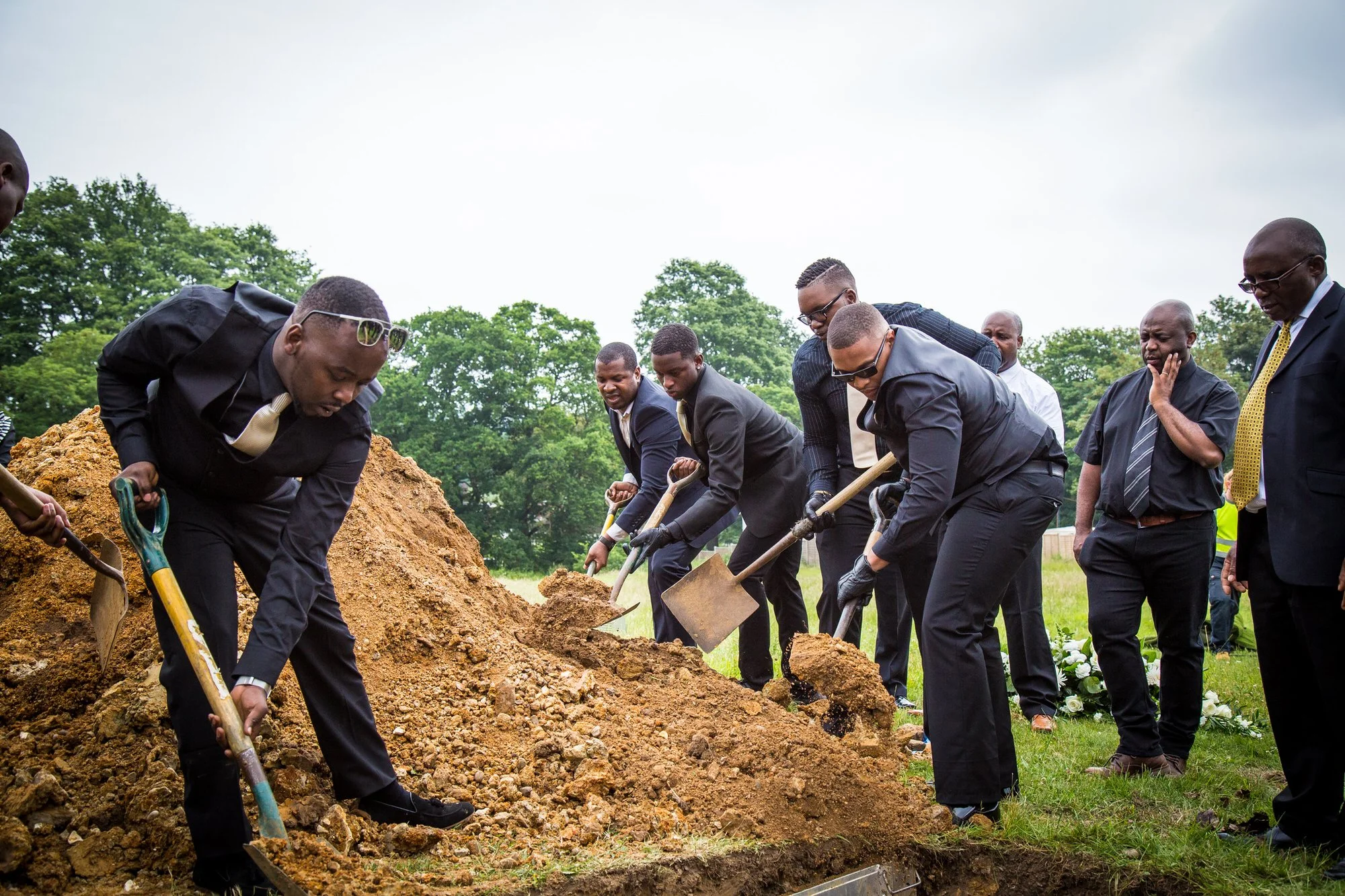
Graveside ceremonies are often deeply emotional, sometimes longer than expected, and frequently involve moments — the lowering of the coffin, the backfilling of the grave, spontaneous singing or drumming — that simply cannot be missed.
This is why experience matters so much for outdoor funeral streaming.
Professional Equipment for Outdoor Funeral Streaming
Before looking at the different types of outdoor service, it is worth explaining what I bring to every graveside funeral. The equipment is chosen specifically for the challenges of working outside.
Bonded 4G/5G internet I never rely on venue Wi-Fi or a single mobile signal. I use a bonded internet solution that combines multiple mobile networks simultaneously, giving a strong and stable connection even in remote or rural cemeteries where signal can be patchy. This is one of the biggest differences between a professional outdoor stream and an attempt made on a smartphone.
Two-camera setup One camera covers the wide scene — the graveside, the gathered family, the coffin being carried from the hearse. The second captures closer detail — the minister or celebrant, the lowering, and the faces of those closest to the person who has died. There is no fumbling with a single camera trying to catch everything.
Professional directional microphones Wind is the enemy of outdoor audio. I use professional shielded microphones, correctly positioned, to capture the words of the minister or celebrant clearly in open air — something a standard microphone cannot do reliably.
Discreet setup Everything is set up and tested before guests arrive, so the equipment is simply there when people come — not being assembled as the hearse pulls in.
For more on what professional funeral streaming includes as standard, you can visit my funeral live streaming page.
Types of Outdoor Funeral I Stream
Church Followed by a Graveside Committal
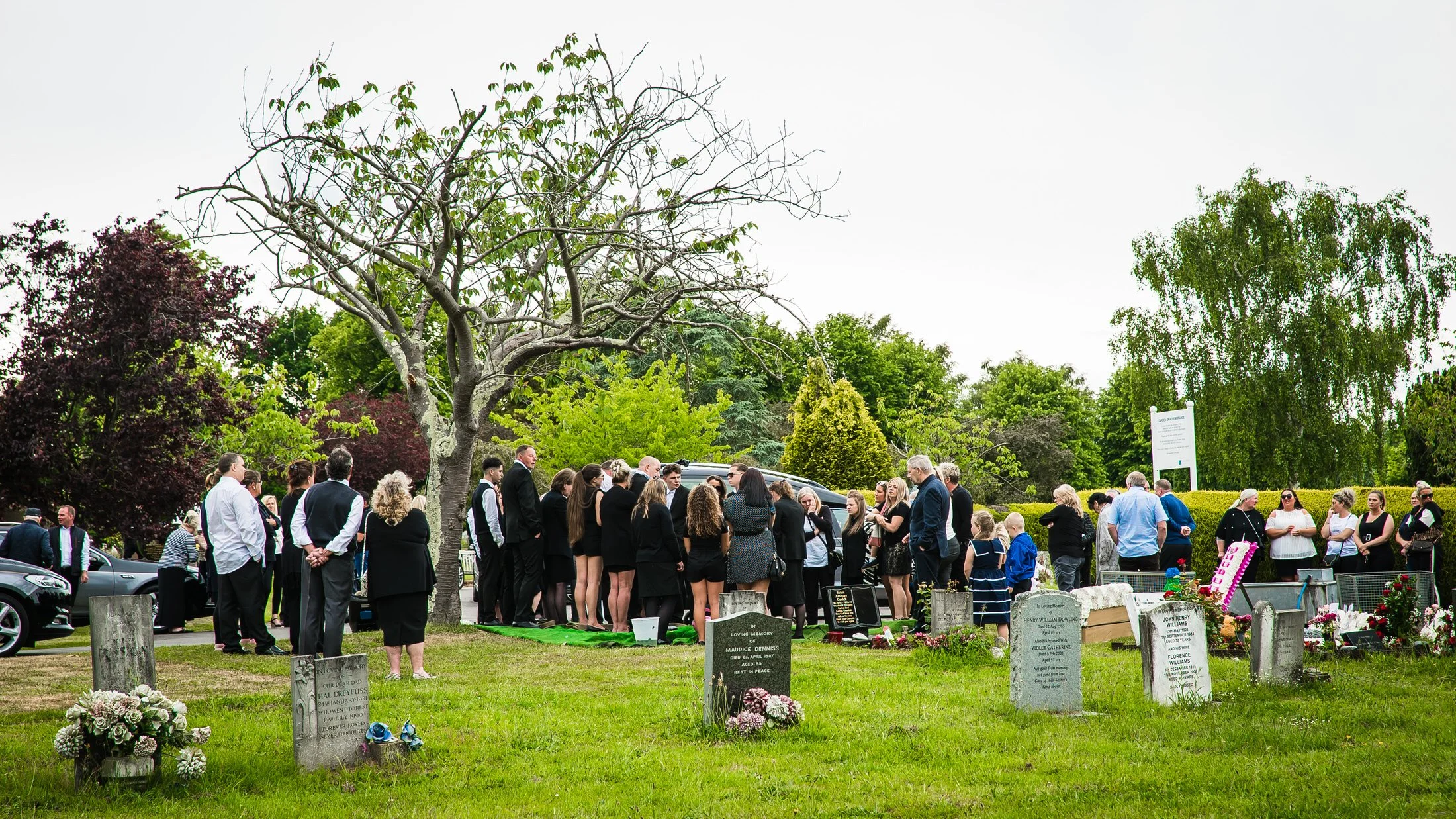
The most common type of outdoor service I stream is one that begins inside a church and then moves to a graveside — either in the churchyard directly outside, or at a separate cemetery nearby.
When this is the arrangement, timing is everything. I manage the stream at the church for the full service, then need time to move and set up at the graveside before the family and coffin arrive. In practice, this means allowing an additional 15–20 minutes between the church service ending and the graveside service beginning. This is something families and funeral directors should build into the order of the day when booking.
It helps to let your funeral director know that I will need to travel ahead to the graveside. In most cases I coordinate directly with the funeral director to make sure the timing works smoothly — that is something I am used to doing and it rarely causes complications when it is planned for.
What I typically cover at the graveside:
Guests arriving and gathering at the grave
The coffin being carried from the hearse to the graveside
The minister or celebrant's words of committal
The lowering of the coffin
Any hymns, singing or spoken tributes
Dove releases, where included as part of the farewell
The final farewell and departure
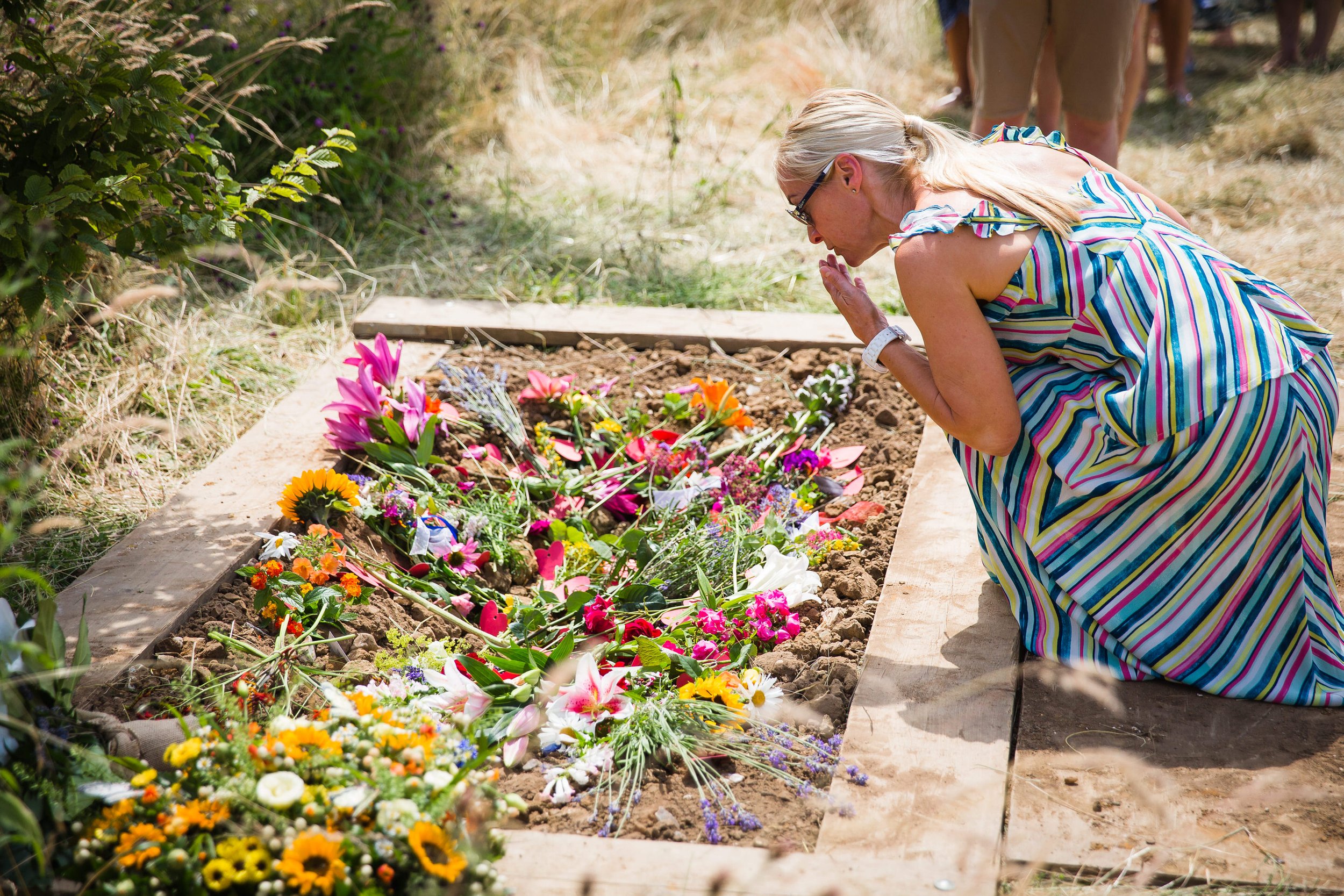
The backfilling and dressing of the grave with flowers and tributes
The recording of the full day — church and graveside — is then available as a single continuous viewing experience for those watching online.
Dedicated Graveside Funeral Service
Some families choose a graveside service with no prior venue — the graveside is the entire service. These are increasingly common, particularly for families who want something more personal and outdoors-focused, or for natural and woodland burials.
For this type of service, I arrive early — well before any guests — and have everything set up and tested before the family arrives. The stream begins around 20 minutes before the service starts, giving online viewers time to connect, check their sound, and settle.
These services vary enormously in length and character. Some are short and simple. Others feel more like a full celebration at the graveside — PA systems, speakers, music, readings, catering, and gatherings that last several hours. I have covered both ends of that spectrum and everything in between.
If your graveside service includes PA equipment or external speakers, it is helpful to mention this at the time of booking so that the audio setup for the stream can be planned accordingly. I can also provide graveside audio-visual support where needed — from microphones and speakers to managing music and tribute playback alongside the live stream.
Caribbean and Jamaican Graveside Funerals
Caribbean funerals — especially Jamaican, Barbadian, Trinidadian and other West Indian services — are among the most meaningful and involved funerals I have the privilege of streaming, and they are also some of the most technically demanding.
These services often follow a church service with a full graveside programme that can last several hours. They are community events in the fullest sense — large gatherings, extended family travelling from across the world, spontaneous singing, traditional drummers, and traditions that vary by family and denomination.
Elements I commonly cover at Caribbean graveside services include:
The procession from the hearse to the graveside, often with family members carrying
Extended graveside tributes and prayers
Congregational and solo singing — often powerful, extended, and the most emotionally significant part of the day for those watching from overseas
The lowering of the coffin
The backfilling of the grave, where close family and friends help fill the grave as an act of love and respect
The dressing of the grave with flowers and tributes
For families with relatives watching from Jamaica, Barbados, Trinidad, or elsewhere in the Caribbean, the live stream is not a secondary extra — it is essential. The quality of the audio during the singing, and the continuity of coverage during a long graveside service, matters enormously to those watching from thousands of miles away.
I have extensive experience with Caribbean funeral traditions and understand the importance of capturing every part of the graveside programme, not just the formal elements. Some of the most moving services I have ever been part of have been Caribbean graveside funerals, and I feel privileged every time I am trusted with one.
You can read one family's experience in the testimonials on my funeral live streaming page, and see a real example in my Caribbean funeral case study from Bedford.
Greek and Orthodox Graveside Traditions
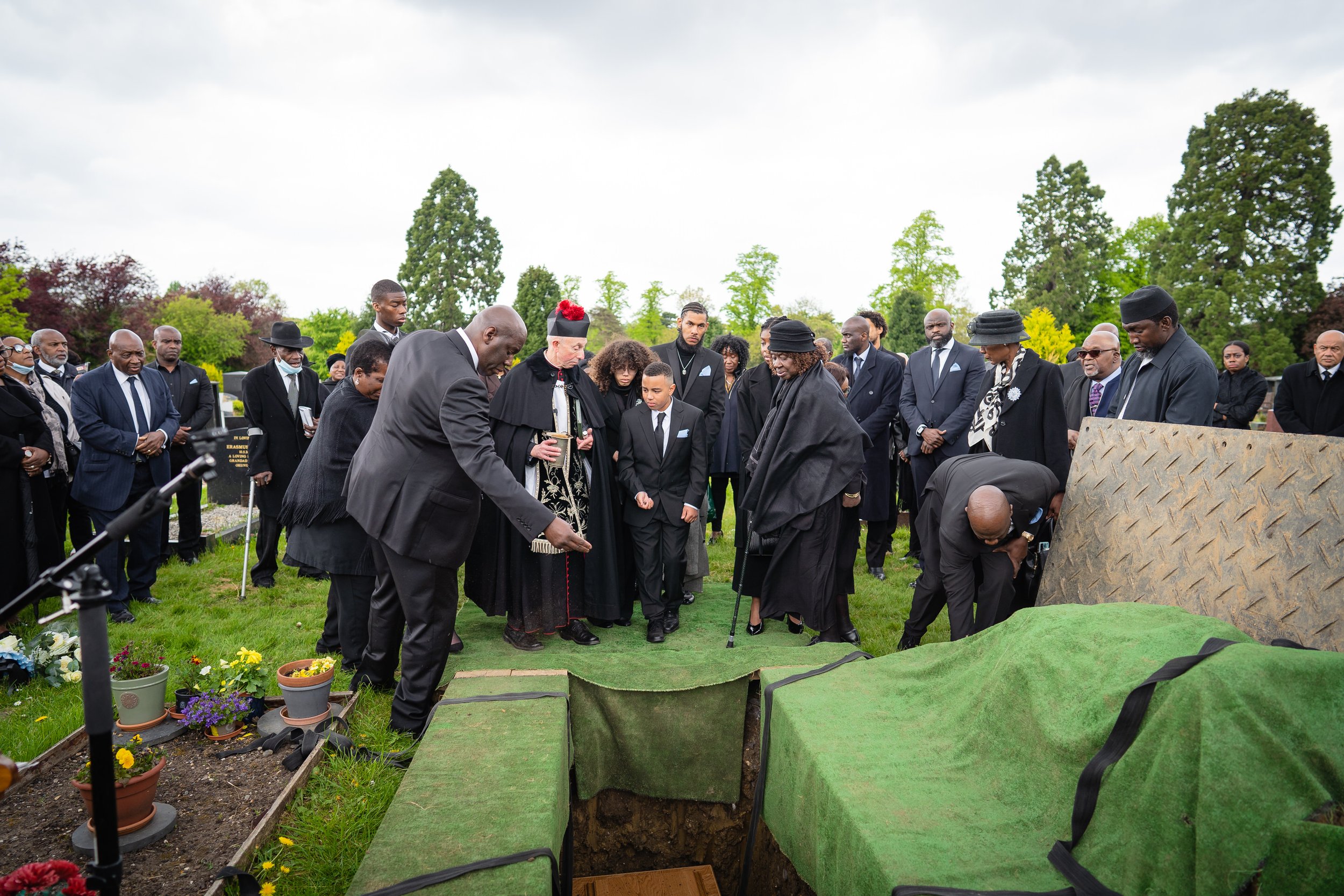
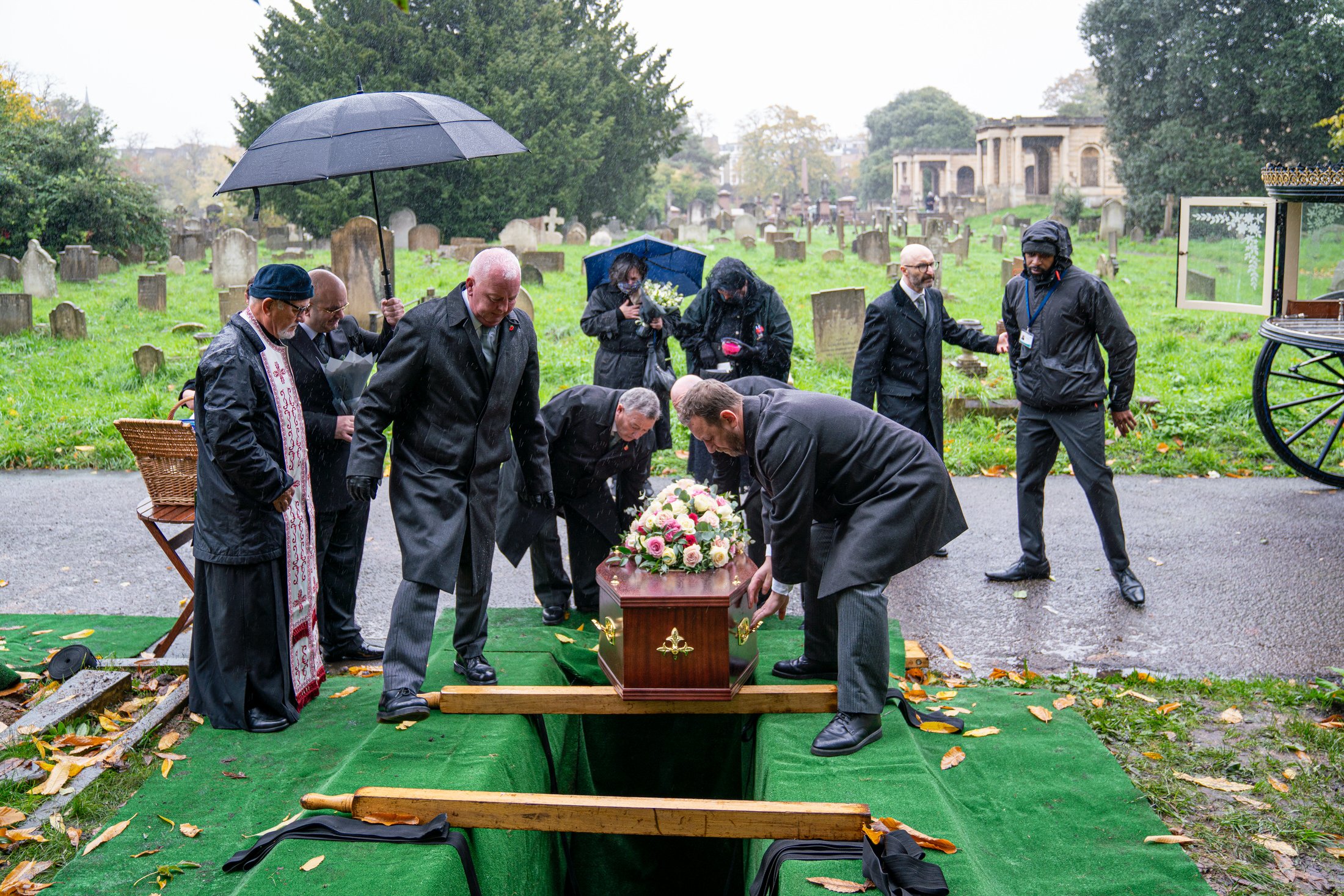
Greek Orthodox funerals follow a specific liturgical structure, with traditions at the graveside that are distinct from a standard Church of England or non-religious service. The graveside element typically follows a church service and includes prayers, incense, and set rituals around the lowering and the final farewell.
For family members watching from Greece or the wider Greek diaspora, having a clear, well-managed stream of these moments is deeply important — not just for the practical reason of being unable to travel, but because the graveside ritual is a significant part of how grief is held and shared within Orthodox tradition.
I approach these services with the same careful preparation as any other, taking time to understand the order of service in advance and ensuring the stream captures the traditions that matter most to the family.
African Graveside Funerals and Celebrations
African funerals in the UK are some of the most vibrant, expressive and community-centred services I have the privilege of live streaming. They often combine deep Christian faith with traditional elements: drums, singing, call-and-response, dancing, and long periods of praise and remembrance at the graveside.
These services usually follow a church service and then continue at the cemetery, but the graveside element can feel like a full celebration in its own right. It is not unusual for the programme to last several hours, with different speakers, choirs, drummers and family groups contributing in turn. For relatives watching from Nigeria, Ghana, Kenya, Zimbabwe, South Africa and across the African diaspora, being able to follow the music, the movement and the atmosphere at the grave is just as important as hearing the words.
At African graveside funerals I typically cover:
The arrival of the hearse and procession to the grave
Drumming and singing as the coffin is carried and positioned
The formal prayers, Bible readings and tributes
Congregational singing, choirs and dancing around the grave
The lowering of the coffin
The backfilling and dressing of the grave with flowers, fabrics and personal items
Any continued singing, drumming and dancing after the burial is complete
From a technical point of view, these services demand clear audio and stable, continuous coverage. Drums and amplified music can easily overwhelm a basic microphone, so I use carefully positioned directional microphones and a two-camera setup to balance the sound and show both the close detail at the grave and the wider movement of the congregation.
You can see how this looks in practice in my African funeral case study from Hertfordshire.

DIY graveside streaming vs professional coverage
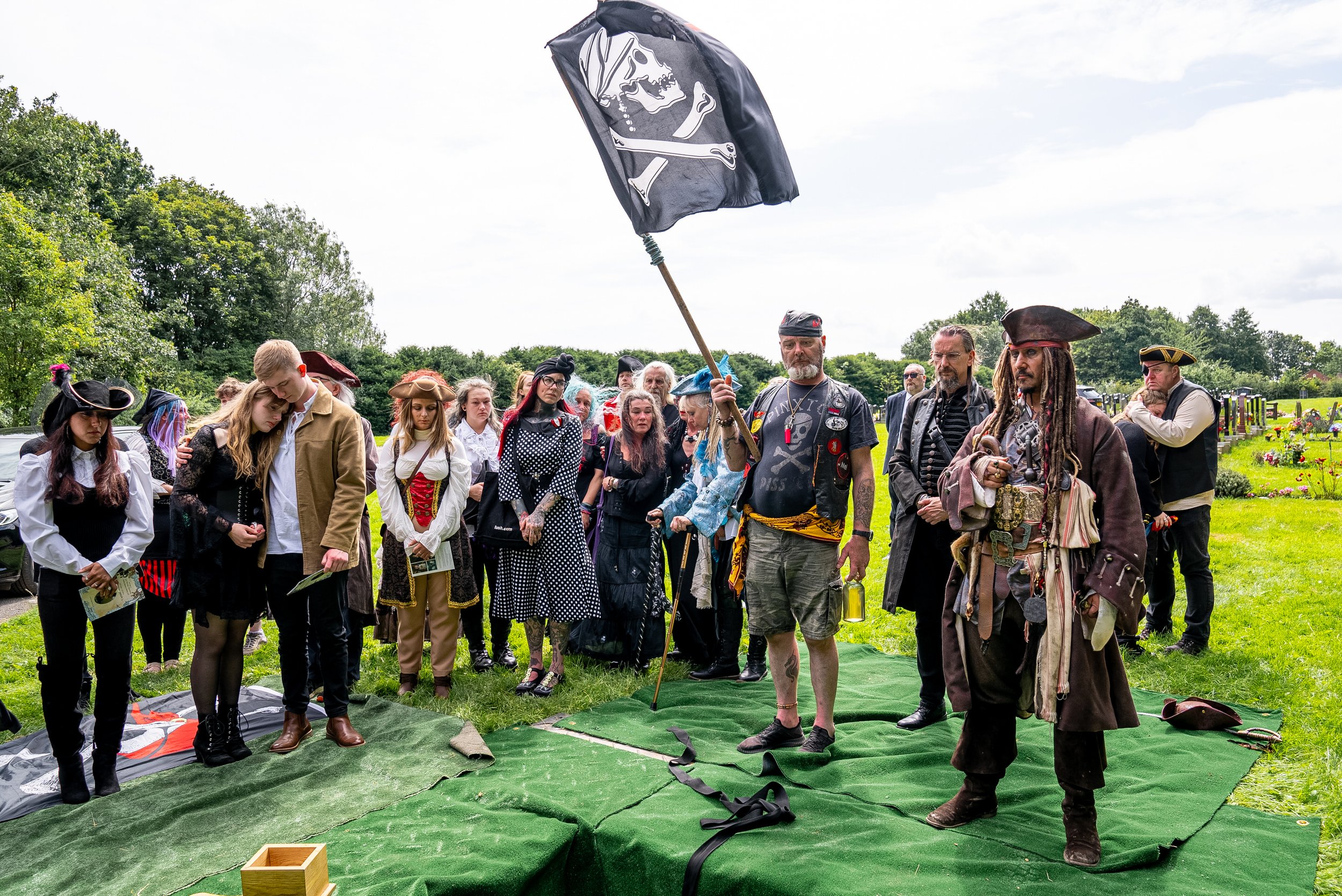
It is possible to attempt a DIY graveside stream on a smartphone — but it is not something I recommend, and here is why.
A graveside service is not a controlled environment. Wind, movement, changing light and unreliable mobile signal all work against a single-person, single-device setup. On a breezy or windy day especially, a phone or non-professional microphone will often pick up almost nothing but wind noise. The result is that the one thing families abroad most want to hear — the words, the prayers, the tributes and the singing — can be almost impossible to make out.
Beyond the technical issues, there is the question of who manages it. At a graveside funeral, every person there should be focused on the person who has died — not watching a phone screen and hoping the connection holds. If the stream drops or the sound is unusable, that person often feels responsible, while also managing their own grief.
When I am there, the family do not need to think about the stream at all. I bring equipment and backup options designed for outdoor conditions, I monitor the connection and audio continuously, and I move as the service moves so key moments are never missed. That allows the family to be fully present on one of the most significant days of their lives.
Practical Advice for Families
Book early
Funerals at cemeteries are often arranged at short notice, but the sooner you confirm streaming the better — particularly for longer services that require more detailed planning.
Tell your funeral director
Let them know I will be attending. In most cases I will liaise directly with them about timing, venue access, and any cemetery-specific requirements — but it helps if they know to expect me.
Share the link before the day
Online viewers should receive the private viewing link in advance, with a note to connect around 20 minutes before the service begins. This is especially important for viewers in other time zones.
Think about the recording
Every stream I do is recorded and remains available for private viewing for 12 months, with a high-definition download for the family to keep. For Caribbean and extended graveside services in particular, families often find the recording becomes something they return to again and again. For more on this, see my guide on can you watch a funeral live stream later?

How to Book Graveside or Outdoor Funeral Live Streaming
If you are arranging a graveside or outdoor funeral and would like to discuss live streaming, I am available seven days a week from 9am to 10pm.
Call or text me on 07772 509101, or visit my funeral live streaming page to find out more and get in touch.
With ten years of experience streaming outdoor funerals of every kind — from quiet rural churchyards to large Caribbean, African and Greek celebrations — I understand what these services mean to the families I work with, and I approach every one with the care, reliability, and discretion they deserve.
Related guides: