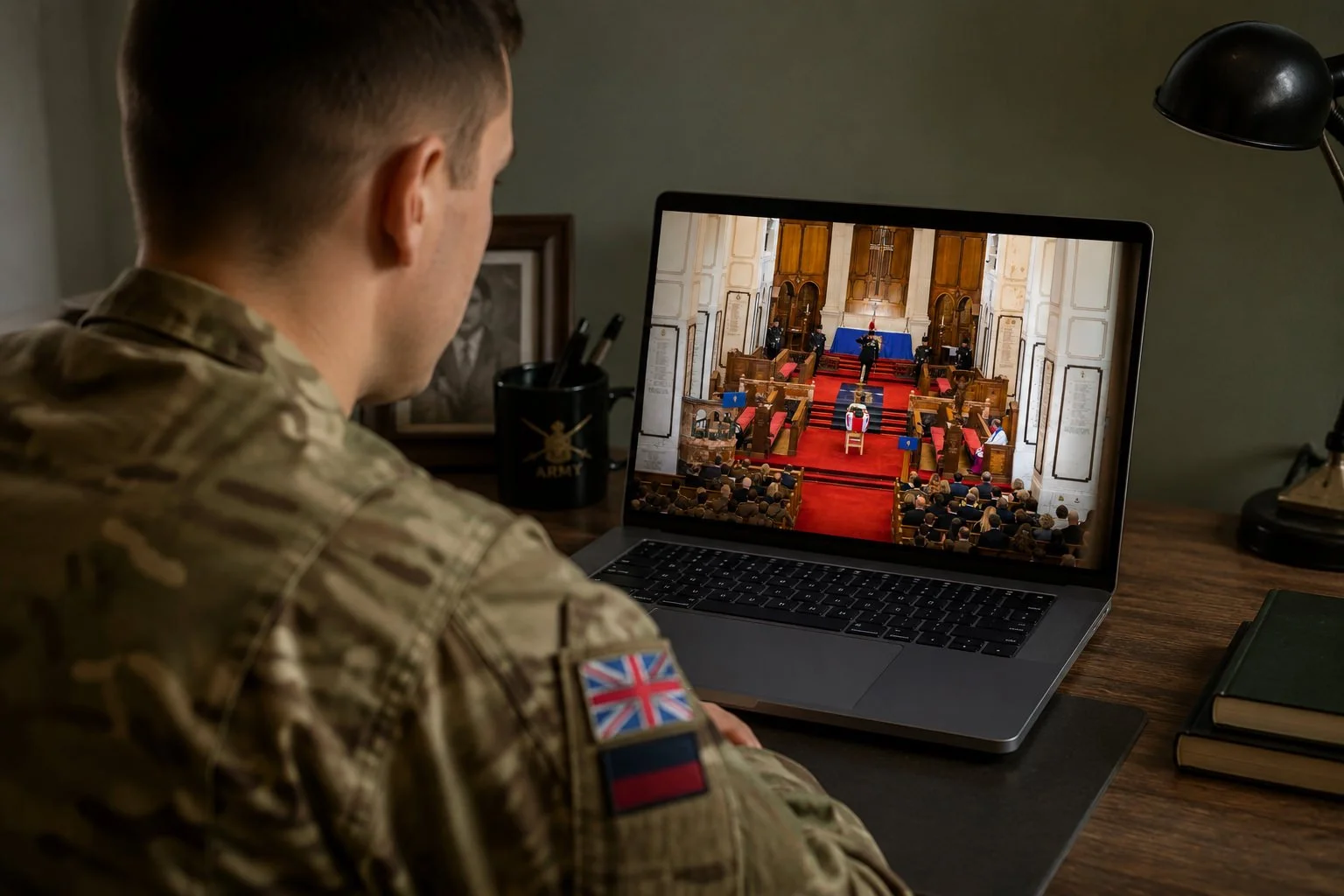
How to Film and Live Stream a Military Funeral in the UK
Military and armed forces funerals are unlike any other kind of funeral to film and live stream. Everything is precise, rehearsed and time‑critical; security is tighter; and many aspects of the day cannot simply be repeated if something is missed. At the same time, families are grieving in public, under the weight of ceremony and rank.
This guide is based on a real Royal Military Academy Sandhurst funeral that I was asked to provide the funeral streaming, on behalf of Second Lieutenant Max George, a 26‑year‑old officer who died during a Salisbury Plain training exercise. It will walk through the specific challenges of live streaming a military funeral, and how careful planning, security awareness and unobtrusive filming can work together to give families what they need.
If you are planning a military funeral and considering live streaming, this guide will help you understand what’s involved, what to look for in a streaming provider, and how I work in these sensitive, highly structured situations.
Why military funerals demand a different approach
Armed forces funerals sit at the intersection of public ceremony and private grief. That creates challenges you do not usually see in a churchyard or crematorium.
Key differences include:
Precision timing
Every movement, salute and reading is rehearsed and timed to the second. There is no chance to ask anyone to pause, repeat or move slightly for the camera. Missing a moment is not an option.Security and restricted access
Places like Sandhurst, Wellington Barracks and other military sites operate under strict security protocols. Equipment must be logged, routes agreed, and certain areas are entirely off‑limits. Filming plans must respect both security and ceremonial duties.Complex layouts: inside and outside
Many military funerals combine outdoor ceremonial moments (parade ground, arrivals, guards of honour) with indoor services in a chapel or hall. Cameras need to work across both, often with thick stone or concrete between them.Global audiences
Serving personnel, veterans and extended family may be posted anywhere in the world. Live streaming often needs to reach hundreds of devices across dozens of countries, with no room for drop‑outs.Protocol and etiquette
The presence of senior officers, flags, medals and military honours means there are formal expectations about where you can stand, how you move, and how visible you are.
All of this means that filming and live streaming a military funeral requires more preparation, more specialist equipment and a very steady, unobtrusive presence.
Background: a Royal Navy funeral at Sandhurst
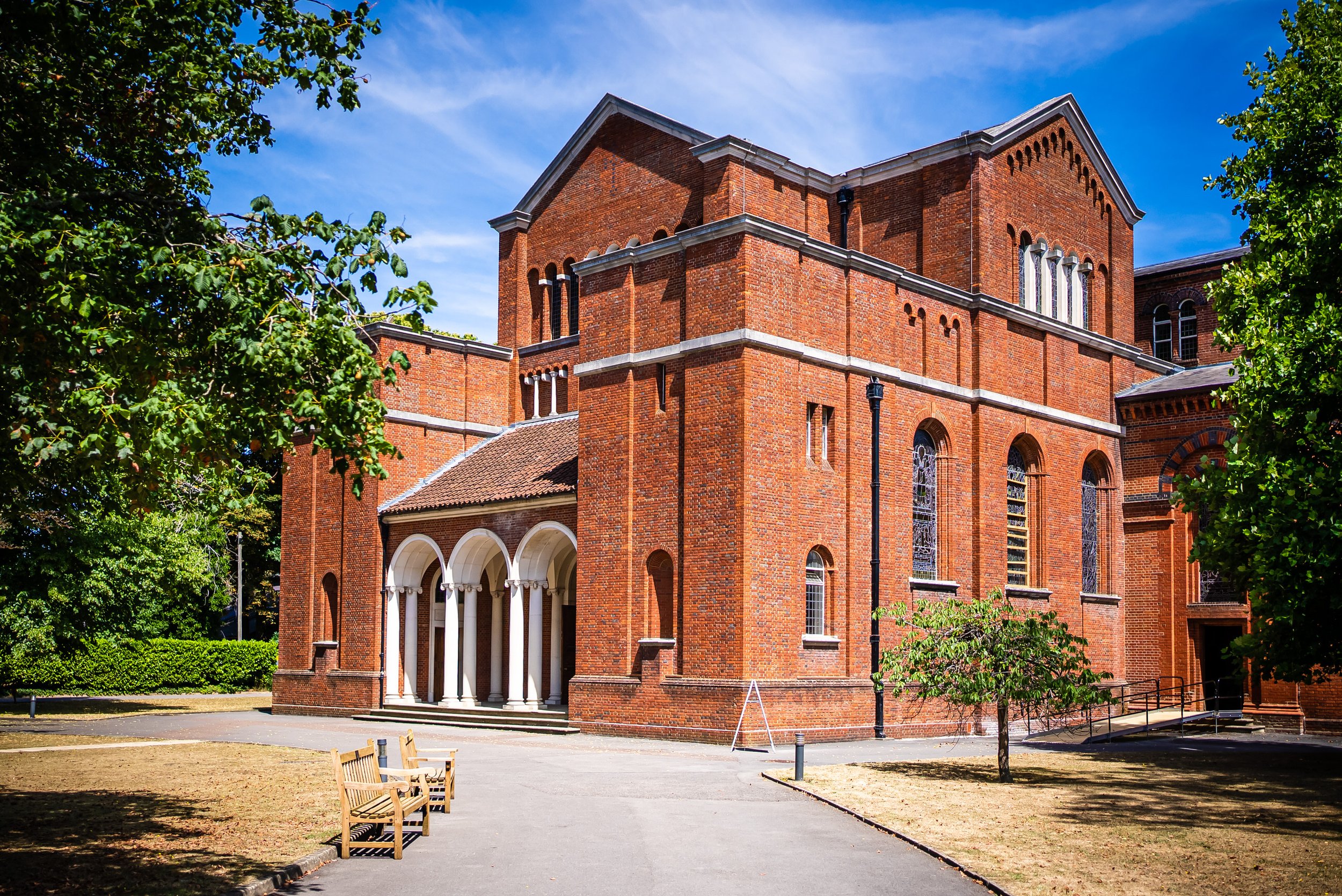
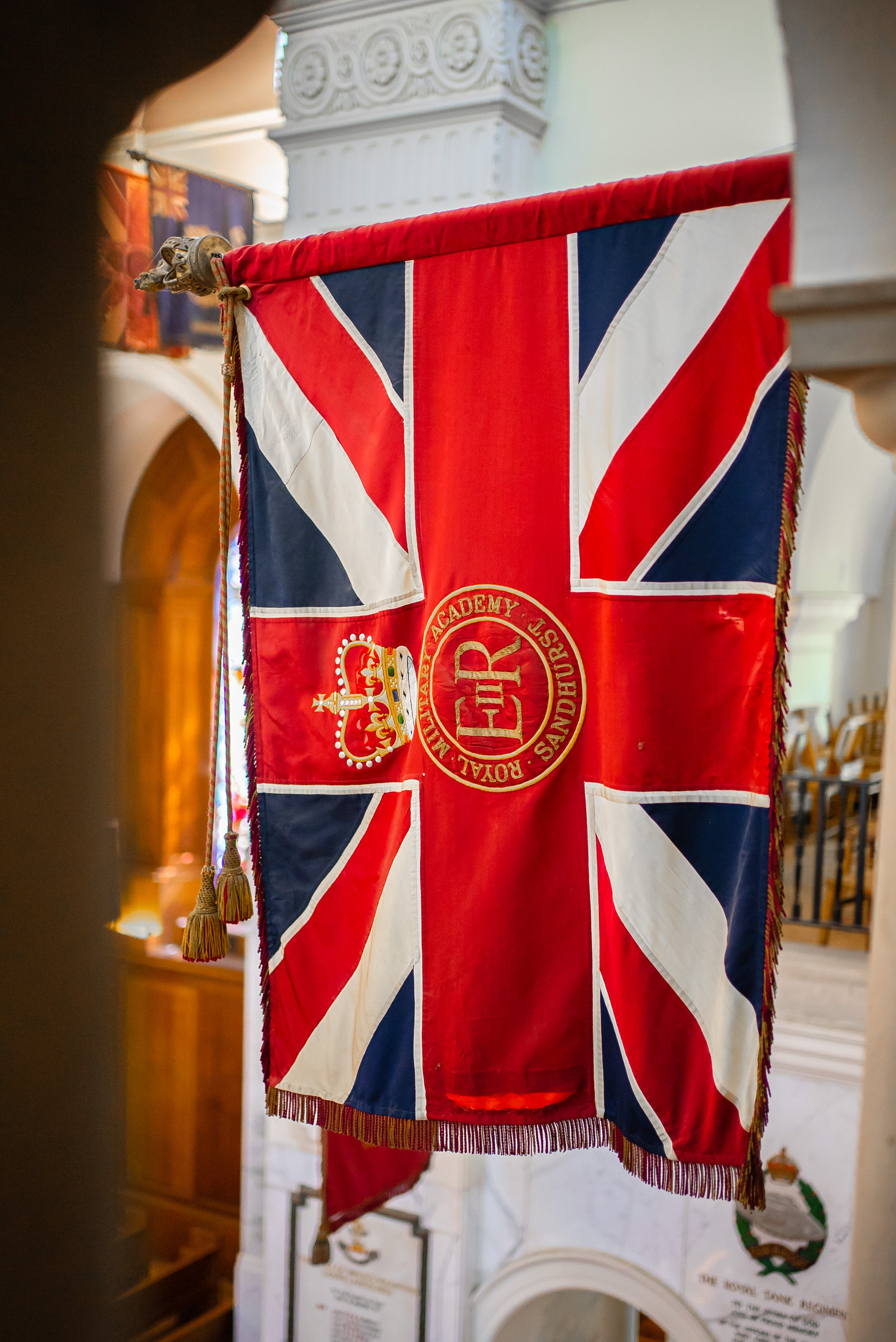
I was asked by the Ministry of Defence to provide funeral live streaming for the funeral of Second Lieutenant Max George at the Royal Military Academy Sandhurst. The venue itself is steeped in tradition and ceremony, and felt like a fitting place to honour a young officer whose life had been cut short in service.
The family’s request was clear: they needed a professional live stream that would allow relatives, colleagues and friends across the world to join them on the day. With hundreds unable to be there in person, the webcast became an essential way to bring people together.
For this funeral:
The service combined outdoor ceremonial elements with a full chapel service.
The Guard of Honour and other military units had their own movements and timings.
Freinds & Colleagues from 20+ countries around the world were expected to connect live.
The rest of this guide uses that day as an example of how to plan and deliver military funeral live streaming well.
Planning and security: getting the basics right
The first step in any military funeral live stream is preparation and security clearance.
For Sandhurst, that meant:
Early liaison with the MOD and Funeral Directors
Confirming what was permitted, where equipment could be placed, how early access would be granted, and who would be my main point of contact on the day.Agreeing camera positions in advance
The layout of the chapel and parade ground dictated where cameras could and could not go. Positions had to avoid blocking the Guard of Honour, obstructing the family, or interfering with the ceremonial routes.Equipment lists and checks
All cameras, tripods, audio equipment and streaming units needed to be brought in through security and set up in a way that didn’t compromise safety or protocol.
For anyone planning a live stream of a military funeral, it’s important to choose someone who is completely comfortable operating within these constraints. A good provider will expect security checks and will build them into their schedule, rather than seeing them as an inconvenience.
Early arrival and rehearsal: learning the choreography
Military funerals are choreographed. To film them well, you need to learn that choreography long before the service begins.
On the day at Sandhurst, I:
Arrived well in advance of the funeral to allow generous time for setup and testing.
Walked both the chapel interior and outside areas, noting sightlines, lighting, and possible obstructions.
Met with the officer in charge to go through the running order minute by minute.
Watched the Guards rehearse a few hours before the service.
Seeing the rehearsals was invaluable. It showed exactly:
Where the coffin would arrive and be carried.
How and where the Guard of Honour would form up and move.
Where senior officers would stand, salute and depart.
How the cortege would transition from outdoors into the chapel.
From a funeral streaming point of view, this allowed me to pre‑plan each camera angle and anticipate movement, rather than reacting in the moment. It meant the cameras could be placed once, correctly, and then left to work quietly.
Camera setup: covering indoor and outdoor moments
For this funeral, the family wanted both the outdoor arrivals and the indoor chapel service streamed live. That required a multi‑camera setup designed to work across very different spaces.
The configuration included:
Two main cameras inside the chapel
These were positioned discreetly on the balcony. They captured wide shots of the whole congregation, as well as closer views of the lectern, minister and family.A third camera outside
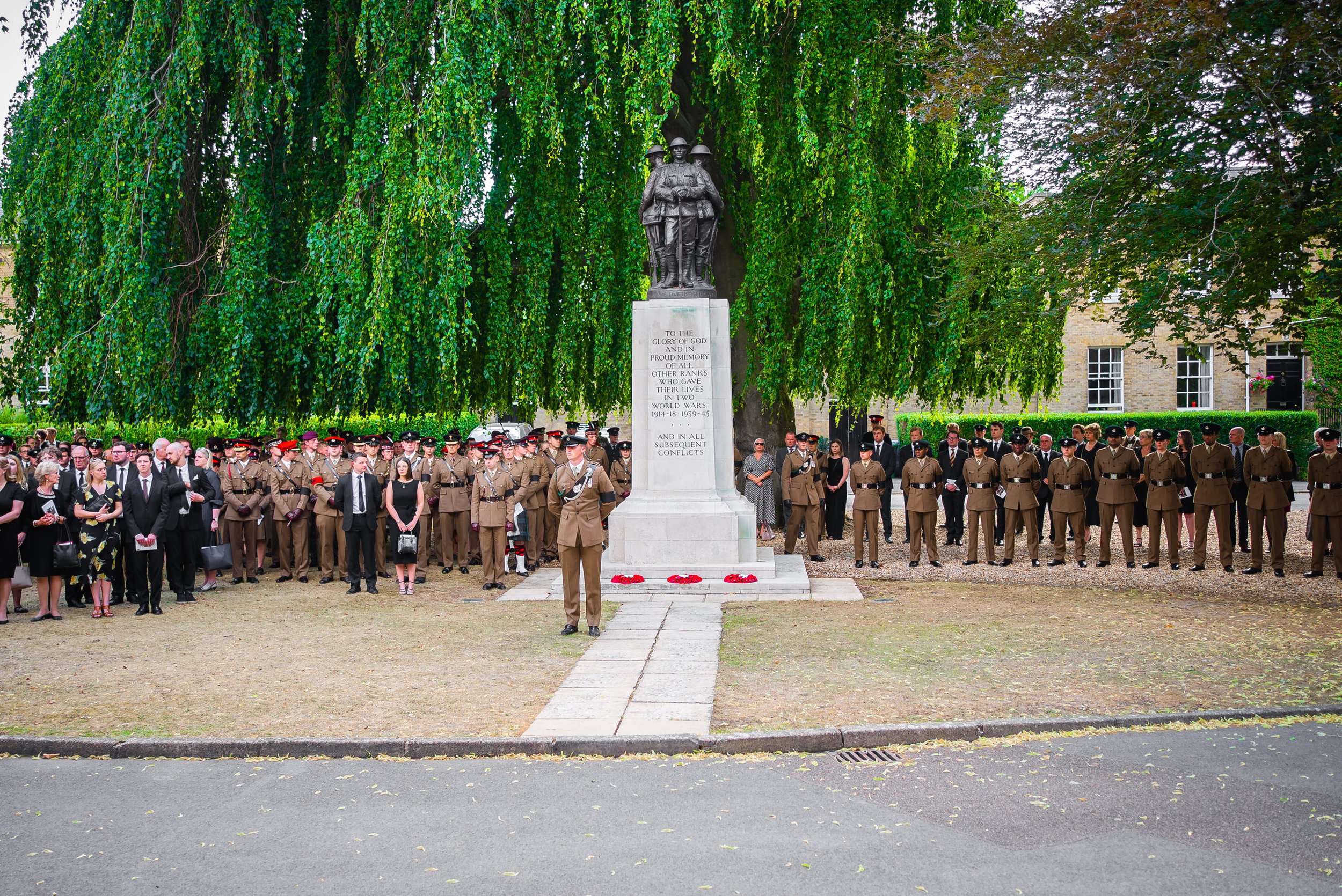
This covered the arrival of the coffin, the Guard of Honour and the military salutes on the parade ground.Remote control and switching
All cameras were connected back to a central streaming rig, allowing me to switch angles in real time without walking around the chapel or intruding on the ceremony.
Because the outside camera had to send its signal through thick walls back into the chapel, specialist wireless video equipment was used and tested thoroughly. In a military venue with heavy construction, this step is crucial; ordinary wireless links are not always reliable enough.
Audio: every word and salute needs to be heard
For viewers watching remotely, sound is as important as the picture. If you can see the service but cannot clearly hear the words, hymns and commands, you lose much of the meaning.
For this service I:
Microphoned the minister and the main lectern.
Added microphones in key areas where readings and tributes would take place.
Placed ambient microphones to capture hymns, ceremonial commands and the sound of marching outside.
During the live stream, I mixed these feeds in real time, switching between microphones as different parts of the service unfolded. The aim was to:
Ensure the officiant could clearly be heard throughout the service.
Capture the Family reflections and tributes perfectly.
Hear the crisp commands and responses that mark a military funeral.
Listen to the atmosphere of hymns and collective moments of silence.
When choosing someone to film or stream a military funeral, ask specifically how they handle audio. A single on‑camera microphone is rarely enough in a large chapel or parade ground.
Connectivity: building a stream that won’t drop
Military sites can be challenging for connectivity, especially if thick walls, restricted Wi‑Fi and large crowds are involved. For a funeral where hundreds of people may be watching online from different countries, the stream must be resilient.
At Sandhurst, I:
Brought four bonded 4G/5G connections, combining multiple mobile networks into a single, more stable connection.
Tested signal strength inside and outside the chapel before the service.
Monitored bandwidth throughout the funeral to ensure the stream remained stable.
Bonded connections are central to how I approach all funeral streaming, but they are particularly important for military funerals. If one network drops or slows, the others keep the stream live without viewers noticing.
Filming the service: ceremony and family in balance
The funeral itself combined formal military honours with deeply personal reflections.
Key moments included:
Arrival and honours outside
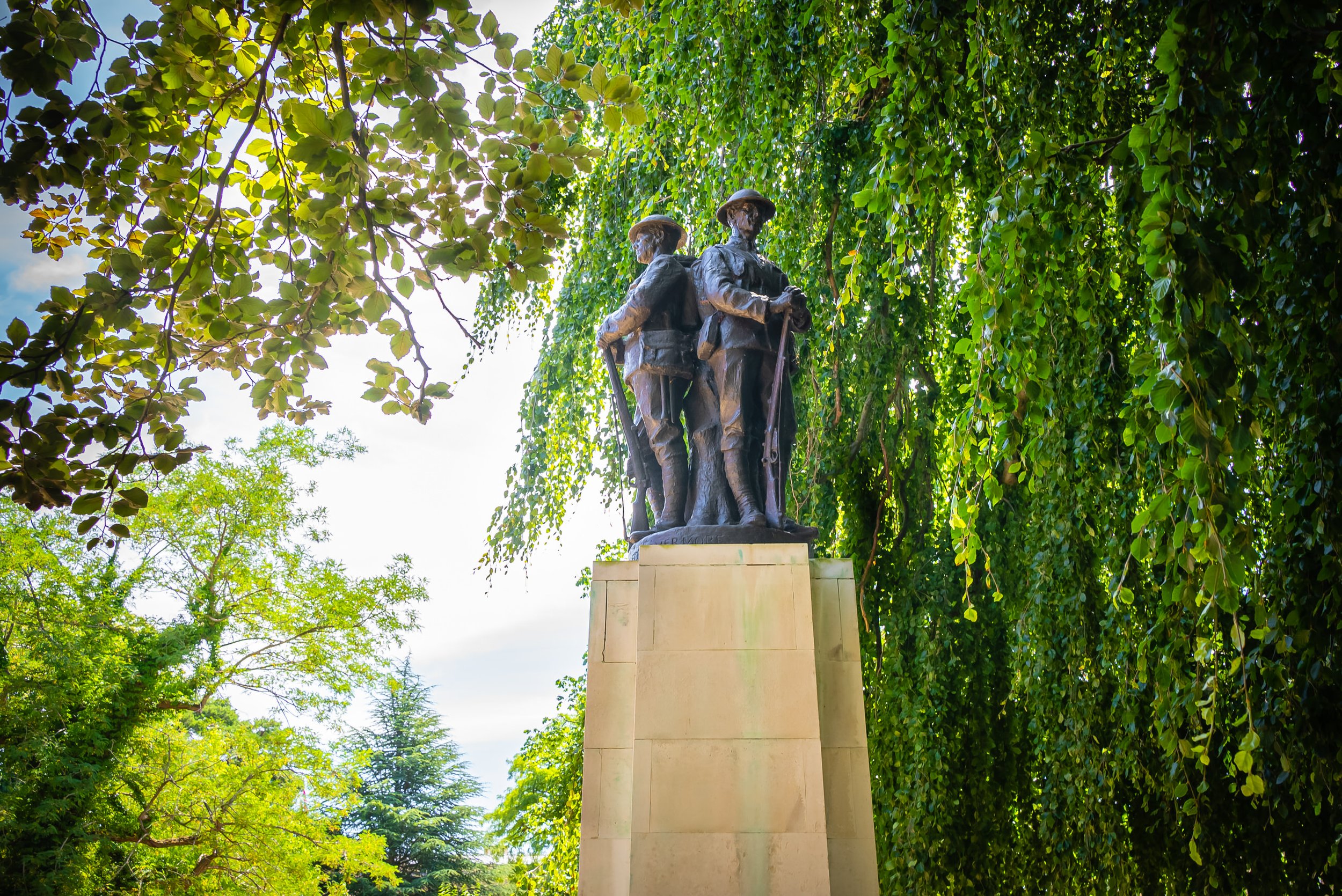
The coffin was carried with military precision, accompanied by the Guard of Honour. The outdoor camera showed this live, capturing both the discipline of the Armed Forces and the emotional weight of the moment.The chapel service
Inside, hymns, prayers and tributes filled the space. Balcony cameras showed the grandeur of the chapel and the gathered community, while closer angles focused on faces and expressions during readings and music.Family reflections
Relatives spoke about Max as a son, brother and friend. These moments balanced the ceremonial elements with intimate, human stories.Formal tributes
Salutes, commands and words from senior officers underlined a sense of duty, service and sacrifice.
Throughout, my approach remained the same as at any funeral:
Unobtrusive – always in the background, never directing or interrupting.
Respectful – aware that this is both a public ceremony and a private farewell.
Attentive – ready to capture small gestures and reactions as well as headline moments.
From the viewers’ perspective, the stream moved seamlessly between indoor and outdoor cameras, allowing those watching online to follow the entire service without disorientation.
Outcome for the family and those watching online
After the funeral, the family received:
A full HD recording of the entire live stream.
A private link they could share with trusted family, friends and colleagues for 12 months. (Read our guide on how you can watch a Funeral Live Stream later)
A downloadable copy they could keep permanently.
On the day, the live stream reached hundreds of devices across more than 20 countries. Serving personnel, veterans and relatives who could not be at Sandhurst were still able to see, hear and feel the service as it unfolded. Afterwards, the family spoke about the comfort it gave them to know that people around the world had been able to stand with them, even if only online.
Key principles for filming and live streaming a military funeral
Whether the funeral is at Sandhurst, Wellington Barracks, a regimental chapel or a local church with strong forces connections, the same principles apply:
Plan early, with security in mind
Expect security checks, restricted areas and strict timings. Build them into your plan rather than working around them at the last minute.Learn the choreography
Attend rehearsals where possible. Understand the running order, where people will stand, and how they will move. The more you know in advance, the more invisible you can be on the day.Design a multi‑camera setup that respects the space
Balance coverage of outdoor honours and indoor service, without obstructing guards, clergy, family or senior officers.Prioritise audio
Use multiple microphones, not just one. Make sure online viewers can hear tributes, commands and hymns clearly.Build robust connectivity
Use bonded connections and test thoroughly, especially in buildings with thick walls or limited Wi‑Fi.Work quietly and respectfully
A military funeral is not a broadcast set. The technology should disappear into the background so the family and armed forces community can focus on the person they are honouring.
Considering live streaming for a military or armed forces funeral?
If you are arranging a military funeral – for a serving member, veteran or someone with strong forces connections – and are unsure about whether or how to include live streaming, you are very welcome to get in touch. If you would like to find out how much funeral streaming costs?
We can talk through:
The venue and any security or access considerations.
Who you would like to be able to watch from elsewhere in the UK or around the world.
How multi‑camera coverage, careful audio and secure, private links can support your family and the wider military community.
My work providing funeral streaming around the UK is always quiet, documentary and respectful – focused on allowing people to be fully present, while ensuring that those who cannot be there in person are still able to share in the farewell. To find out more read our guide to How Funeral Live Streaming Works or visit our Funeral Streaming Portfolio page to see real examples.