
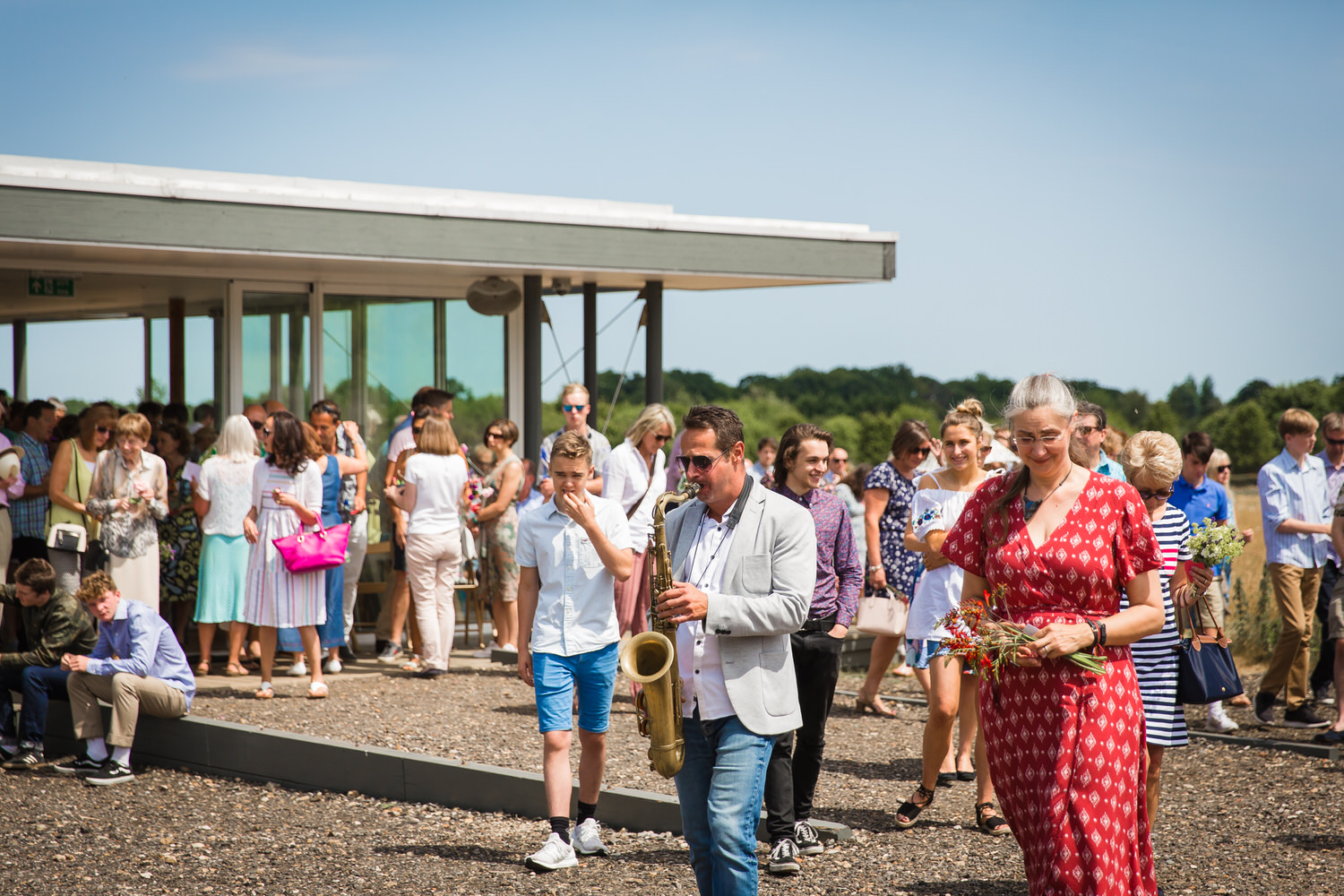
Our Funeral Videography, Photography & Live Streaming Blog
Over the past 10 years, we’ve filmed and live streamed more than 2,500 funerals across the UK, covering all faiths, cultures and settings. This page brings together real case studies from our work alongside practical guides and honest advice for families and funeral directors arranging services.
Here, you’ll find examples of our funeral live streaming, funeral videography, funeral photography, funeral slideshows and funeral AV support work, plus experience-led guidance on how these services work in practice. From Caribbean and African funerals to military ceremonies, Hindu and Sikh services, Muslim funerals, Jewish funerals, church services, crematorium funerals, natural burials, graveside committal and celebrations of life, these posts show the diversity of families and traditions we’ve worked with and the respect we bring to every occasion.
Whether you’re looking for practical advice on how funeral streaming, videography, slideshows or AV works, comparing your options, or want to see real examples of how we approach different faiths, cultures, venues and situations, you’ll find thoughtful, compassionate answers drawn from a decade of professional experience across London, the Midlands and beyond.

Sikh Funeral Videography at Slough Crematorium & Sri Guru Singh Sabha Gurdwara

I had the privilege of providing funeral videography for a Sikh funeral at Slough Crematorium and Gurdwara Singh Sabha Slough. I spent the full day quietly filming everything that mattered to the family — from morning prayers at the family home, through the horse-drawn cortege, the gurdwara service and the crematorium ceremony, to the small details that made the day what it was as they said goodbye to someone deeply loved.
This case study gives a sense of how Sikh funeral videography works in practice, and how I approach filming with respect for Sikh traditions and the family's wishes.
What the Family Wanted from the Filming
When the family first got in touch, they were clear about what they hoped the video would do:
Provide a full record of the day for relatives who could not travel
Capture the atmosphere at the gurdwara and crematorium without being intrusive
Include the key prayers, tributes and family moments, rather than just a few short clips
Give them something they could watch back in their own time, after the intensity of the day
They wanted a documentary-style film — honest, steady coverage from beginning to end, with careful attention to sound. Not a highly produced piece, but a true record of the day as it actually happened.

A Full Day Across Three Locations — Family Home, Crematorium and Gurdwara
The funeral took place across three main locations, and I followed the family through all of them.
The family home — I arrived early to capture the morning prayers and the blessing over the coffin. A horse-drawn carriage arrived at the front of the house, where a red carpet led up the steps to where the coffin was carried out. The priest prayed while family members gathered around — an intimate, deeply moving beginning to the day.
Slough Crematorium — I travelled ahead of the cortege to be set up and ready before the family arrived, ensuring I could capture the arrival and the entry into the chapel without rushing. Slough Crematorium chapel is equipped with an Obitus AV system and seating for around 150 people, with outside speakers for larger congregations — a well-suited venue for filmed or streamed funerals when managed correctly.
Sri Guru Singh Sabha Gurdwara, Slough — the gurdwara service included prayers, kirtan and Ardas. Shoes removed, head covered, I filmed from agreed positions that kept me out of the way of worshippers and the Granthi, while still giving a clear view of the prayers and the family paying their respects.


At Slough Crematorium — Prayers, Farewell and the Curtains Closing
At the crematorium I filmed:
The coffin being carried into the chapel
The Sikh prayers and any readings chosen by the family
The moment the curtains closed and the final farewell
Family and close friends leaving the chapel at the end of the service
Where permitted and requested, I can also film elements afterwards — for example, family witnessing the charging — but this is always discussed in advance with the family and the crematorium.


Filming Inside the Gurdwara — Kirtan, Ardas and the Sangat
Inside Sri Guru Singh Sabha, I filmed from positions agreed in advance with the family and gurdwara staff. The priority is always the same: to be present enough to capture what matters without drawing attention to the camera or interrupting the flow of worship.
Key moments covered:
The kirtan — the singing of sacred hymns, which is at the heart of a Sikh funeral and which families often most want to hear again when they watch the film back
The Ardas — the congregational prayer led by the Granthi
The sangat gathering and family paying their respects
Any movement was kept to a minimum during prayers and kirtan — repositioning only between key parts of the service. This is not just a courtesy but a genuine expression of respect for what is happening in the room.


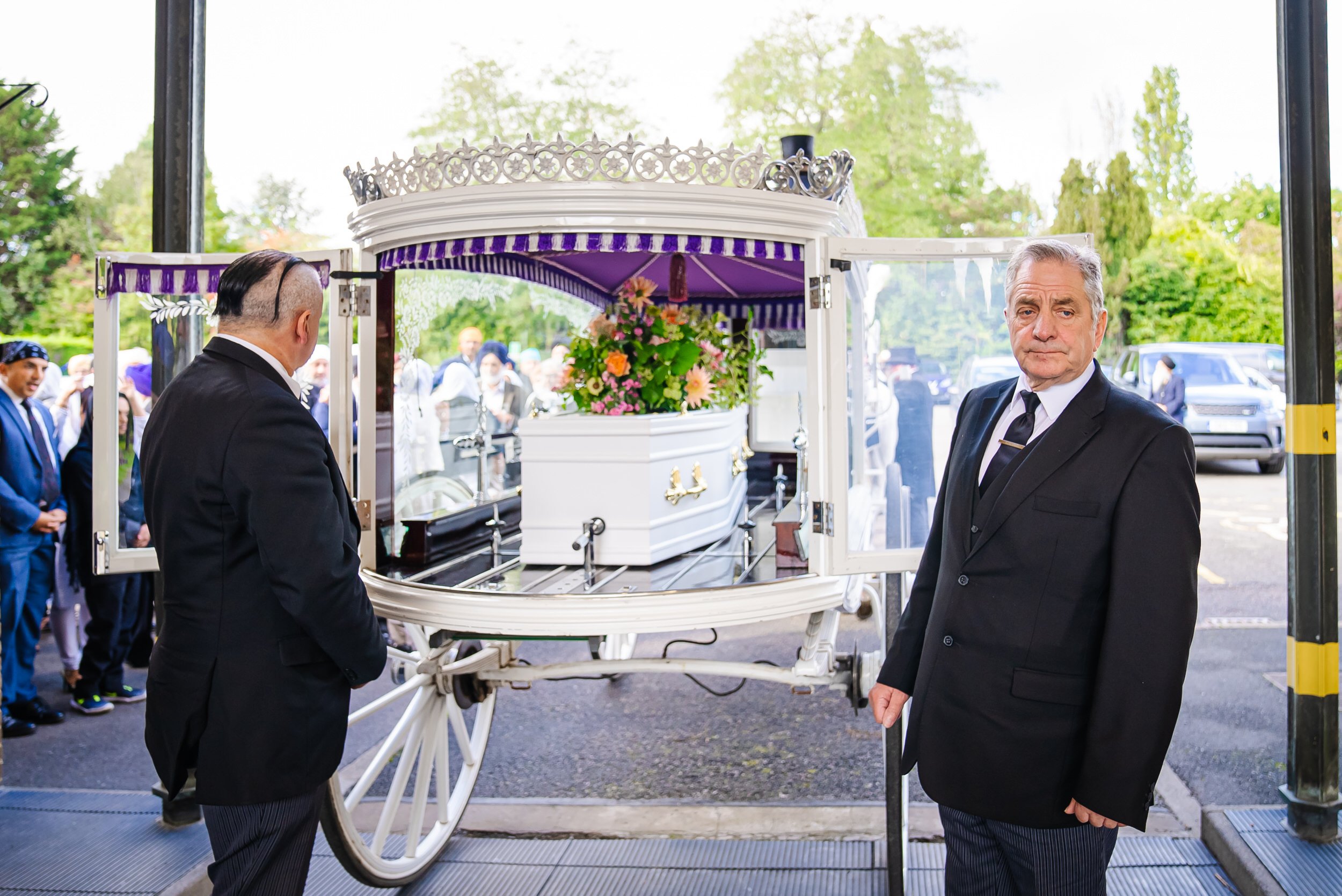


Audio for Sikh Funerals — Capturing the Kirtan Clearly
For Sikh funerals, clear audio is as important as the picture. Families often want to hear the prayers and kirtan again, especially when watching with older relatives who could not attend — and the quality of that audio matters enormously.
For this service I used:
Multiple directional microphones to capture speech and kirtan without overpowering the natural acoustics of the gurdwara or chapel
A two-camera setup to avoid constant repositioning — one camera covering the wider scene, the other focusing on key speakers and the immediate family
Careful exposure settings to cope with changing light between the gurdwara, the outdoor cortege and the chapel, so the final film feels consistent and easy to watch throughout
If funeral live streaming had been required alongside the videography, I would have added four bonded 4G/5G internet connections to ensure a stable stream for relatives watching at home or overseas — integrated with the Obitus facilities at Slough Crematorium where appropriate.
Staying Respectful and Unobtrusive Throughout the Day
Sikh funerals are communal, spiritual occasions. My priority is to work around that — never to draw attention to the cameras or disrupt what is happening.
On this day I agreed camera positions with the family and, where appropriate, with gurdwara staff and the funeral director. I minimised movement during prayers and kirtan, filmed without strong lights or intrusive equipment, and relied on sensitive camera settings and stable support to keep the coverage clean and steady throughout.
Families often tell me afterwards that they barely noticed the filming on the day itself — which is exactly what I aim for.
What the Family Received
After the funeral the family received:
A complete film of the full day, edited to flow naturally from the family home through the gurdwara to the crematorium
Clean audio of the prayers, kirtan, tributes and key moments
A private online link to share with relatives who could not attend
A high-definition download to keep permanently
For some families I also create a short highlight version alongside the full recording — a gentle 3–5 minute piece that gives an overview of the day, set to appropriate music or to live audio from the service.
Sikh Funeral Videography and Streaming Across the UK
If you are arranging a Sikh funeral at Slough Crematorium, Sri Guru Singh Sabha Gurdwara, or another gurdwara or crematorium across the UK, and are considering videography or live streaming, I'm happy to talk through what might work best for your family.
For guidance on the difference between filming and streaming, see my guide on funeral filming vs live streaming and my broader guide on why funeral videography matters.
Call or text me on 07772 509101 — available seven days a week, 9am to 10pm — or get in touch online.
Related pages and guides:

Woodland Burial Videography at South Downs Natural Burial Site, Hampshire
South Downs Natural Burial Site, near East Meon in Hampshire, is one of the most peaceful locations I have worked at. Set within the South Downs National Park and surrounded by woodland, it offers families a very different kind of farewell from a traditional cemetery or crematorium chapel — quieter, more organic, and deeply connected to the landscape.
In this case study I walk through how I filmed a woodland burial here — from arrival at the Sustainability Centre to the walk into the forest and the committal at the graveside. It shows what a natural burial looks like in practice, and how funeral videography can work sensitively in a setting like this.
About South Downs Natural Burial Site
South Downs Natural Burial Site sits within the grounds of The Sustainability Centre, between Clanfield and East Meon in Hampshire. The burial ground is managed as a native woodland, with graves dug by hand to minimise disturbance and a long-term plan to restore and protect the woodland for future generations.
There are no traditional headstones. Graves are located using a mapping system and the woodland is allowed to develop naturally, with memorial trees and wildflowers becoming part of the landscape over time. It is a place designed for people who want a more natural, environmentally conscious burial — and for families who want a quiet, wooded setting that feels entirely different from rows of headstones in a municipal cemetery.
What the Family Wanted from the Filming
For this funeral, the family wanted a simple, unobtrusive record of the day rather than a full live stream. Their priorities were clear:
To capture the arrival at the Sustainability Centre and the walk through the trees to the burial ground
To record the words at the graveside — readings, prayers and tributes — without distracting from the natural, quiet atmosphere the setting created
To have a film that could be shared privately with family members who were unable to travel, and watched back in their own time
They were clear that they didn't want the day to feel filmed or staged. Documentary style — present, but invisible.
Arriving Early — Planning the Route and the Cameras
I arrived well before the funeral party, walking the route into the woodland, speaking with the burial ground staff, and planning where to position cameras at each stage of the day. At a natural burial ground, this preparation matters more than at a crematorium or church — the terrain changes, the light shifts between open paths and dense tree cover, and there are no fixed reference points to fall back on.
Key parts of the day I filmed:
Arrival at The Sustainability Centre — the hearse and mourners arriving, people greeting each other quietly, the first view of the woodland surroundings setting the tone for the day.
The walk to the burial ground — the family and friends moving through the trees and along the paths to the natural burial site, the coffin carried ahead through the forest. This transition — from the car park into the woodland — is one of the most visually distinctive elements of a natural burial, and one of the things families most want captured.
The graveside service — the officiant's words, readings from family members, and time for quiet reflection.
The committal — the lowering of the coffin into the hand-dug grave, and any rituals or gestures chosen by the family.
Final moments at the grave — flowers placed, soil scattered, the family taking their time before walking back through the trees.
I used long lenses throughout to stay well back from the graveside while still capturing close detail — keeping the camera at the edge of what was happening rather than in the middle of it.
Audio and Technical Challenges in a Forest Burial Ground
Natural burial grounds are visually stunning but technically demanding. There is no fixed PA system, no lectern, and often no hard surface to reflect sound. Wind through the canopy, birdsong, and the distance between people at an outdoor graveside can make speech almost impossible to hear on a simple recording.
To keep the filming unobtrusive but the audio clear, I used:
Dedicated microphones on the officiant and family members who spoke, balanced to capture their voices clearly while still allowing the surrounding sounds of the woodland — birdsong, leaves, wind — to be part of the film
A two-camera setup, one covering the wide scene and one positioned closer on those speaking
Careful tripod placement so equipment was completely out of the main line of sight and the woodland still felt like a woodland, not a film set
For live streaming at woodland burial grounds, I always bring bonded 4G/5G internet — woodland areas cannot be relied on for Wi-Fi or strong mobile signal, and a single connection will almost certainly be insufficient for a stable stream.
Filming With Discretion at South Downs
At South Downs Natural Burial Site, the focus is entirely on simplicity and nature. Anything that disrupts that atmosphere — heavy equipment, visible rigs, unnecessary movement during prayers — works against what the family chose this setting for.
On this funeral I spoke briefly with the officiant beforehand so they knew where I would be and how I would move. I avoided any repositioning during readings, prayers or moments of silence — moving only between clearly defined parts of the service. Equipment was kept to a minimal footprint throughout.
Families at natural burials consistently tell me afterwards that they barely noticed the filming on the day. That is exactly what I aim for — and at a place like South Downs, where the whole atmosphere is about stillness and presence, it matters more than anywhere.
The Finished Funeral Film
The family received a professionally edited film covering the day from arrival through to the final moments at the grave:
High-quality audio of all the words and readings at the graveside
Colour-graded to reflect the natural greens and soft, dappled light of the woodland
Available as a full-length film and, at the family's request, a shorter 4-minute highlight version for sharing with relatives who wanted an overview of the day
Delivered privately, without any public upload
The film gave relatives who couldn't attend a genuine sense of the place — not just what was said, but what it felt and looked like to be there in that particular forest on that particular day.
Live Streaming at South Downs Natural Burial Site
Although this particular funeral was filmed for recording and private sharing rather than live broadcast, it is entirely possible to stream a woodland burial at South Downs where the family wants relatives to watch in real time.
A graveside live stream is particularly useful where close family are overseas or unable to travel, where the burial follows a separate service elsewhere and people want to follow both parts of the day, or where health or mobility means some people simply cannot make the walk into the woodland.
I bring the same bonded mobile internet and discreet multi-camera setup that I use for all outdoor funerals, adapted to the paths and clearings at South Downs. For more on how graveside and outdoor streaming works in practice, see my guide to live streaming a graveside or outdoor funeral.
Funeral Videography at Natural Burial Grounds Across the UK
South Downs is one of several natural and woodland burial grounds where I've filmed funerals across the UK — alongside sites in Surrey (Clandon Wood), the Chilterns, Yorkshire and elsewhere. Each has its own character, terrain and technical considerations, and each requires the same careful advance preparation and willingness to work entirely within the atmosphere the family has chosen.
If you are planning a funeral at South Downs Natural Burial Site, or a woodland or natural burial elsewhere, and would like to discuss filming or streaming, I'm happy to talk through what would work best for your day.
Call or text me on 07772 509101 — available seven days a week, 9am to 10pm — or get in touch online.
Related pages and guides:

Funeral Tribute Film Case Study — Creating a Personal Memorial Slideshow for a Church Service
For this family, a funeral tribute film was the way they chose to bring their loved one's life into the room. Not a eulogy, not a reading — a sequence of photographs set to a song that had meant something to her, telling the story of who she had been in a way that words alone couldn't quite reach.
I was providing funeral live streaming for the service as well, and the family asked me to create the tribute film and integrate it directly into the broadcast — so that relatives watching from abroad saw the same film, full screen, at exactly the same moment as those sitting in the church. That combination is something I offer as a single managed service, and it made a real difference to what the day felt like for everyone involved.
This case study walks through how the film came together — from the first conversation with the family to the moment it played at the service.
What the Family Wanted
When the family first got in touch, they were clear about what they were looking for. They didn't want "a generic slideshow" — their words. They wanted something that felt like her. Their priorities were:
Photos that reflected who she really was — family, friends, holidays, her faith, her community, the small everyday moments as well as the big occasions
One song that mattered to the family, not a long playlist — so the film felt focused rather than overwhelming
Something that worked at the service and could also be watched privately afterwards by relatives who couldn't be there
We talked through where the film would sit in the order of service, how long it needed to be for the slot they had in mind, and who in the family would be involved in choosing the photographs and music.
Gathering the Photographs
The family sent a mixture of materials:
Digital photographs from phones and cameras spanning several decades
Scans of older printed photographs — some going back to childhood in the 1950s, slightly faded but full of character
A small number of short video clips they wanted woven in at key moments
The printed photographs were scanned and lightly cleaned up — colour corrected where age had shifted the tones, dust removed, cropped where needed — so that they sat comfortably alongside the more recent digital images without looking out of place. The goal was always to preserve the original character of each photograph, not to make everything look uniform.
I guided the family on:
How many photographs to include for the length of film they had in mind. For a 6–8 minute tribute film, 60–80 photographs is usually the right range — enough to tell the full story without the pace feeling rushed or the audience losing focus. My guide on how many photos a funeral slideshow should have explains this in more detail
How to group and sequence the images — childhood, early family life, friendships, work, faith, travel, later years — so the film had a natural shape rather than a random sequence
Which video clips to include and where to place them so they felt integrated rather than jarring
The family sent everything through a secure private upload link. Once received, I reviewed each image, flagged any that were too low resolution for a large screen, and suggested alternatives where needed.
Choosing the Music
The family chose a single song — one that she had loved and that the family associated strongly with her. I won't name it here, but it was a piece of music that would be immediately recognised by everyone in the church and that carried exactly the right emotional weight for the moment in the service where the film would play.
One song, chosen for the right reasons, almost always works better than a sequence of tracks. It gives the film a consistent emotional register and avoids the jarring key changes and tonal shifts that come with multiple pieces. It also means the editing can be shaped around the music — timing key moments and transitions to the natural rhythm and phrasing of the song.
If you're unsure what music to choose, my guide on best songs for a funeral slideshow covers how to think about tone, length and what works well in different service settings.
Editing the Film
The editing process began once all the photographs, clips and music were in. The images were arranged to tell the story chronologically with some deliberate structural choices — opening with a photograph that immediately established who she was, closing with something the family had specifically asked for as the final image.
Each photograph was timed to fit the natural breath of the music — some images held a little longer, others moved more quickly depending on what was happening in the song at that moment. Transitions were kept simple and understated throughout. The aim was always for the film to feel emotionally coherent — like a story being told — rather than a technical showcase.
The family received a private preview link once the first cut was complete. They asked for a small number of adjustments — one image swapped, the order of two sequences changed, a caption added — and the final version was delivered within 48 hours of those notes.
Playing the Film at the Service — and Full Screen Through the Live Stream
On the day, the tribute film played at the moment chosen by the family — after the main eulogy, as a moment of quiet reflection before the committal. I coordinated with the church in advance to confirm the AV setup, provide the file in the correct format, and check that it would play correctly on their system.
The audio level was balanced carefully so the music could be clearly heard in the church without overpowering the acoustic of the room.
Because I was also providing funeral live streaming for the service, the tribute film was played full screen through the broadcast at exactly the moment it played in the church. Relatives watching from Australia, Canada and Jamaica saw the same film, the same images, the same song — not a distant screen at the front of a church visible on a camera shot, but the film itself filling their screen in full quality.
This is one of the most significant differences between managing the slideshow and the streaming as a single service rather than two separate bookings. When everything is handled by one person, the tribute film becomes part of the live stream rather than something that happens alongside it.
What the Family Received
After the service, the family received:
The full tribute film as a downloadable HD file to keep permanently
A version suitable for private online sharing with relatives who couldn't attend
The film preserved as part of the full funeral recording, available on the private streaming link for 12 months
They told me afterwards that watching it back — a few weeks after the service, when the immediate intensity had passed — was something they returned to more than they had expected. The film had become a record of the day and of her, and they found themselves going back to it.
That is, in the end, what a well-made tribute film is for.
Tribute Films and Slideshows Across the UK
I create funeral tribute films and slideshows for families across the UK, from £220 — handling everything from gathering and organising your photographs through to the final edit, playback coordination and delivery.
If you are considering a tribute film for a funeral or celebration of life service, I'm happy to talk through what might work for you.
Call or text me on 07772 509101 — available seven days a week, 9am to 10pm — or get in touch online.
Related pages and guides:

Funeral Videographer at GreenAcres Chiltern — Woodland Burial & Biker Funeral
GreenAcres Chiltern is one of the most beautiful natural burial grounds in the UK — 72 acres of ancient woodland in the Chiltern Hills, with winding paths, a Woodland Hall, and a landscape that changes completely with the seasons. I've filmed funerals there more than once, and it's a setting that asks something different from a videographer than a church or crematorium. The light moves through the trees. The atmosphere is quiet and alive at the same time. Getting the filming right means understanding the place as much as the day.
As a Funeral Videographer, This is the story of one of the most memorable funerals I have ever had the privilege of covering — the farewell of Steve Mead, a much-loved husband, friend and retired police officer, filmed in the golden weeks of early autumn.
Steve Mead — A Life Worth Remembering
I had the privilege of meeting Steve before he passed, and his character was clear from the start — warm, particular about things that mattered, and someone who had earned deep loyalty from the people around him. His funeral reflected all of that. Nothing about it was generic or off-the-shelf. It was personal in every detail, from the setting to the arrival, to the way his friends showed up for him.
The family asked me to provide the funeral videography and cover the full day — from the family home in the morning, through the service at the Woodland Hall, to the burial itself in the forest. A two-person team meant nothing was missed. While one of us was at the family home capturing the morning, I was already at GreenAcres setting up so the arrival and ceremony were covered from the first moment.
Read more about Why Funeral Videography Matters to find out more.
A Coffin in a Motorbike Sidecar — Filming the Arrival
Steve's coffin arrived at GreenAcres in a motorbike sidecar. If you've never seen this, it is a remarkable thing — the low rumble of the engine through the trees, the sidecar moving slowly along the woodland path, the coffin visible and dignified and completely in keeping with who he was.
As the motorbike approached the Woodland Hall, fellow bikers and friends lined the road through the trees. They stood quietly, helmets off, in a long honour guard stretching back into the forest. There was no instruction given — they simply knew what to do. It was one of the most powerful arrivals I've witnessed in ten years of this work.
Filming this required thinking carefully about position. I needed to capture the full length of the honour guard — the line of bikers disappearing into the trees — while also being close enough to show the sidecar and the family following behind. I moved between positions as the cortege came in, using longer lenses to stay at a respectful distance while still capturing the scale and the emotion of the moment.
Drone Footage of GreenAcres Chiltern in Autumn
The woodland was at its most striking — early autumn light, golden leaves, the canopy still thick but beginning to turn. I used drone footage to capture the setting in a way that ground-level filming simply cannot: the Woodland Hall nestled among the trees, the paths winding through the forest, and the sense of place that makes GreenAcres such a meaningful choice for a natural burial.
For the family, this aerial footage became one of the most valued parts of the finished film. It shows not just the day but the place — and Steve's grave is there in that landscape, a permanent part of it, growing more integrated with the woodland with every passing season.
Filming the Service and the Woodland Burial
The service in the Woodland Hall was led with warmth and genuine reflection — tributes, music, and moments of quiet that felt appropriate to the setting. I worked from the edges throughout, using the natural light coming through the windows and doors rather than any artificial lighting that might have disrupted the atmosphere.
Then came the burial itself. Steve was laid to rest in a natural grave among the trees, in a natural coffin that was as much a part of his values as the woodland setting around it. The family gathered close, and the final prayers and words were shared in the kind of quiet that only a forest can hold.
This is what natural burial photography and videography is really about — not just recording what happened, but capturing the atmosphere that made the place and the day feel particular to that person. The birdsong was part of it. The light through the trees was part of it. The way people stood close to one another was part of it.
For more on how I approach woodland and natural burial filming, see my case study from Clandon Wood Natural Burial Ground in Surrey.
What the Family Received
The finished film combined:
Footage from the family home in the morning
The arrival — biker honour guard and motorbike sidecar — filmed from multiple positions
Drone footage of GreenAcres in autumn colour
The full service in the Woodland Hall
The woodland burial
Edited together, it tells the complete story of the day — not just the formal moments but the character of it, the setting, and the people who came to say goodbye to Steve.
Filming Funerals at GreenAcres Chiltern and Other Woodland Burial Sites
GreenAcres Chiltern is one of several natural burial grounds across the UK where I've filmed funerals — alongside sites in Surrey, Hertfordshire, Yorkshire and elsewhere. Each has its own character and its own challenges: connectivity for streaming, light levels, terrain, and the way the service moves through the space.
If you are arranging a funeral at GreenAcres Chiltern, another woodland or natural burial site, or any venue in the UK and are considering funeral videography, funeral photography or funeral live streaming, I'm happy to talk through what's involved and what would work best for the day you're planning.
Call or text me on 07772 509101 — available seven days a week, 9am to 10pm — or get in touch online.
Related pages and guides:

Filming a Beautiful, Inclusive Funeral Ceremony with Music, Dance and Love
Some funerals follow a familiar pattern. Others create their own, entirely. This was one of the most fluid, heartfelt and genuinely moving ceremonies I have had the privilege of filming — a farewell that felt completely true to the person being remembered and the community gathered to honour them.
Friends and family came together in a warm, open space in London. There was no strict order of service, no formal programme to follow. Instead, the room was given space to breathe — tributes shared naturally and spontaneously, emotion expressed freely, silence held when it needed to be held.
As a Funeral Videographer, it was a ceremony built entirely on love.

Kirtan Chanting Led by Nikki Slade
The ceremony opened with Kirtan chanting led by Nikki Slade — a musician and sound practitioner known for her work using chant, breath and voice as a pathway to stillness and connection.
Kirtan is a call-and-response form of chanting rooted in the devotional traditions of India — simple repeated phrases that invite the whole room to participate, regardless of faith or background. In a ceremony like this, where people had come from many different walks of life, it worked beautifully. Nobody felt excluded. The chanting gave everyone a shared language before anyone had spoken a word.
I filmed the chanting from a respectful position that allowed me to capture both Nikki and the faces of those in the room — the gradual shift in the atmosphere as people settled, softened, and opened. That transition from anticipation to presence is one of the hardest things to capture in a ceremony, and one of the most important.

Tara — A Whirling Dervish Dancer
Later in the ceremony came one of the most visually striking moments I've witnessed at a funeral in over ten years of this work: a performance by Tara, a Whirling Dervish dancer.
The Whirling Dervish tradition — Sema — originates in Sufi mysticism and represents the soul's journey toward divine love. The dancer turns continuously, arms extended, one hand raised toward heaven and one toward the earth — a living symbol of connection between the human and the transcendent.
Watching this in a funeral setting, surrounded by people who loved the person being remembered, was extraordinary. The movement was meditative and completely unself-conscious. The room fell very still.
Filming it required moving quietly to find the right angle — the turn of the dress, the expression, the faces of those watching — without breaking the spell of the moment. I moved slowly and only when the movement itself allowed me to, keeping the camera as steady and unobtrusive as possible throughout.
An Inclusive, Open Ceremony
This was also a ceremony that honoured the LGBTQ+ identity of the person who had died, and the community that gathered to say goodbye. The atmosphere was one of complete acceptance — of the person, of the grief, of each other.
There was nothing performative about it. The inclusivity was simply the air in the room. People were fully themselves. The tributes were honest and warm. The love was present in every part of the day.
As with every service I attend, my role was to observe and document — not to direct, not to intrude, not to impose any particular frame on what was happening. I follow the ceremony's lead. When it was still, I was still. When it moved, I moved with it.
What I Provide for Inclusive and Alternative Ceremonies
I work with families and communities of every background, faith, identity and tradition — and some of the most meaningful services I've been asked to document fall outside any recognisable category. Humanist ceremonies, Pagan and Wiccan rituals, Sufi-inspired celebrations, multi-faith gatherings, woodland memorials, and services built entirely around the particular person being remembered.
For every kind of ceremony, my approach is the same: to arrive without assumptions, to listen carefully beforehand to what the family or the community is planning, and to film what actually happens rather than a version of it shaped by prior expectation.
For LGBTQ+ families in particular, finding a videographer, photographer or streaming operator who will approach the day with complete openness — and who has genuine experience of diverse ceremonies — matters. I hope this case study gives some sense of what that looks like in practice.
If you are planning a ceremony — traditional, alternative, or something entirely your own — I'm happy to talk through what you're imagining and how I can help capture it.
Filming, Photography and Streaming for Any Ceremony
Whether you need funeral videography, funeral photography, live streaming, or a combination, I work with families across London and the UK for services of every kind. You can see more of my work in my funeral videography portfolioand funeral photography portfolio.
For celebrations of life — gatherings that are more about honouring a life than following a formal funeral format — my celebration of life services page explains how I approach these and what's typically involved.
Call or text me on 07772 509101 — available seven days a week, 9am to 10pm — or get in touch online.
Related pages:

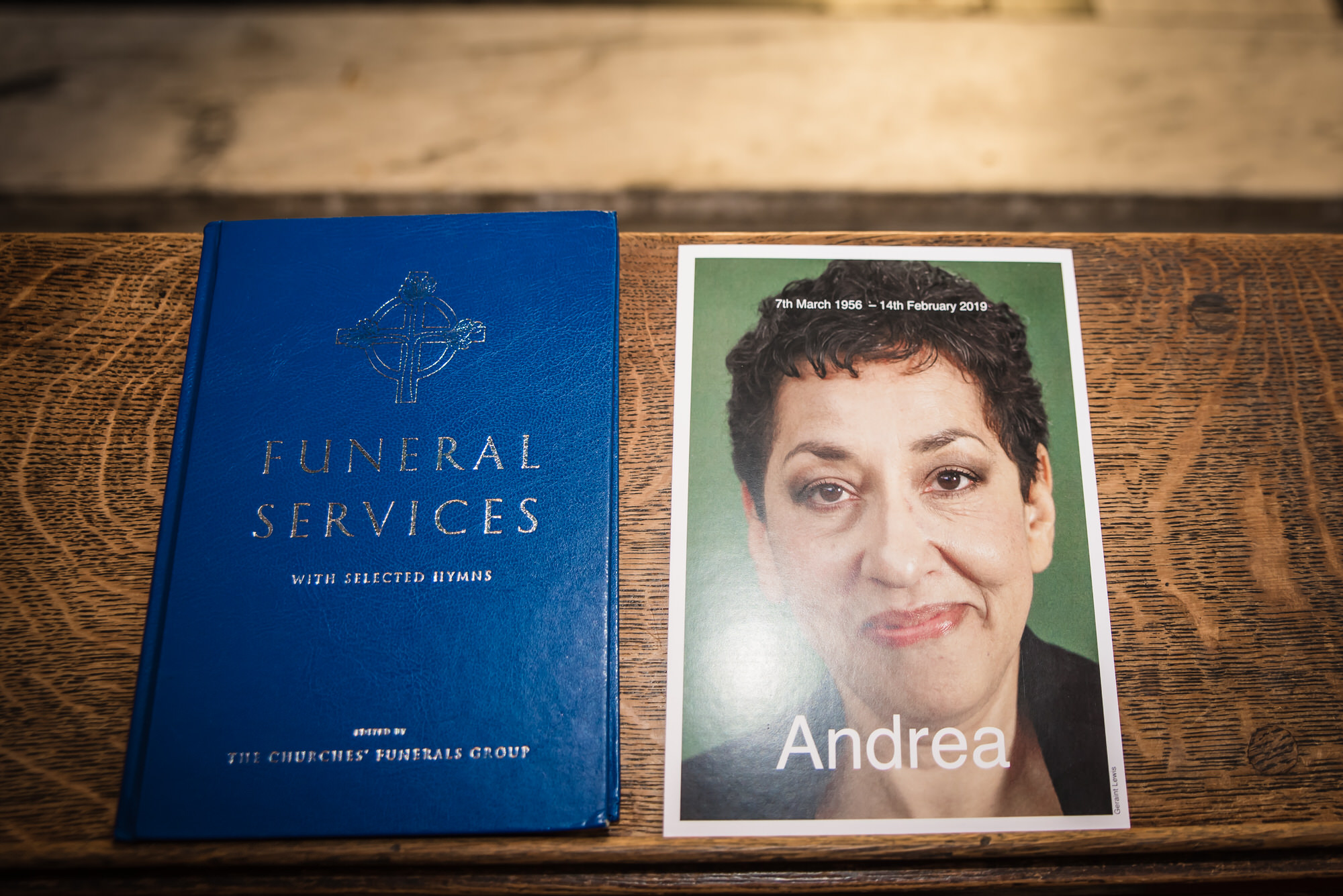
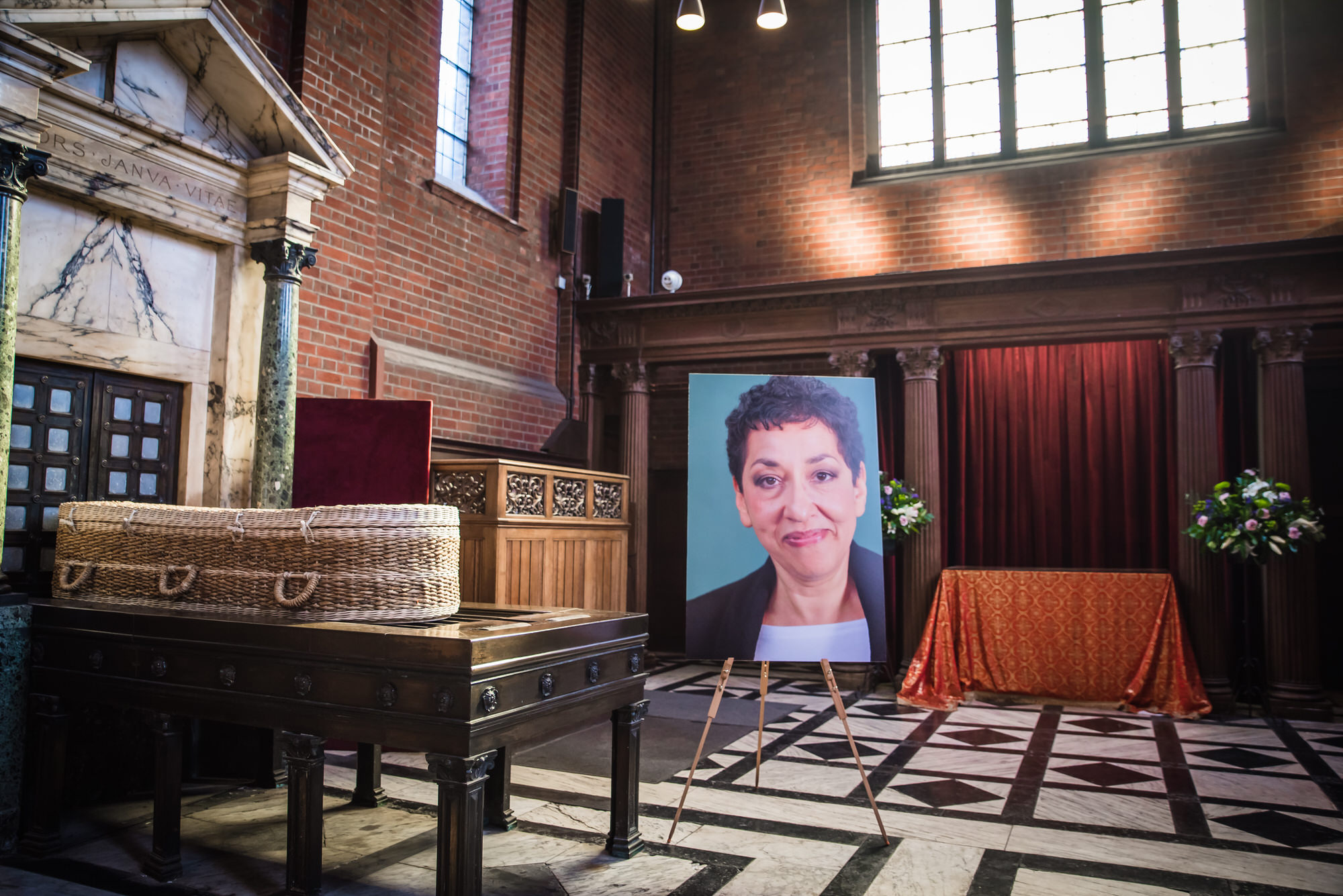
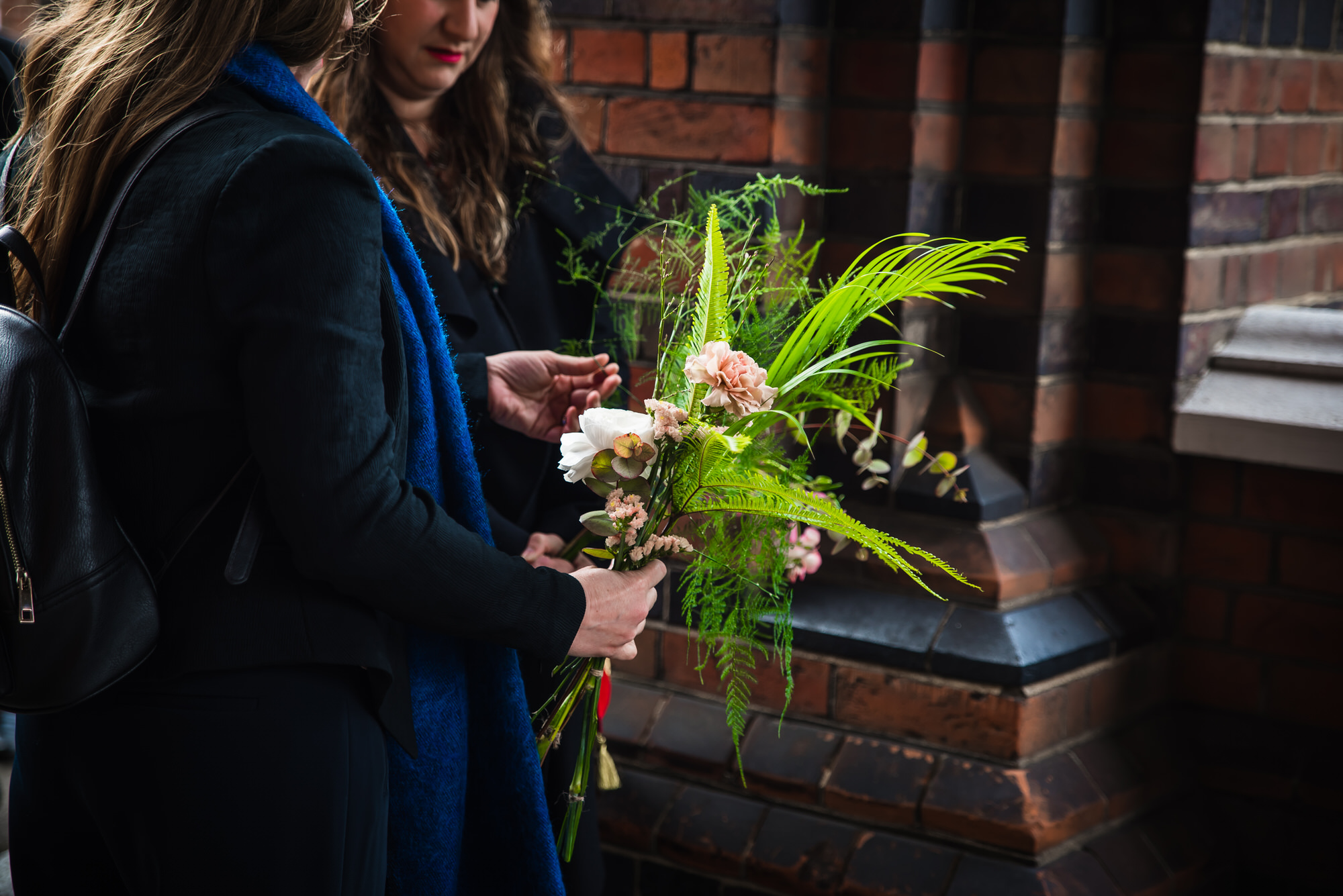
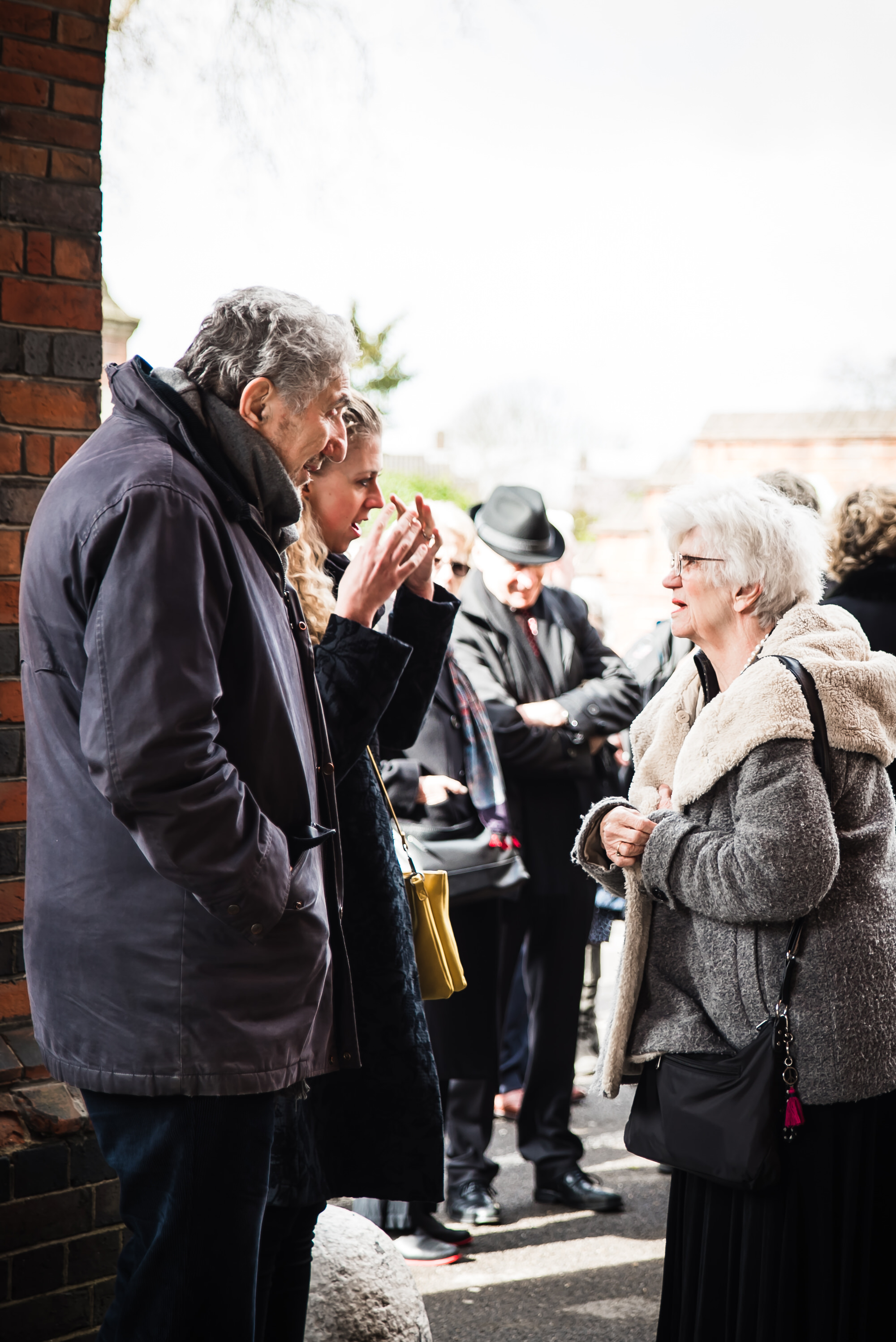
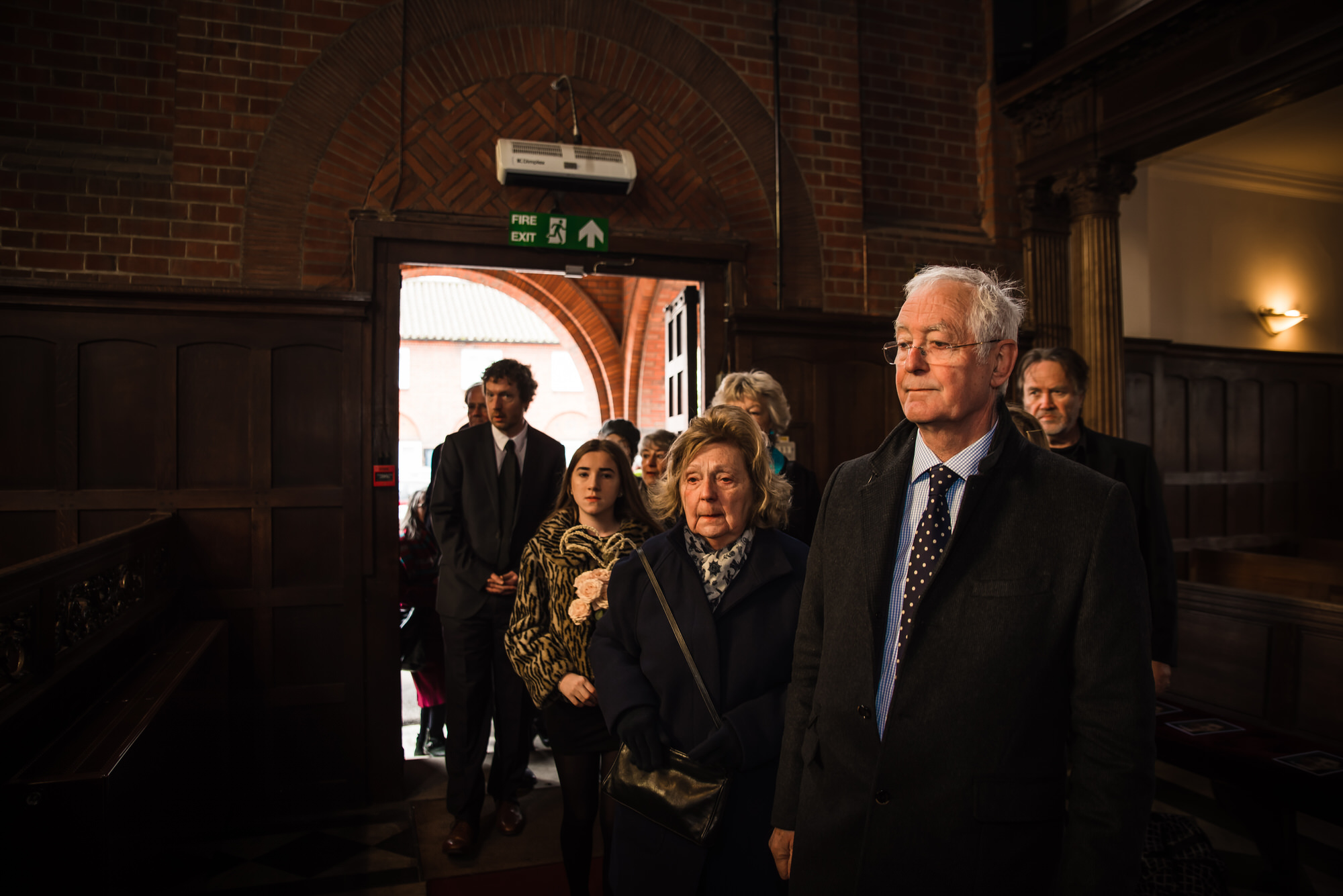
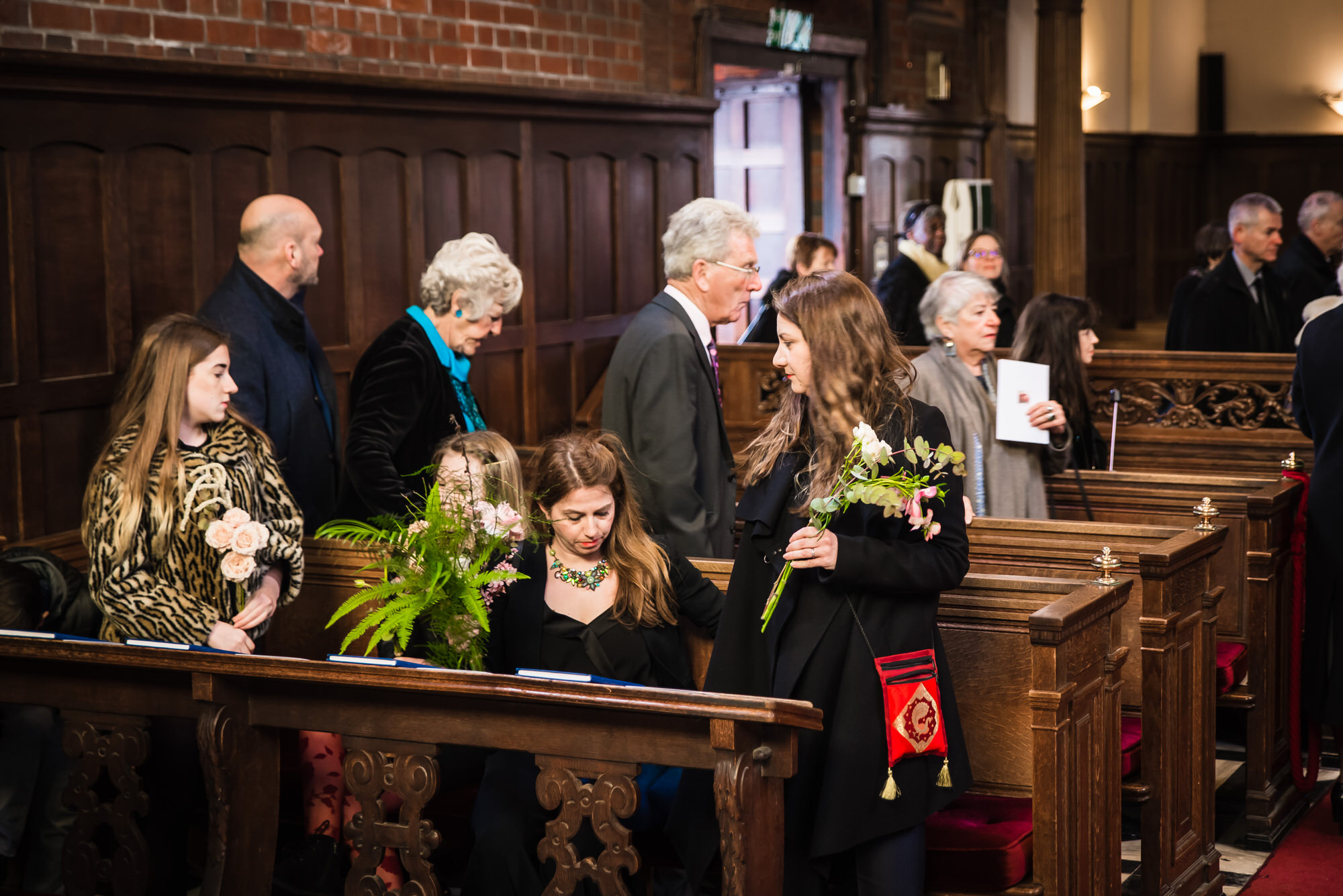
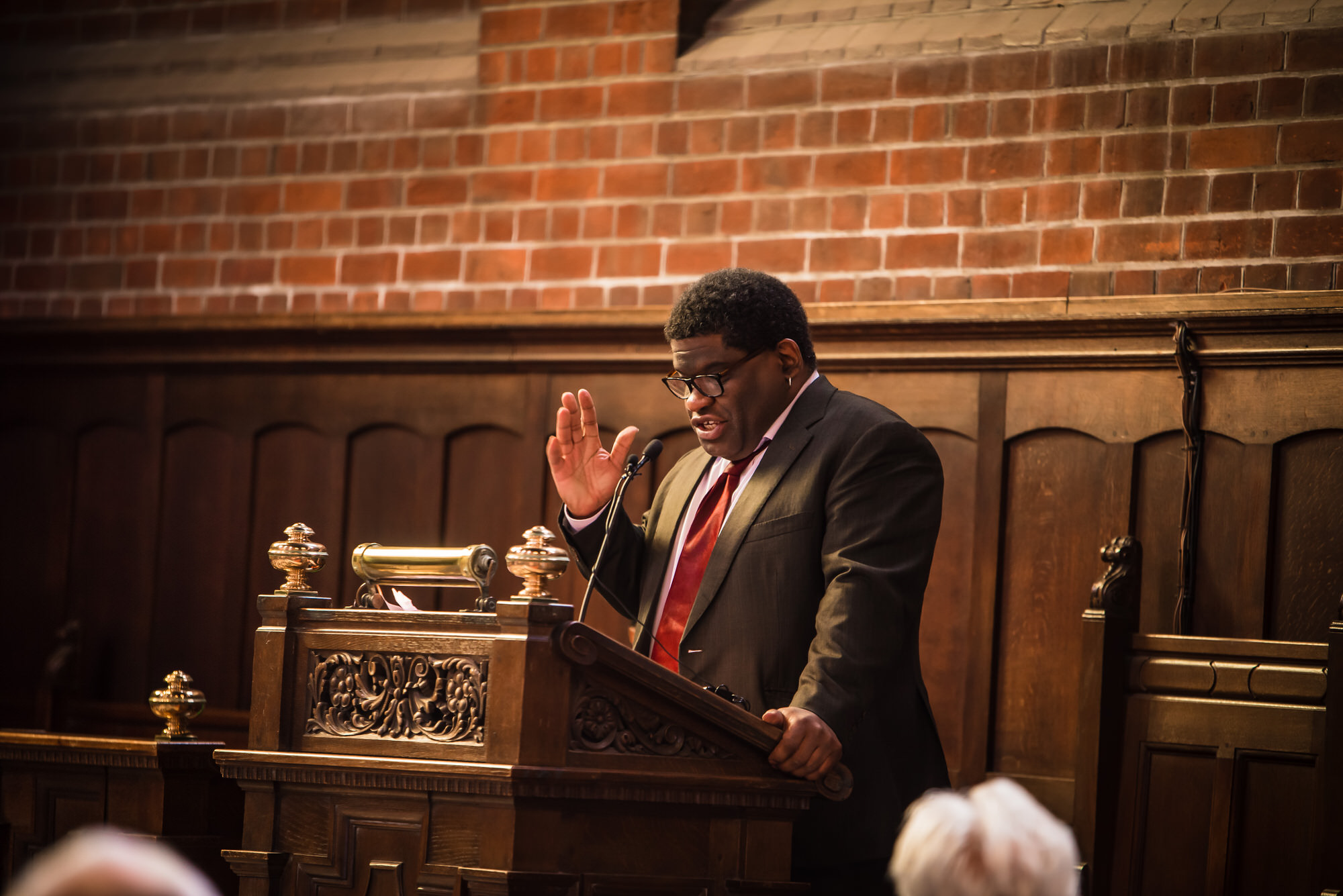
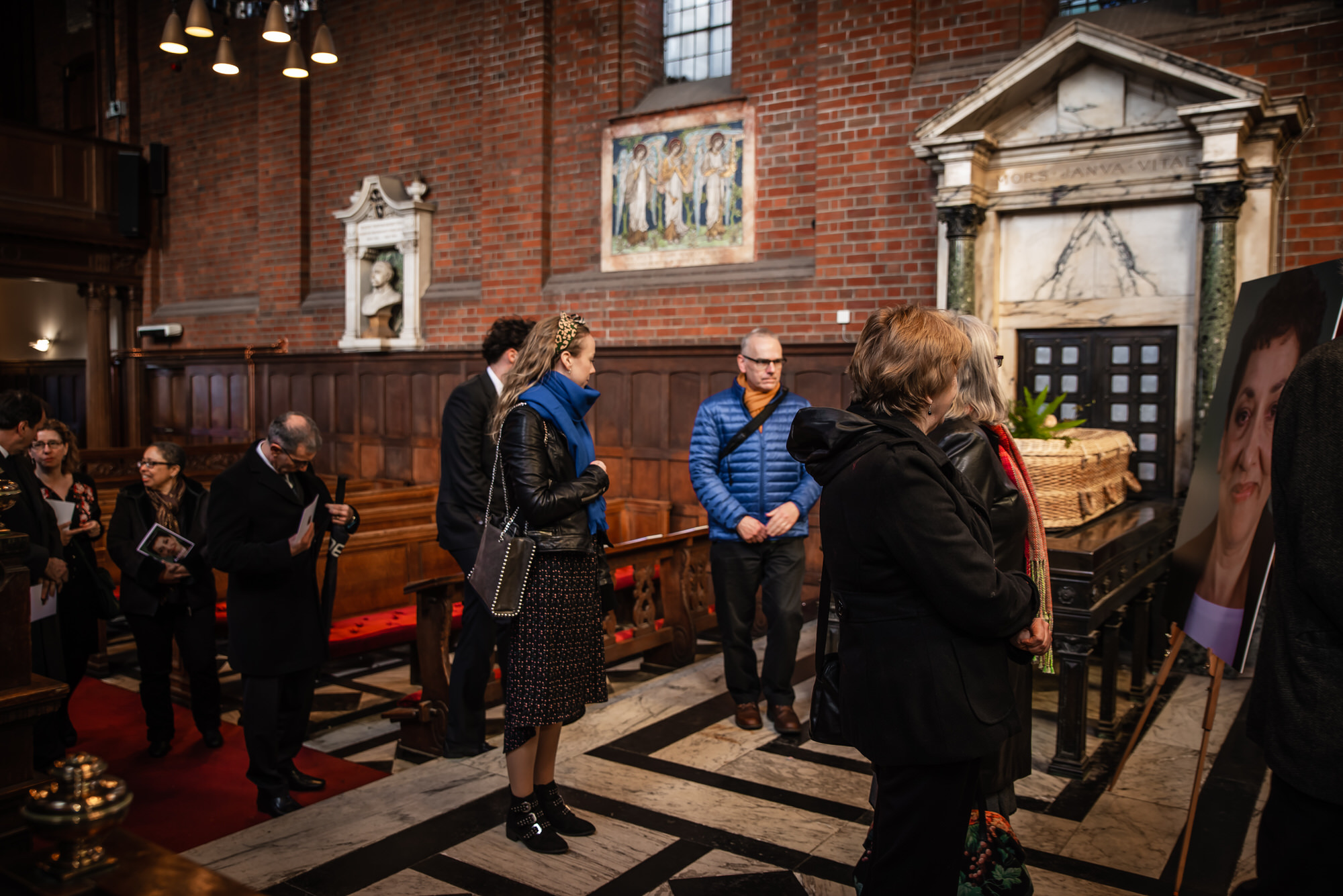
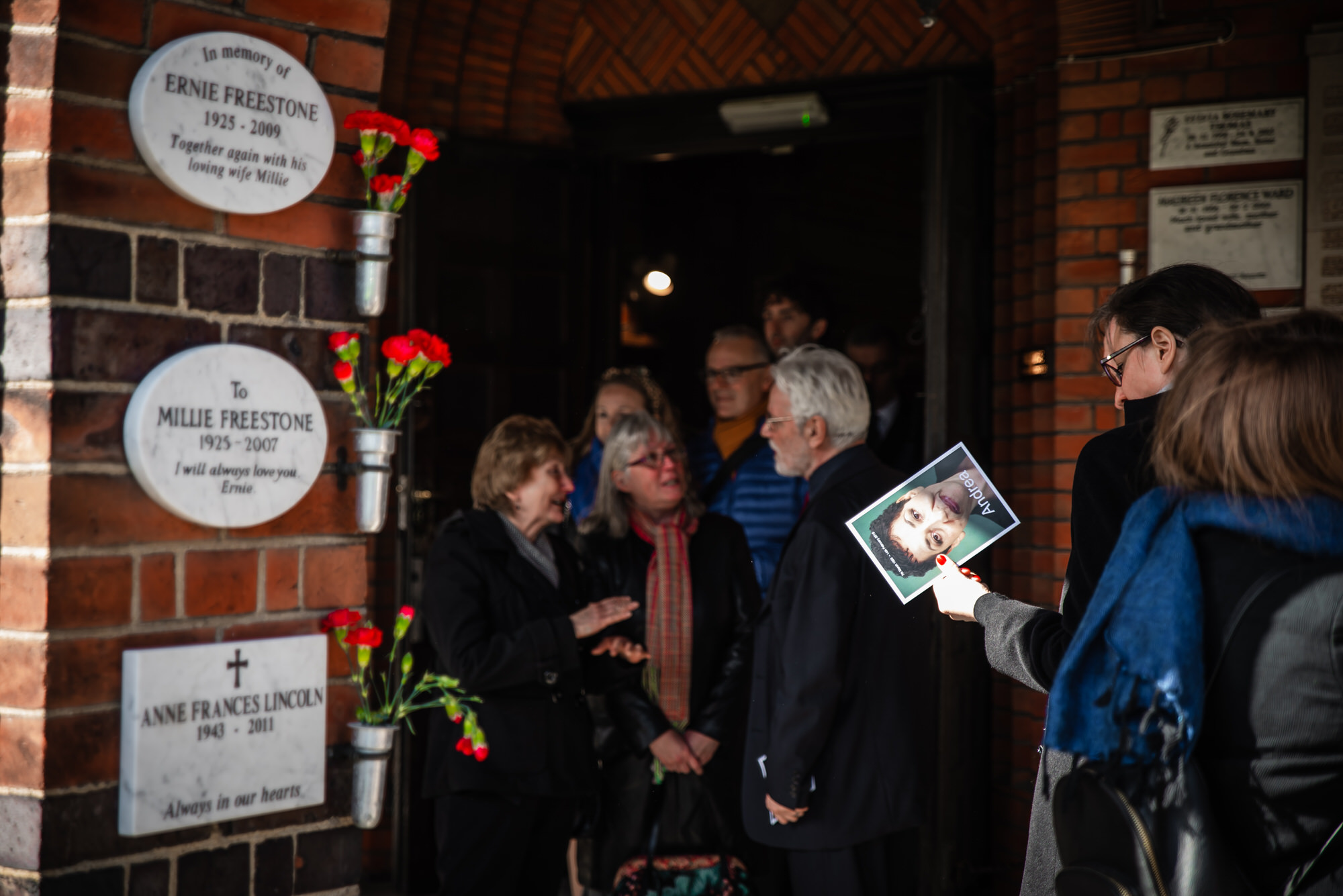
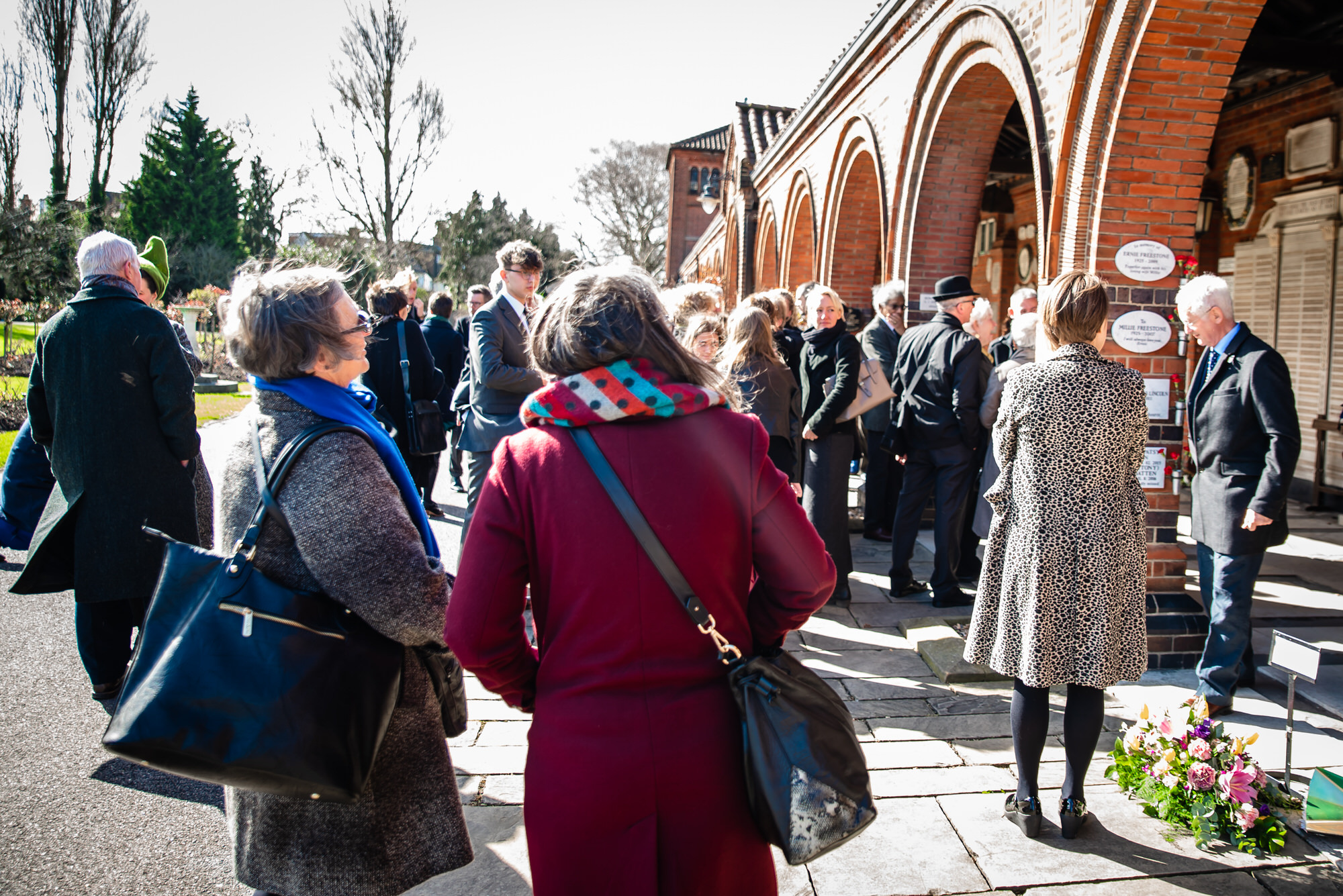
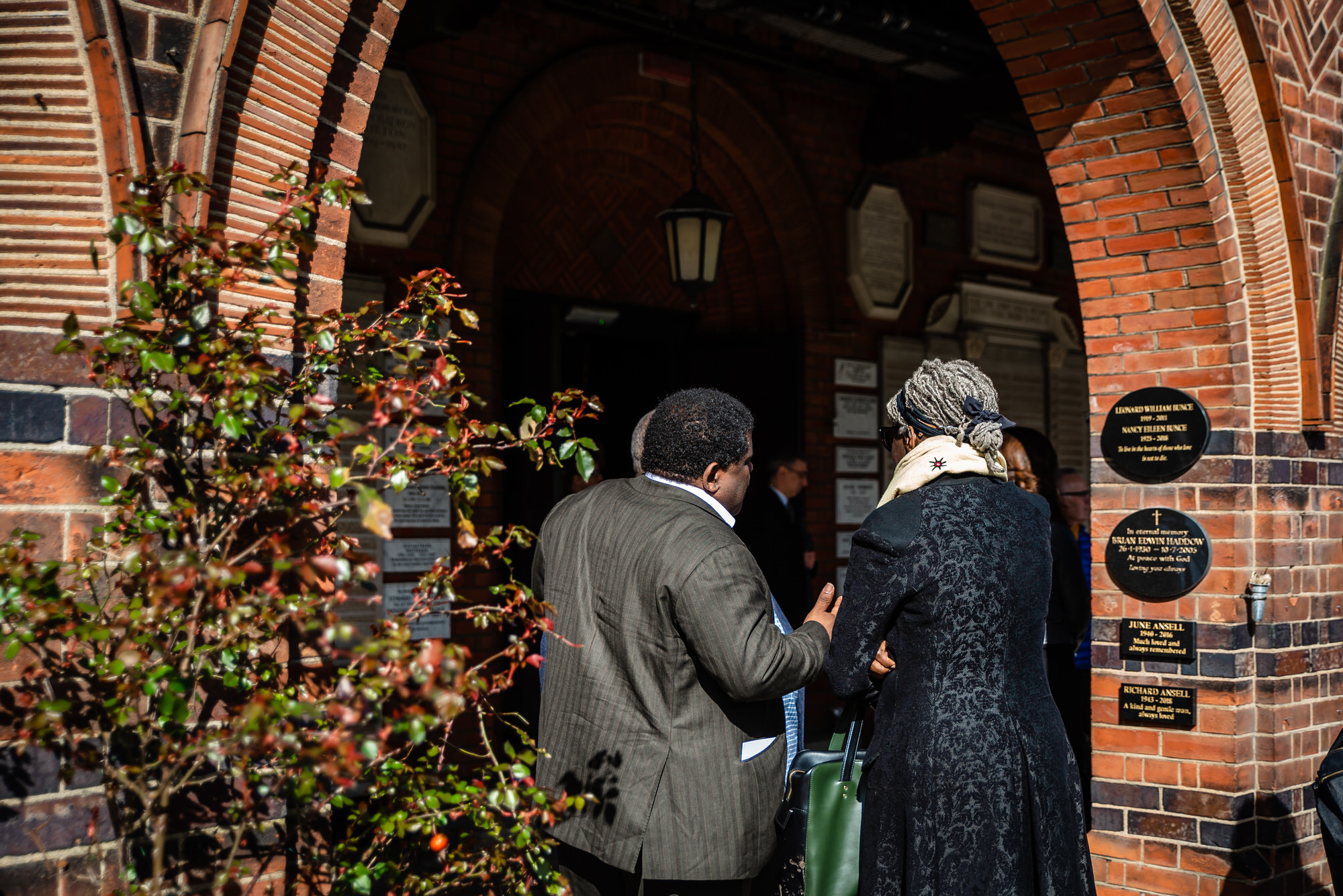
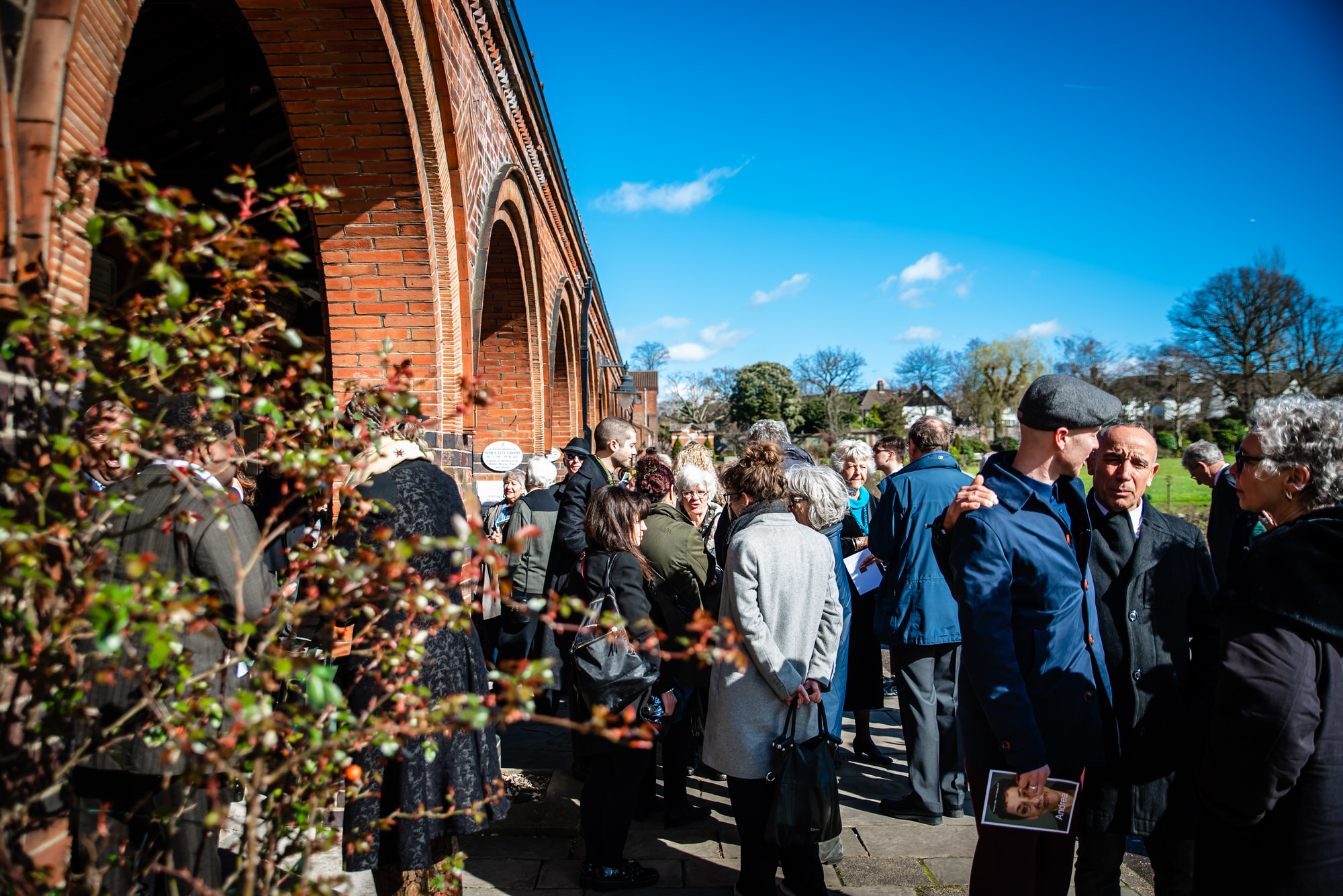
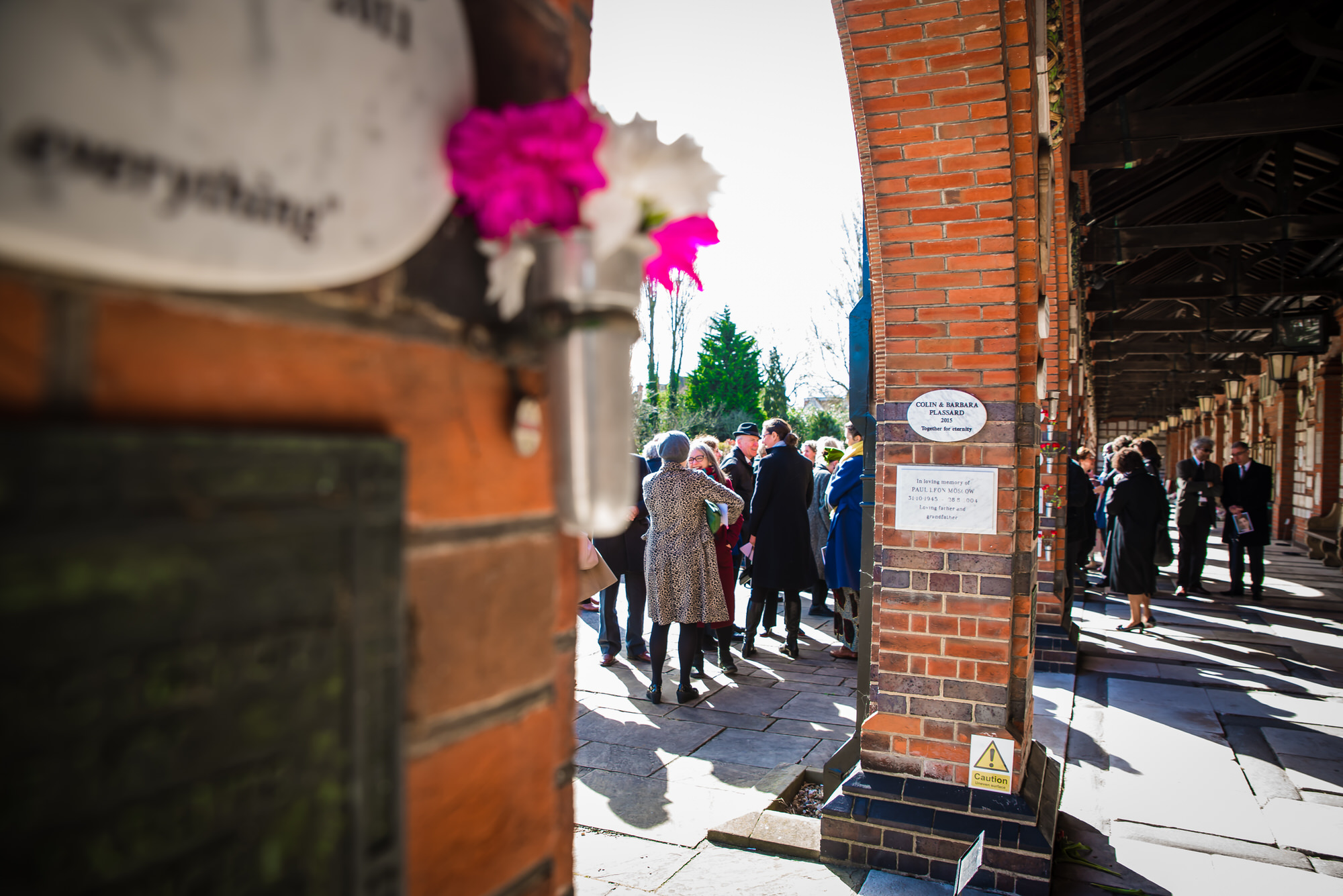
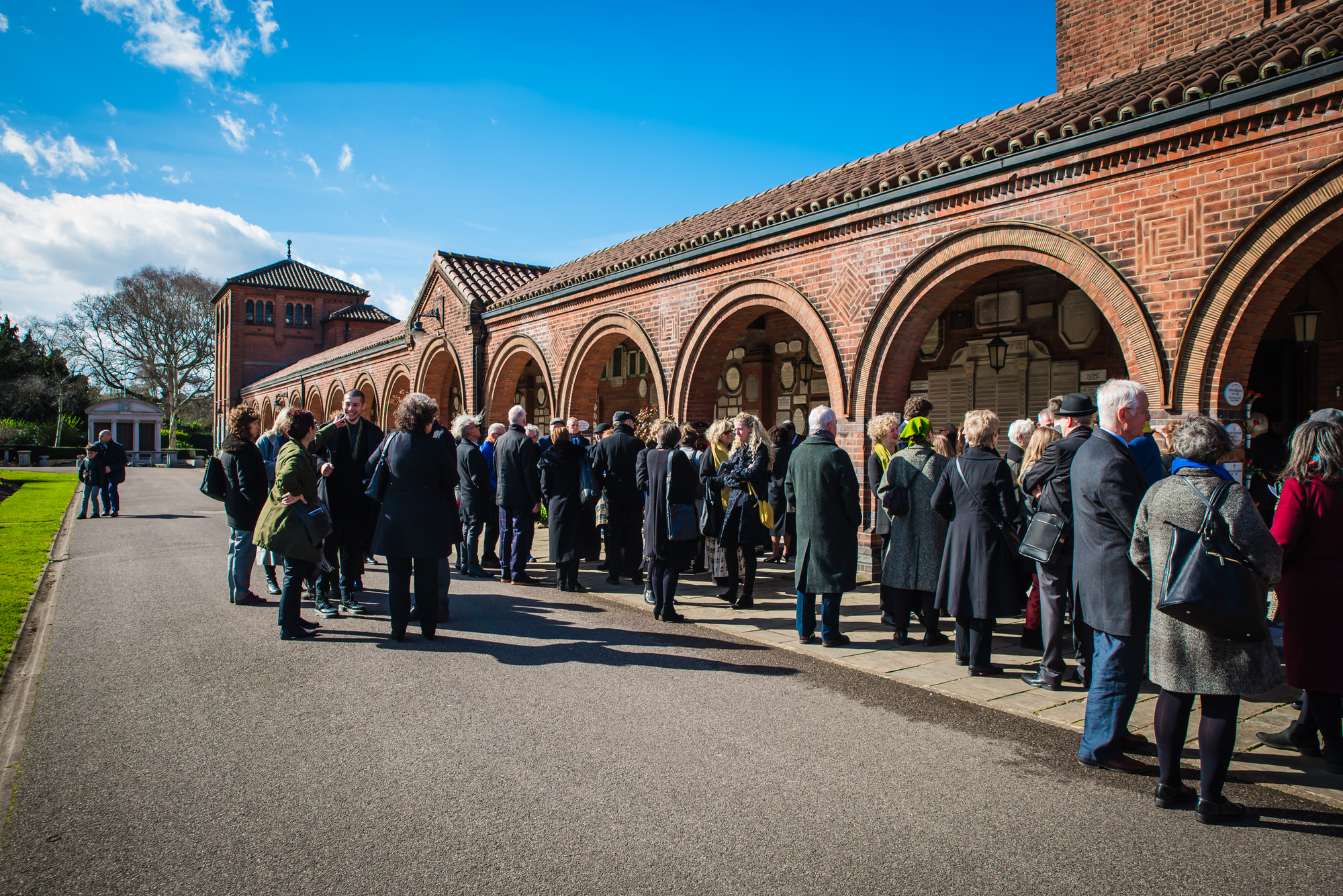
Funeral Photography at Golders Green Crematorium — The Memorial Service of Andrea Levy
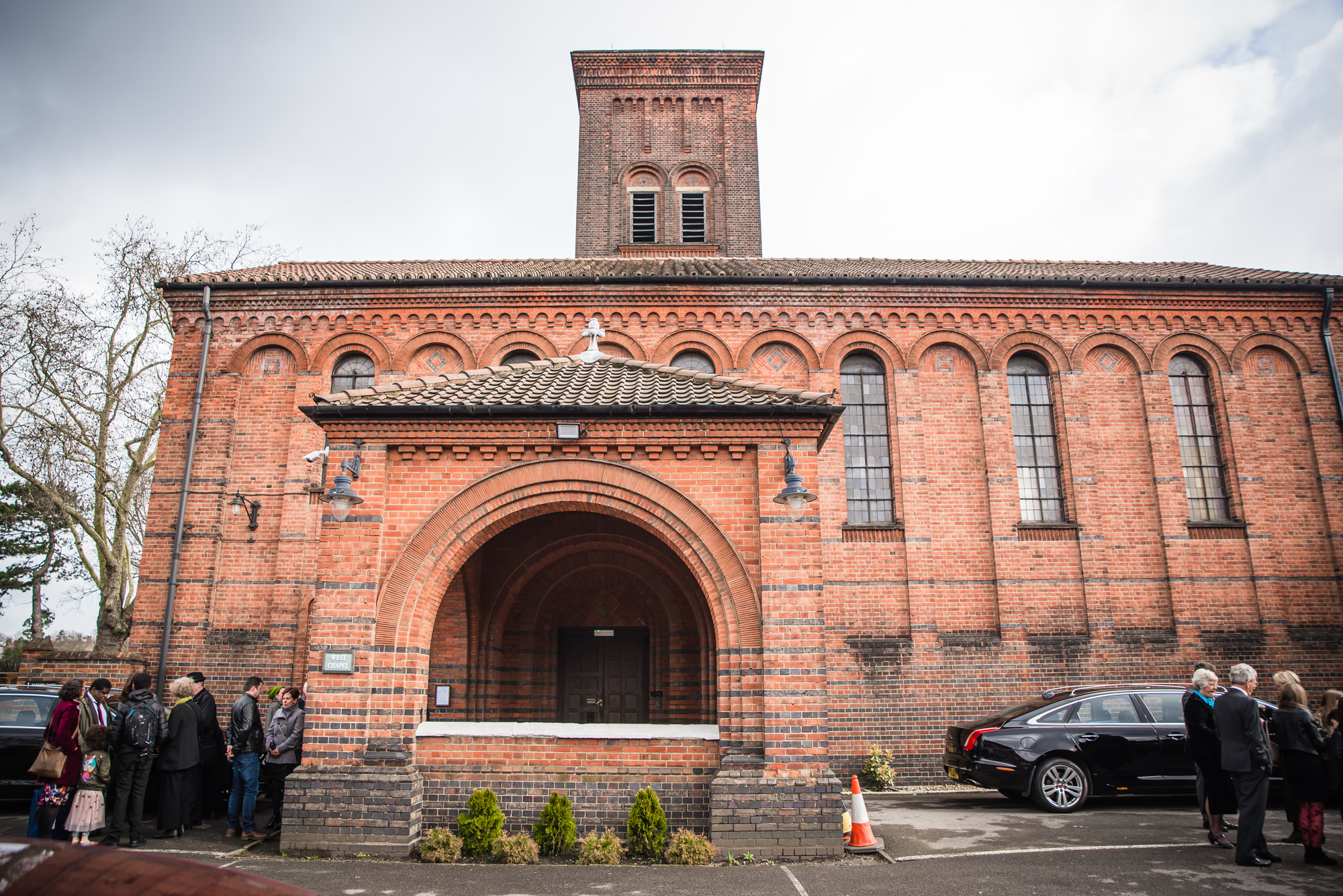
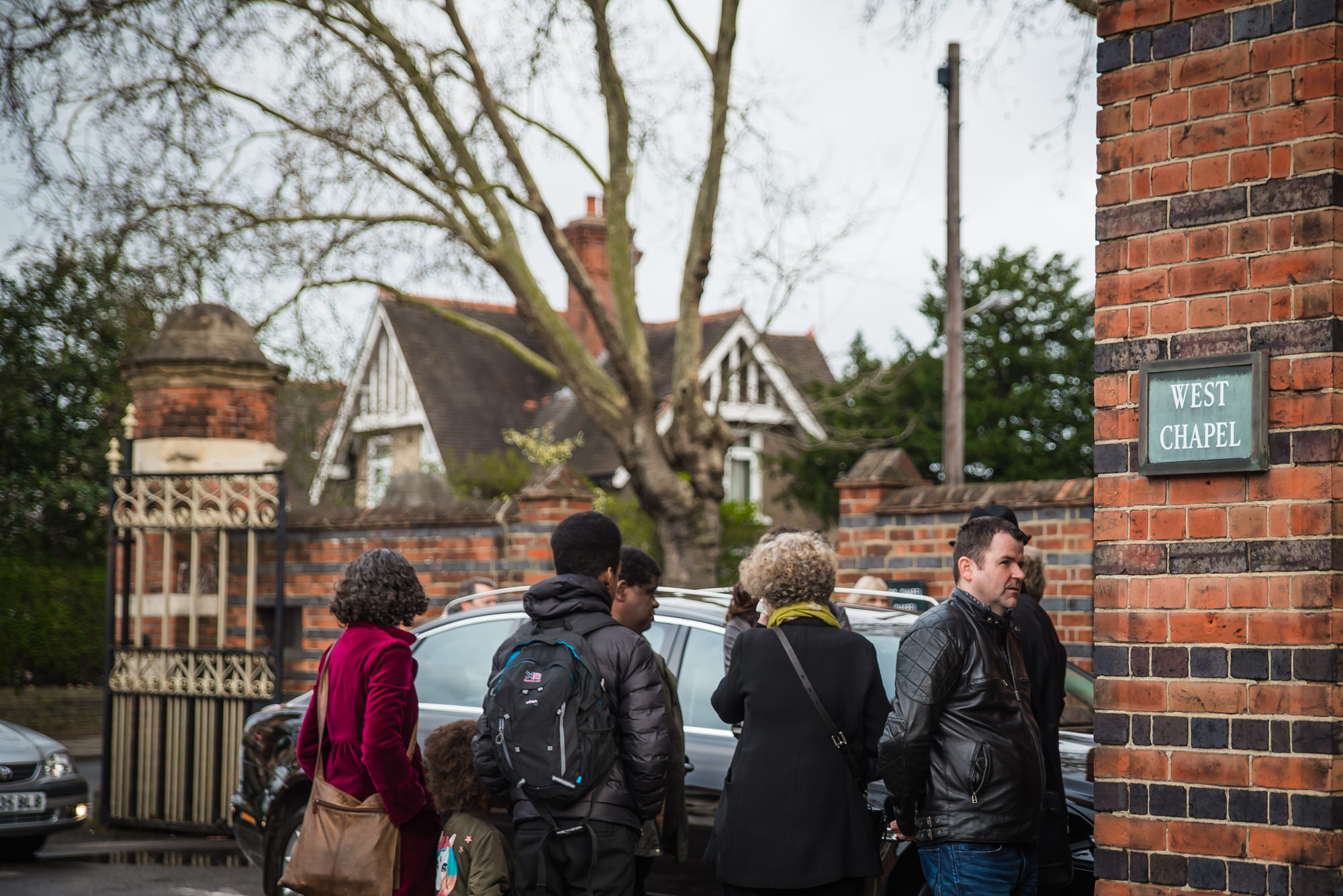
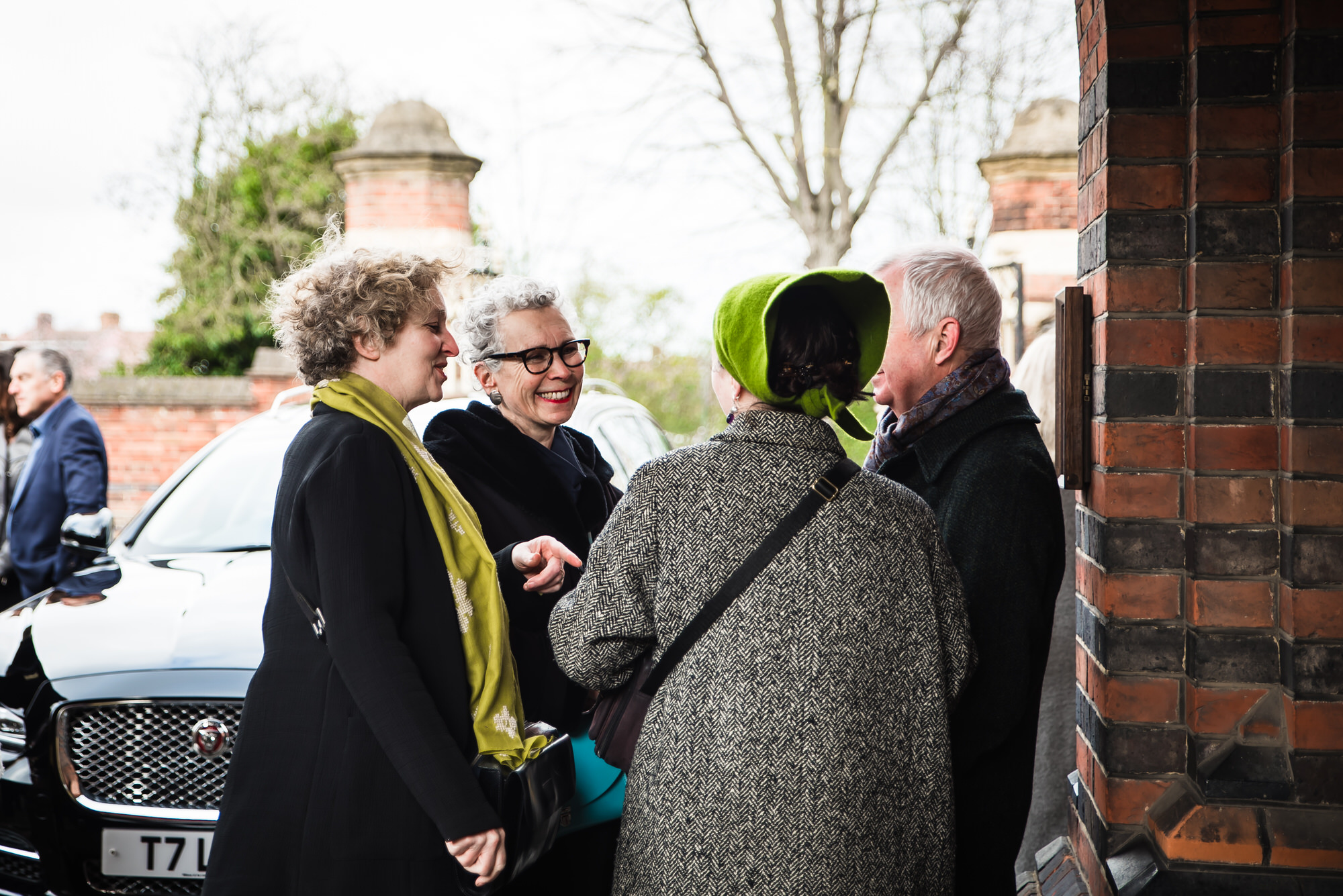
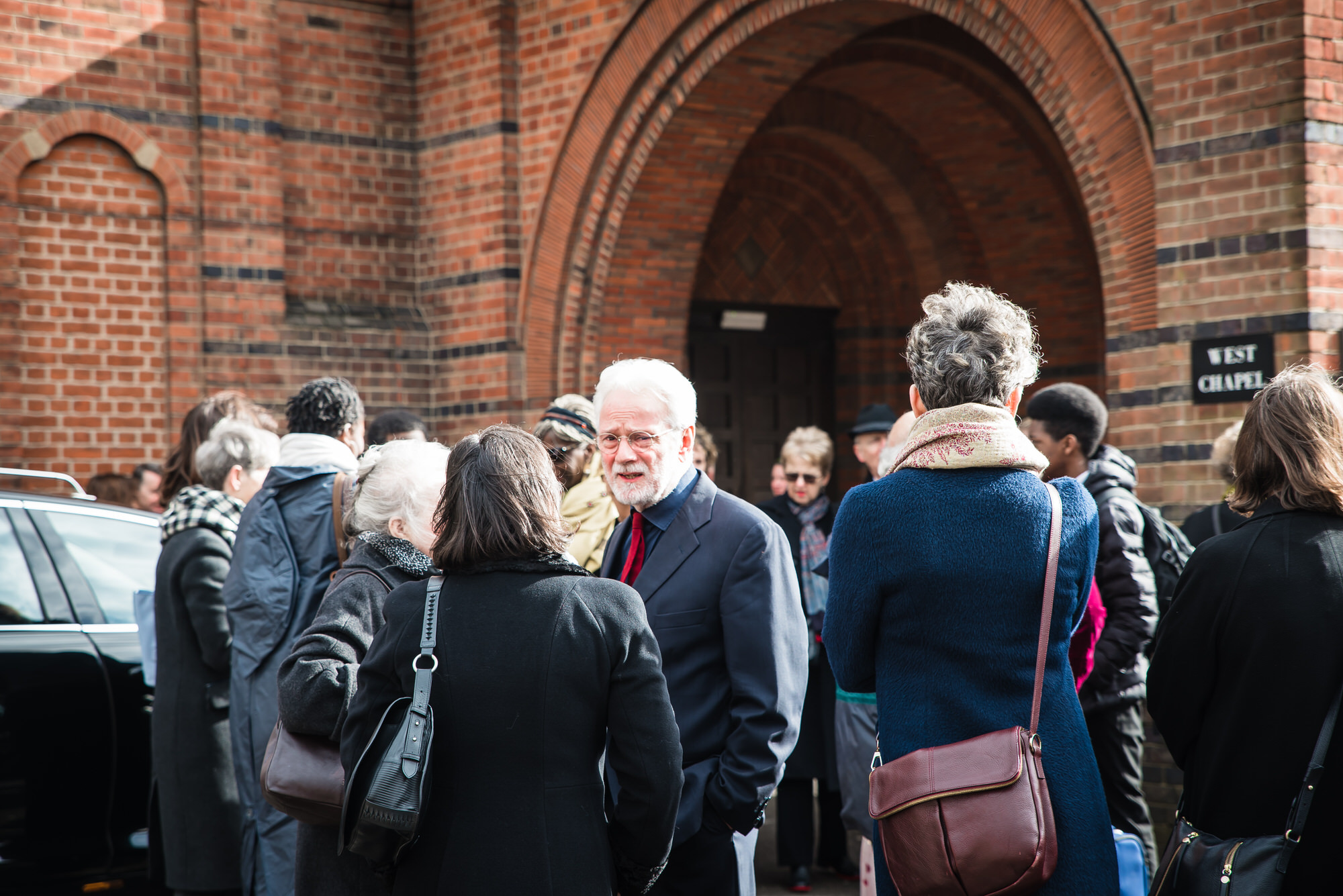
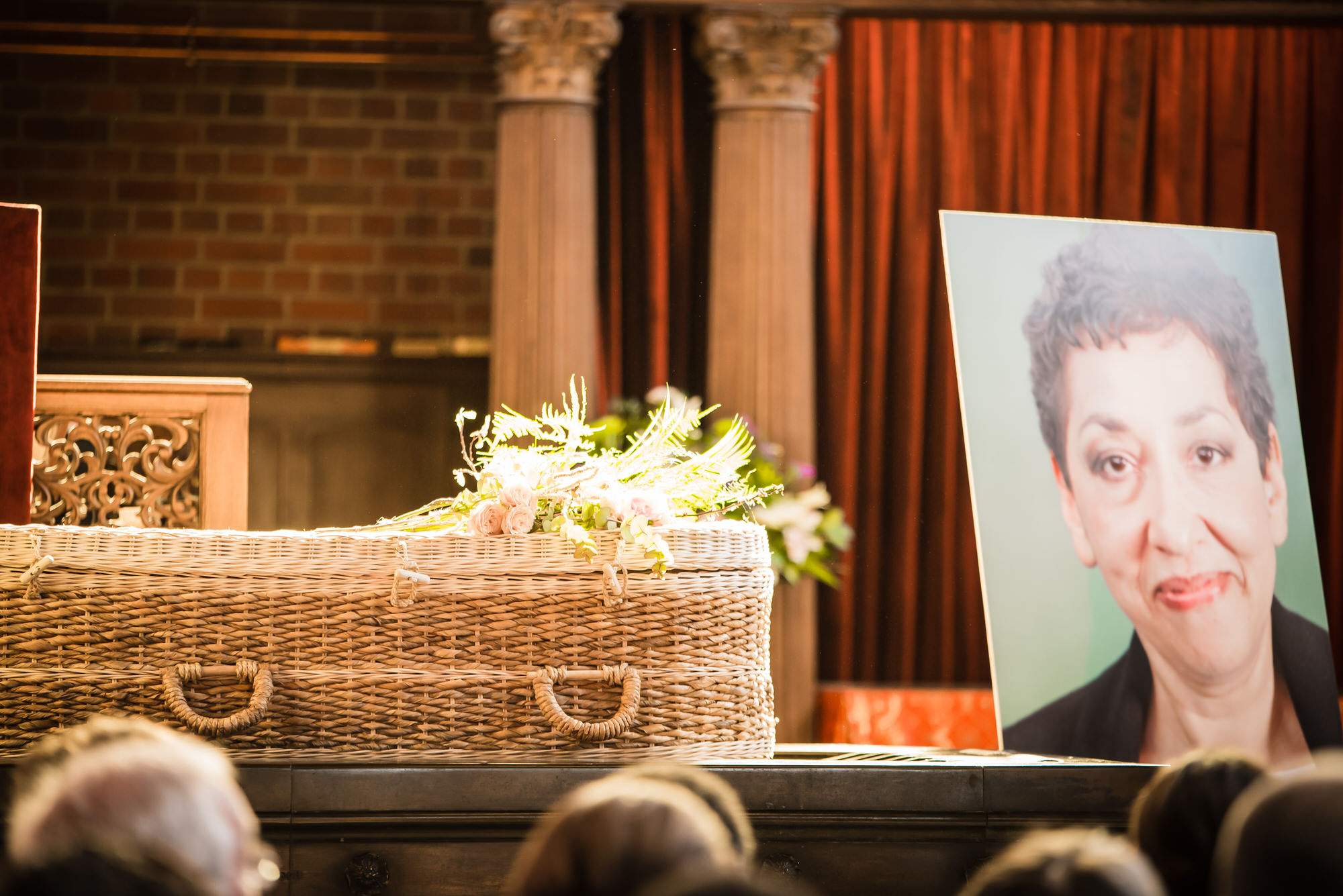
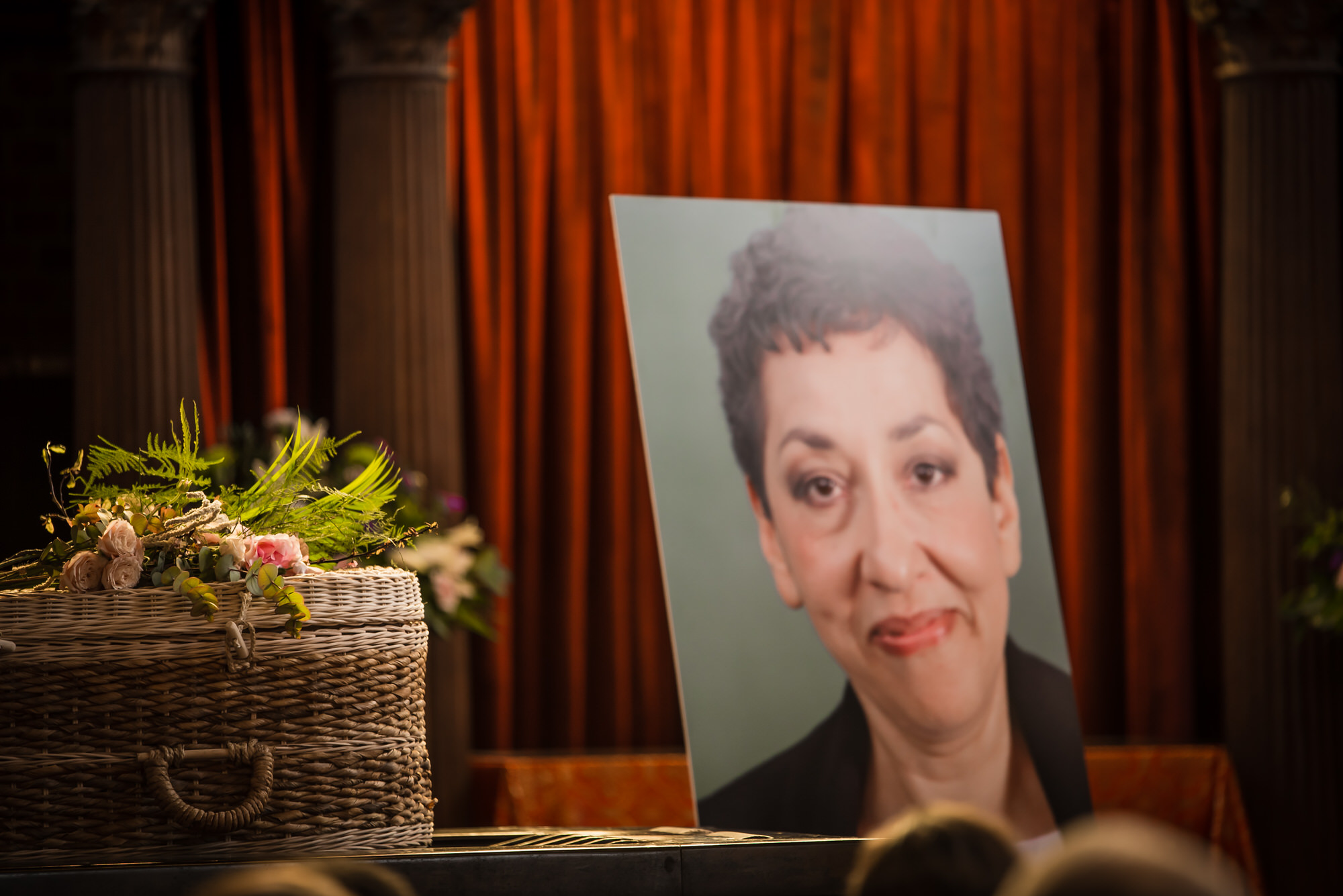
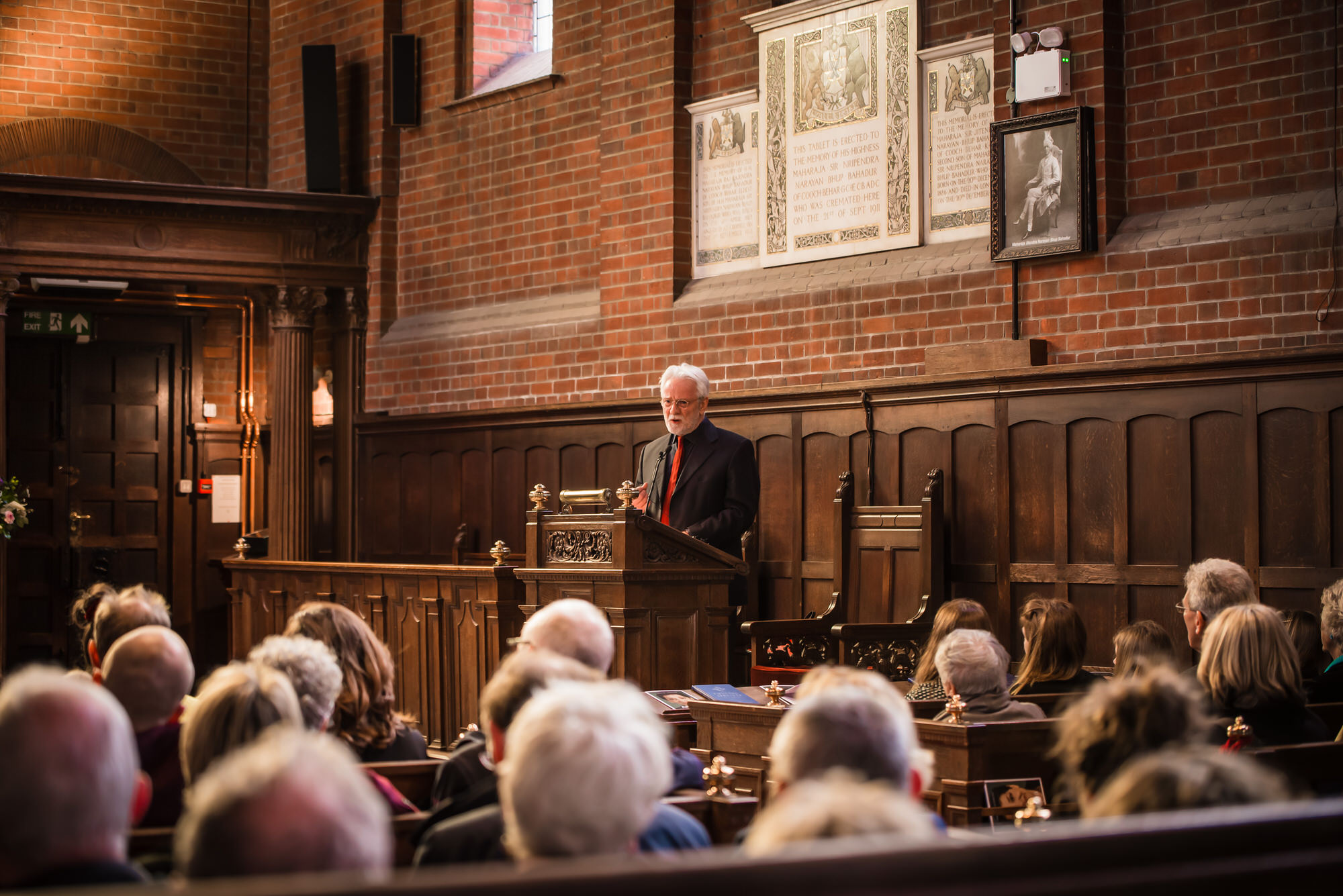
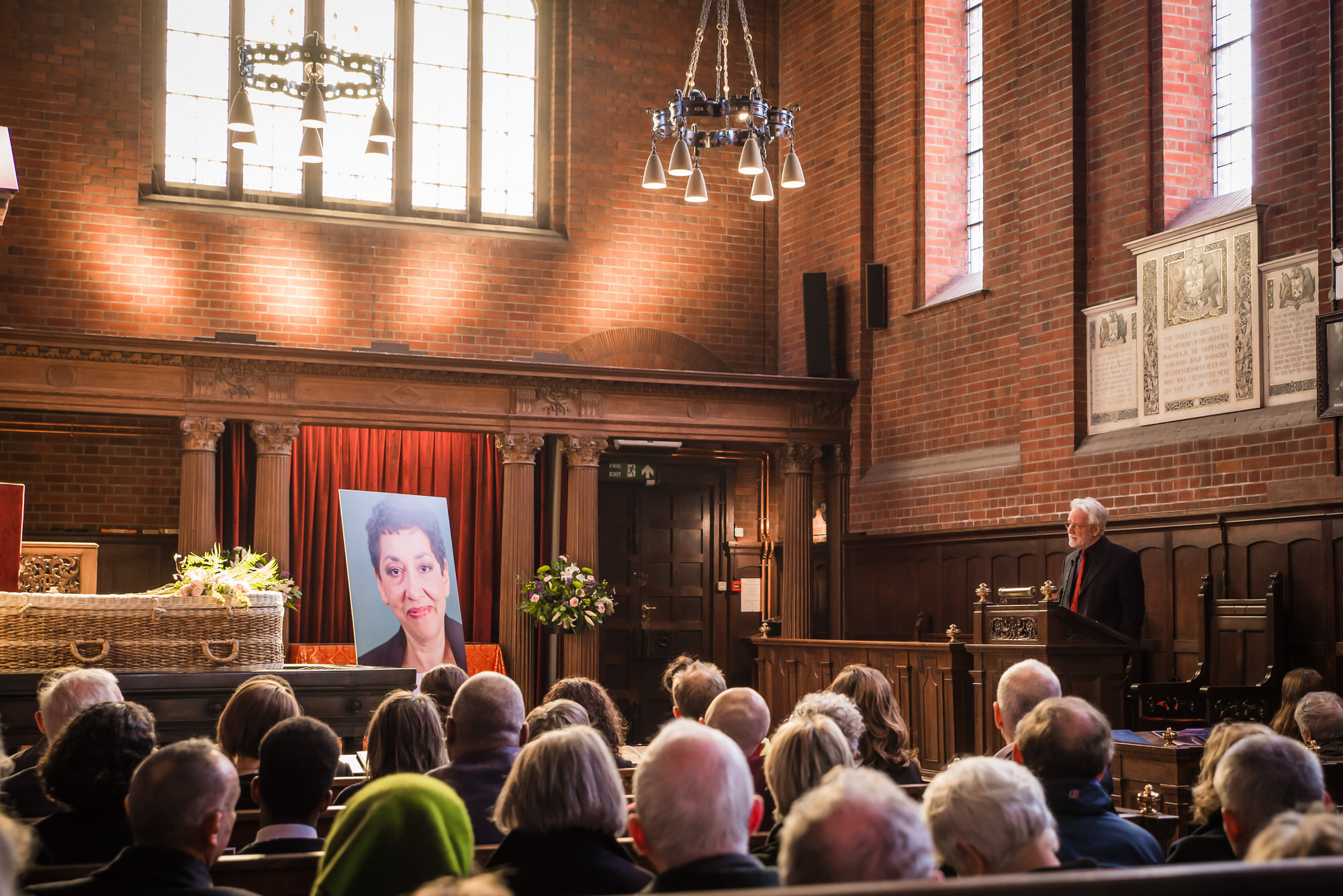
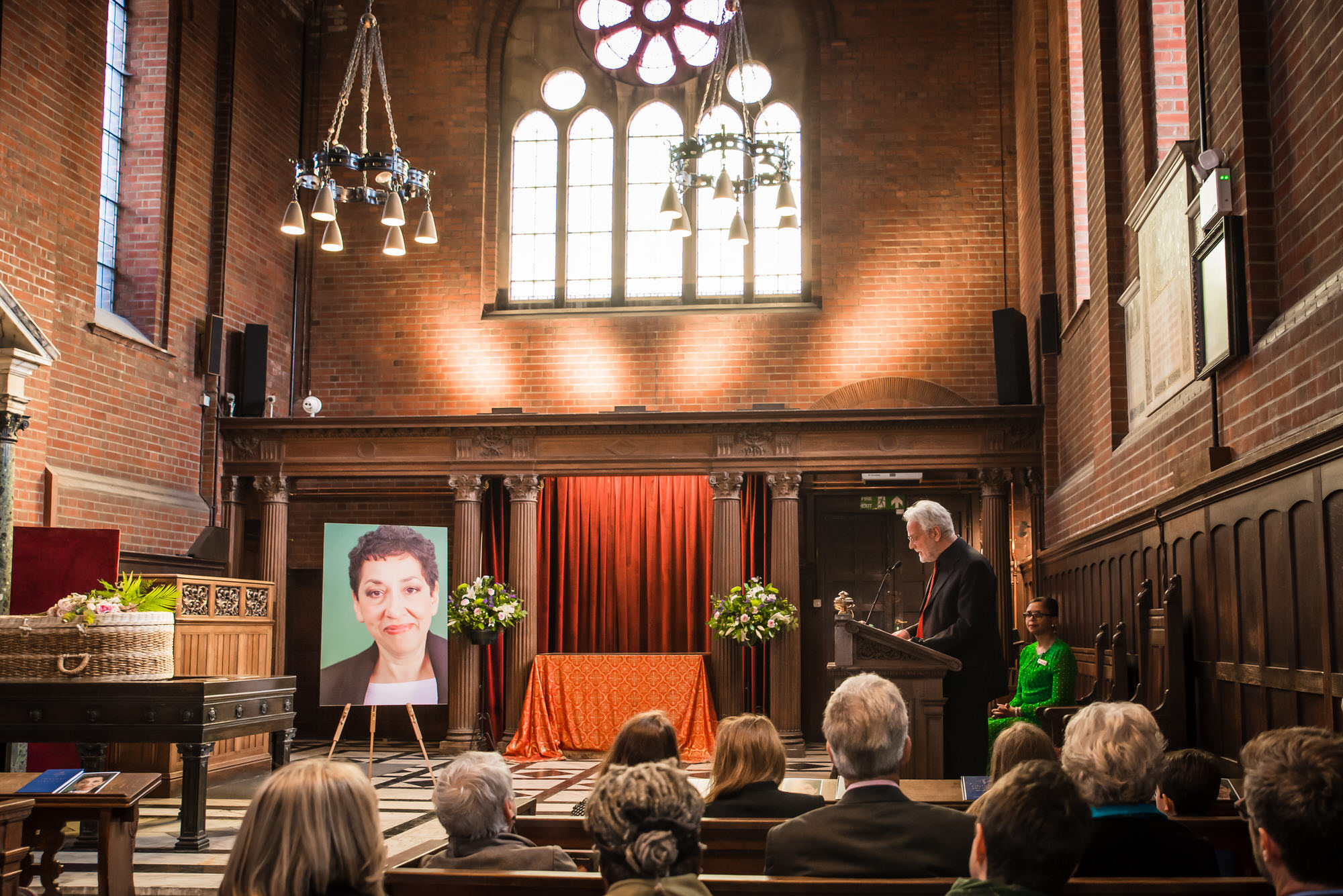
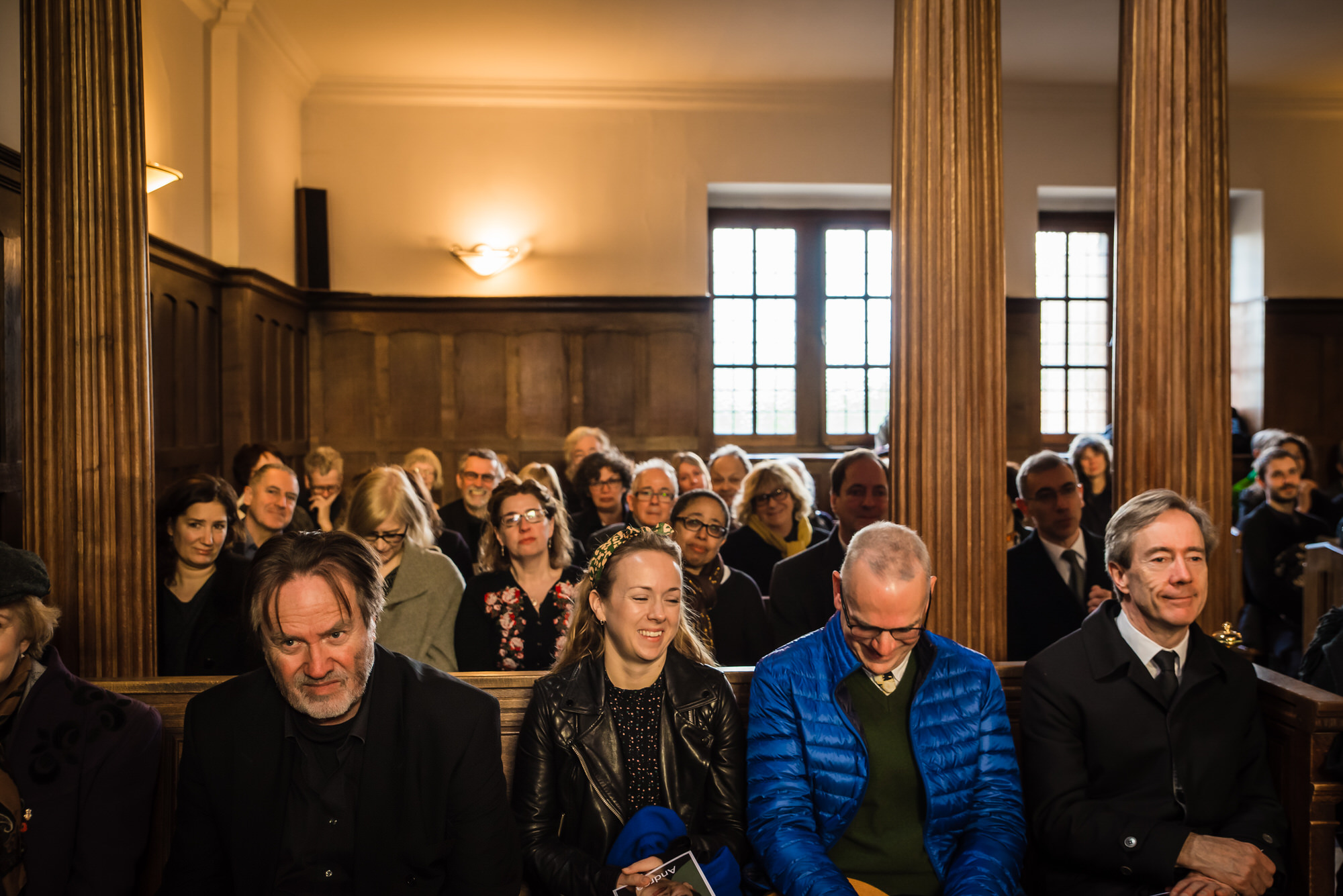
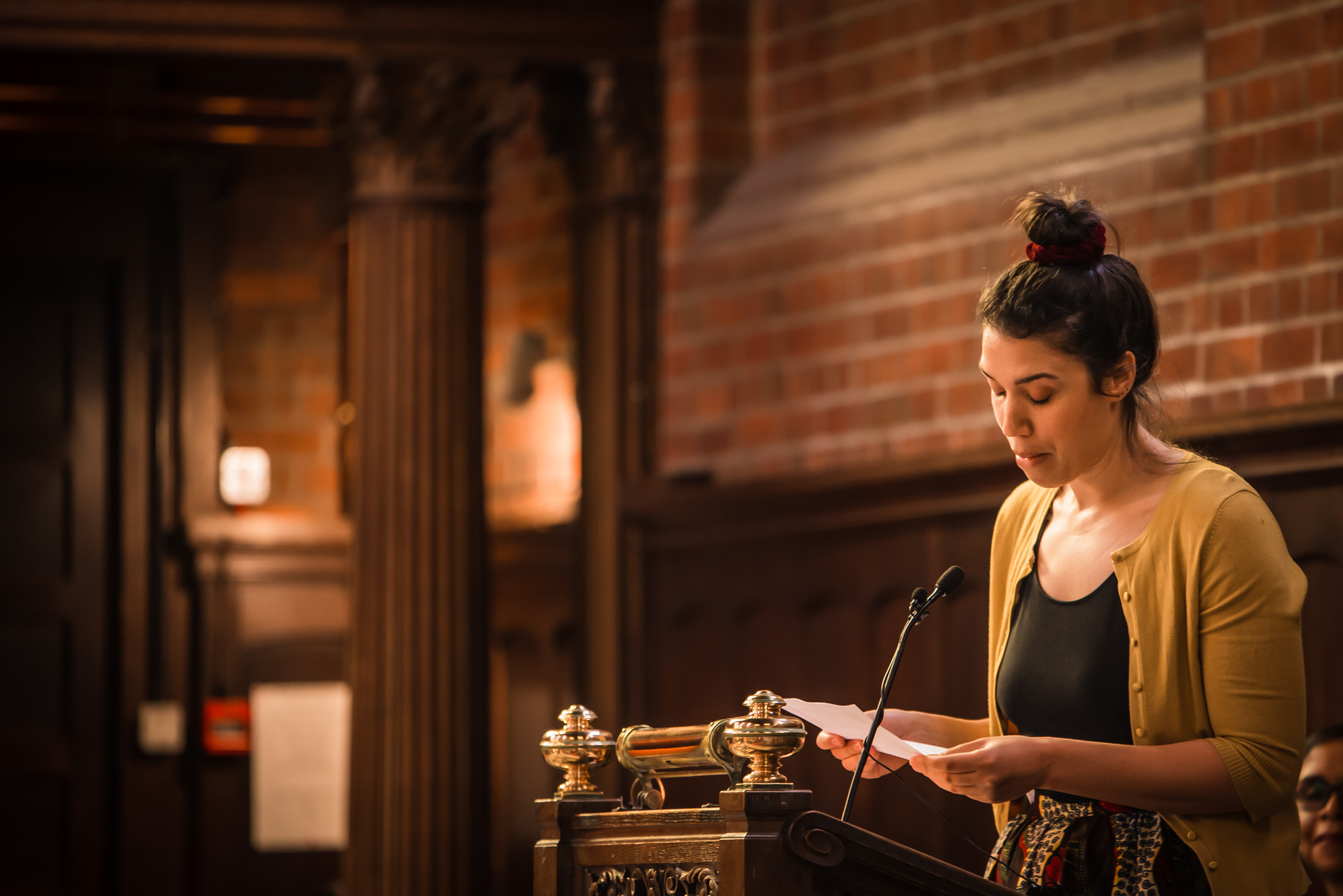
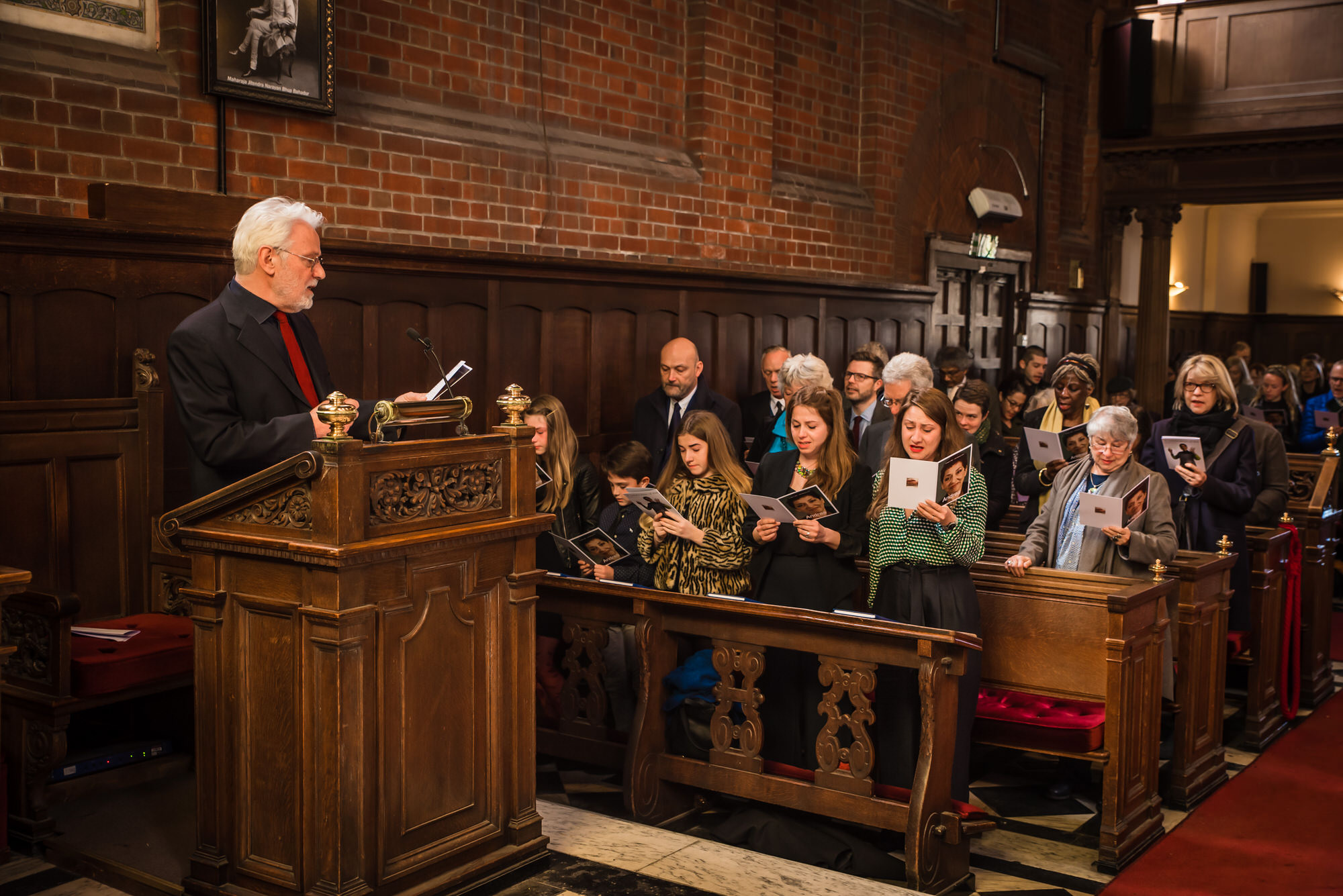
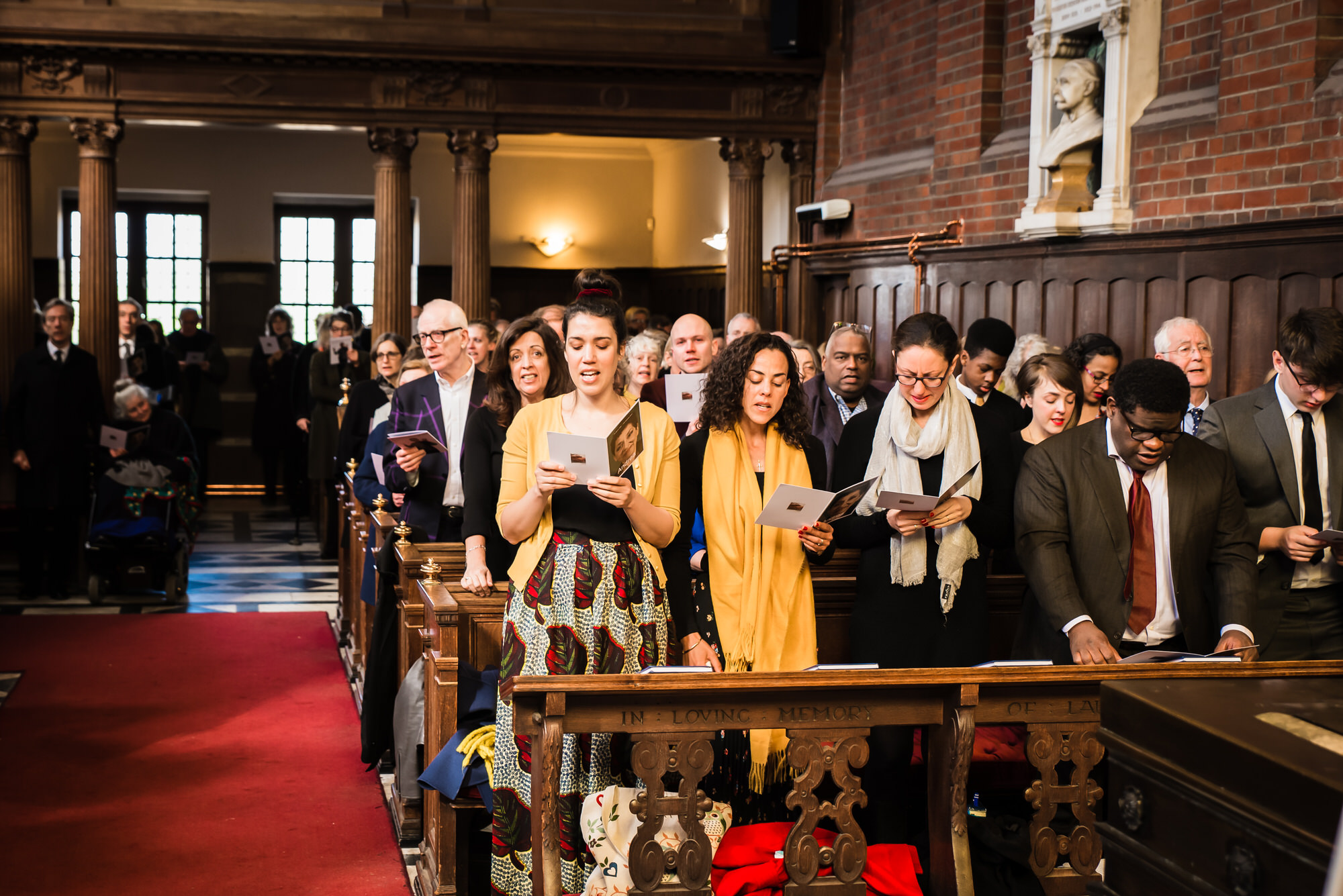
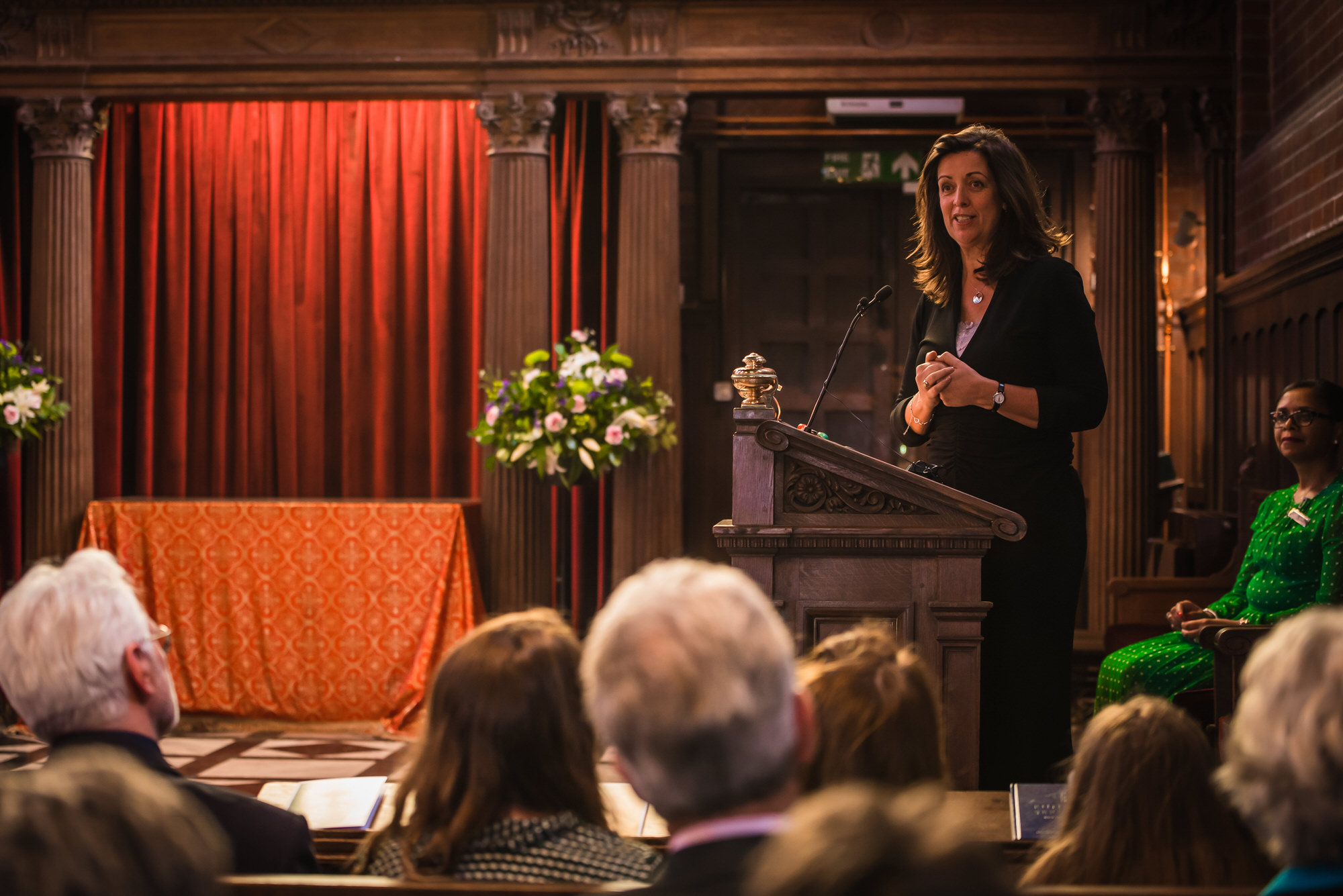
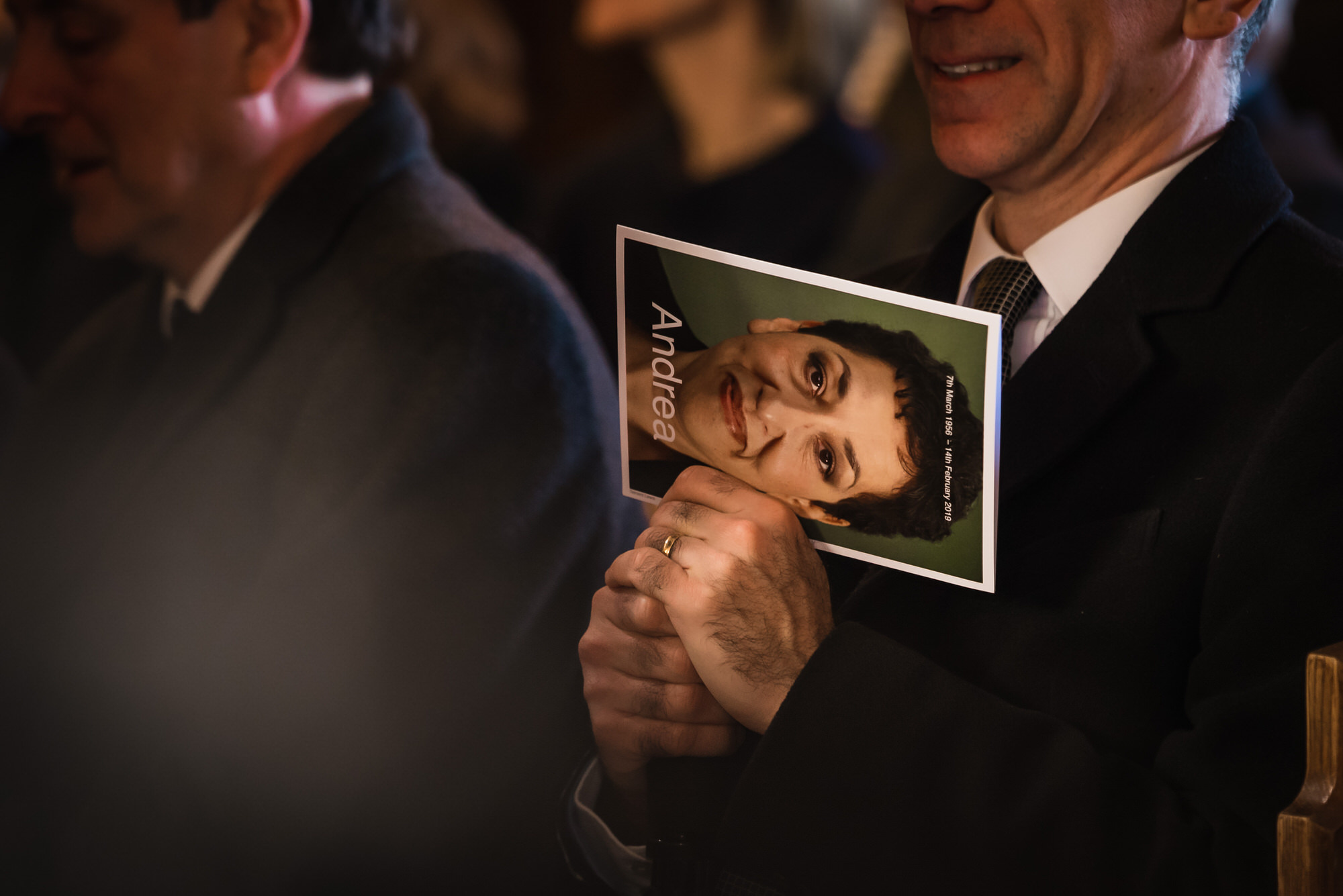
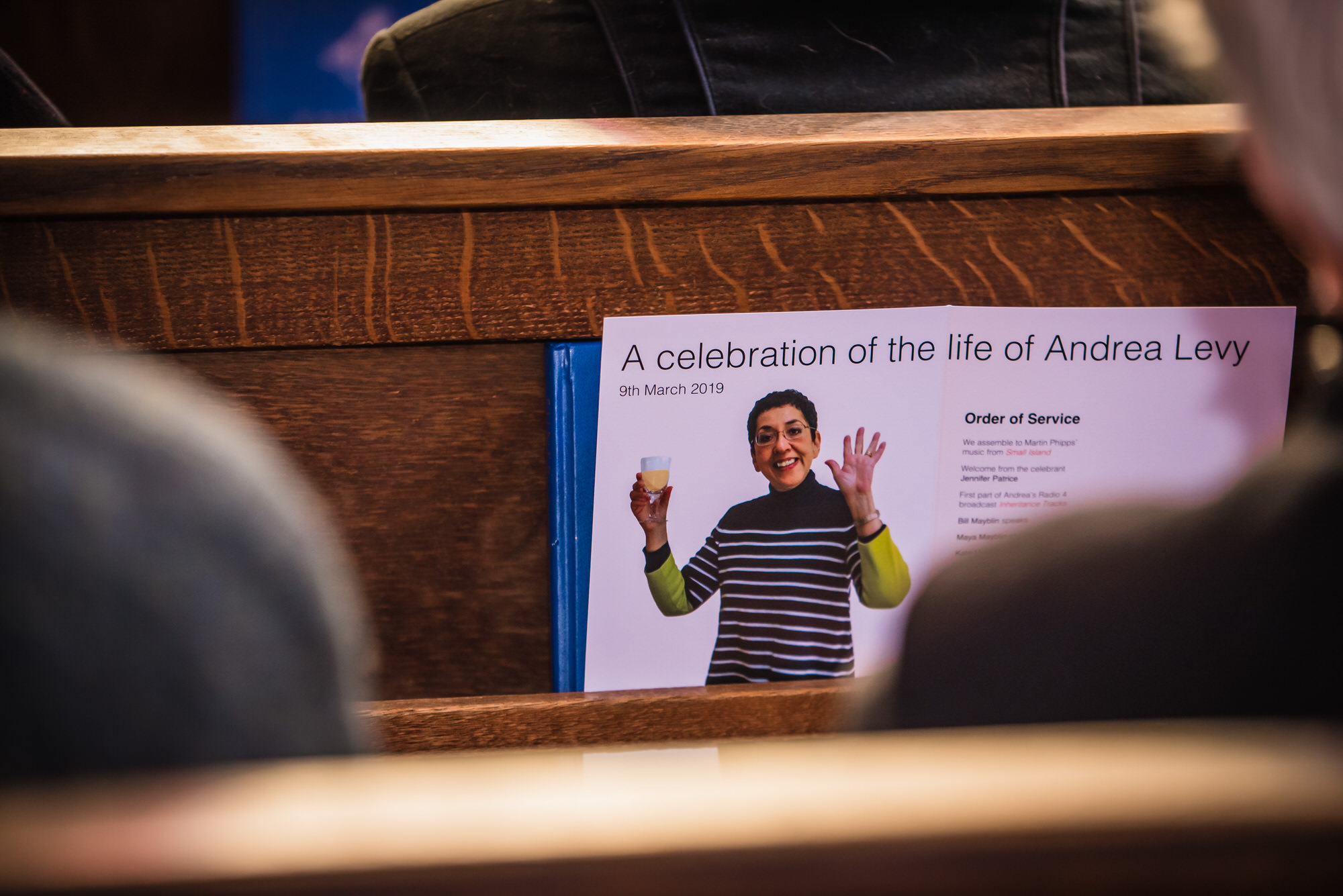
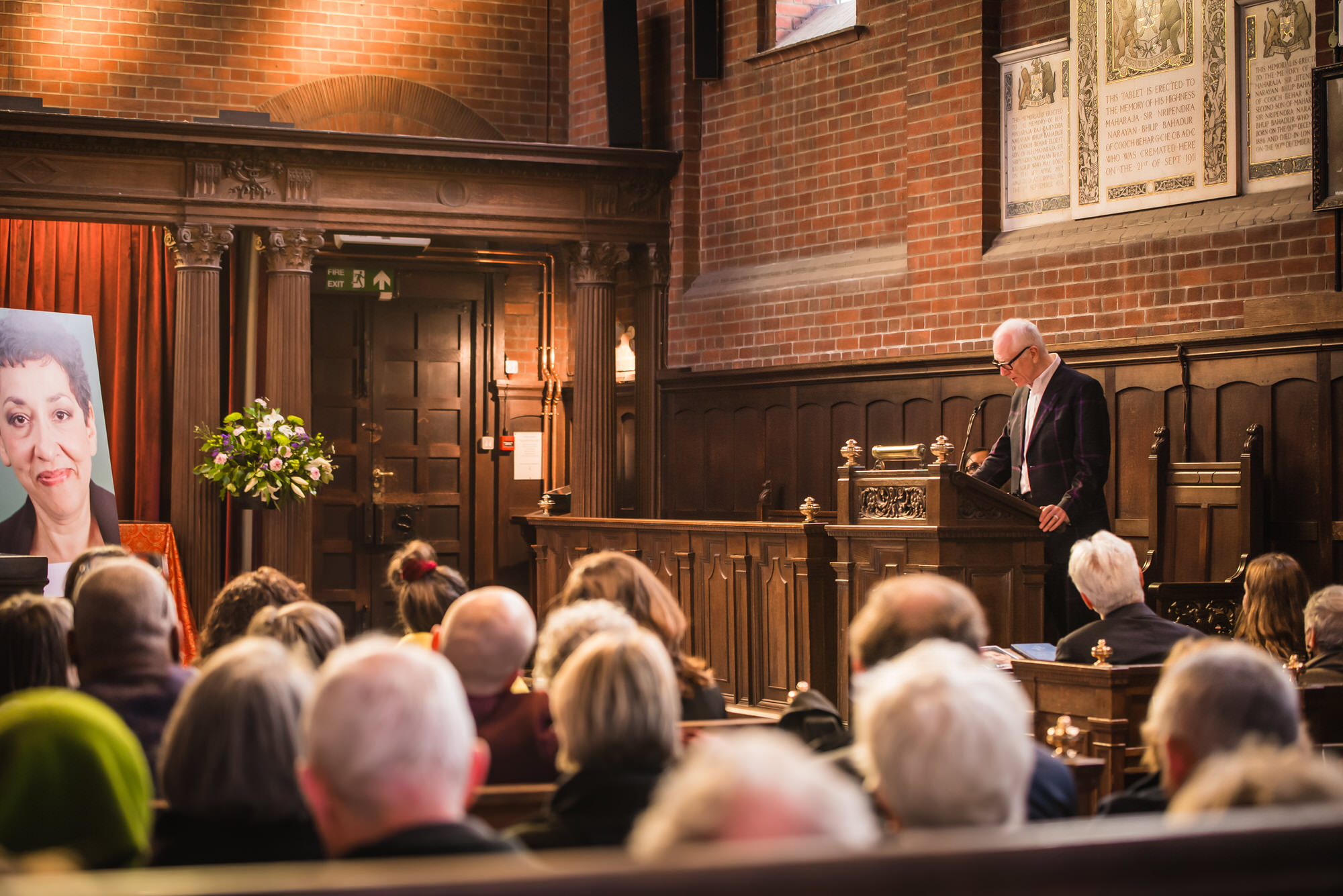
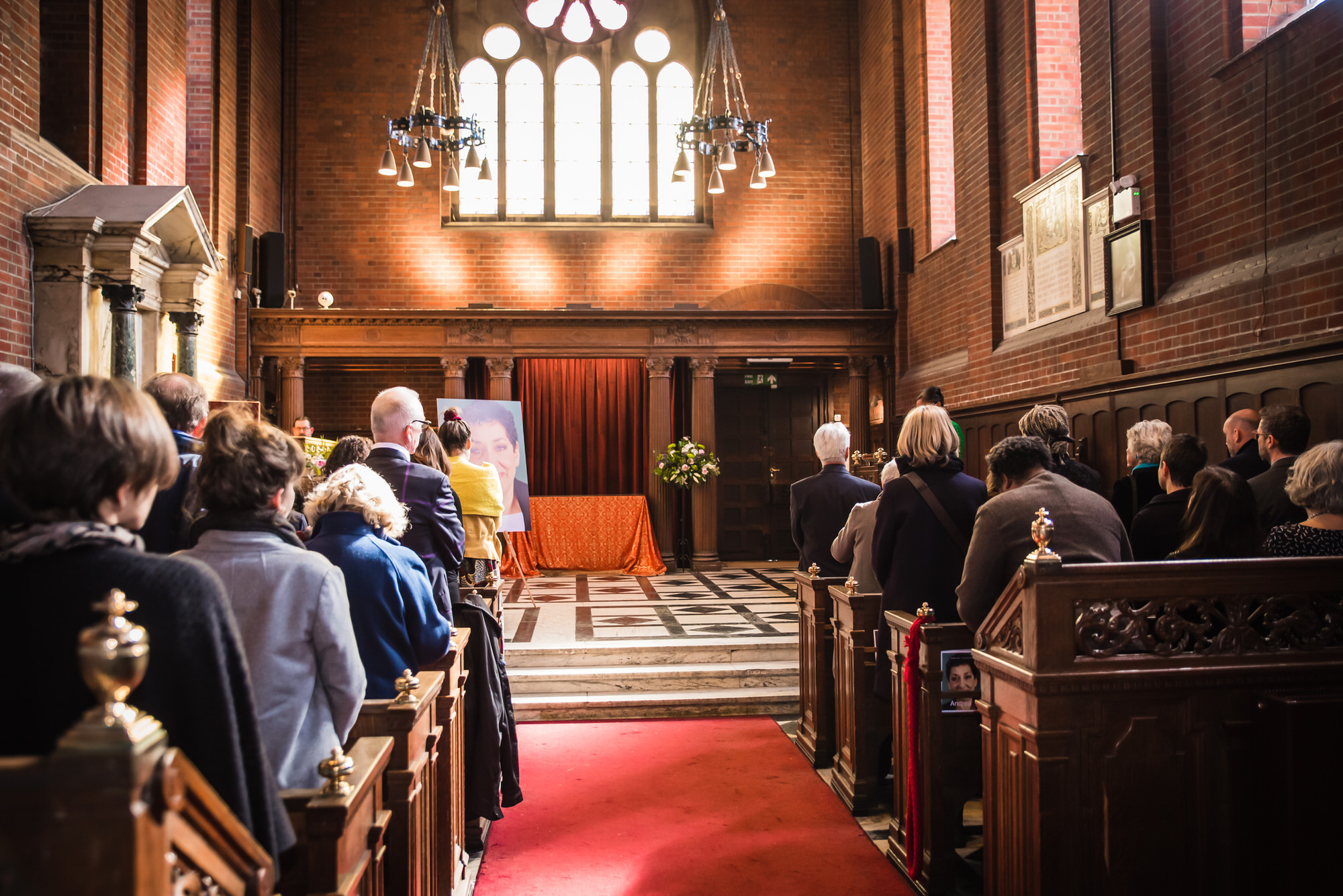
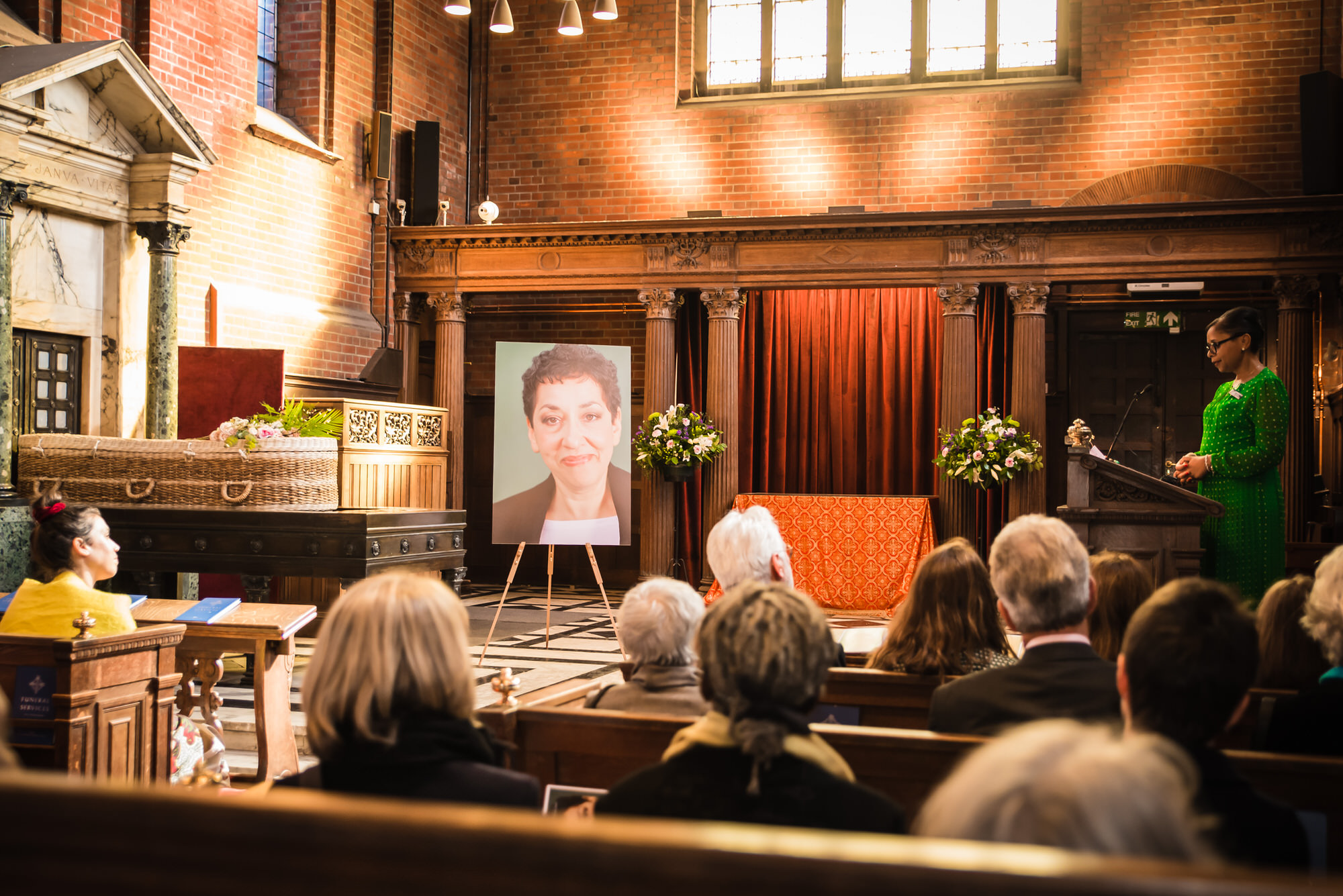
It was an honour to provide funeral photography at Golders Green Crematorium in London for the memorial service of Andrea Levy — one of the most important British novelists of her generation, and a writer whose work changed how Britain understood its own story.
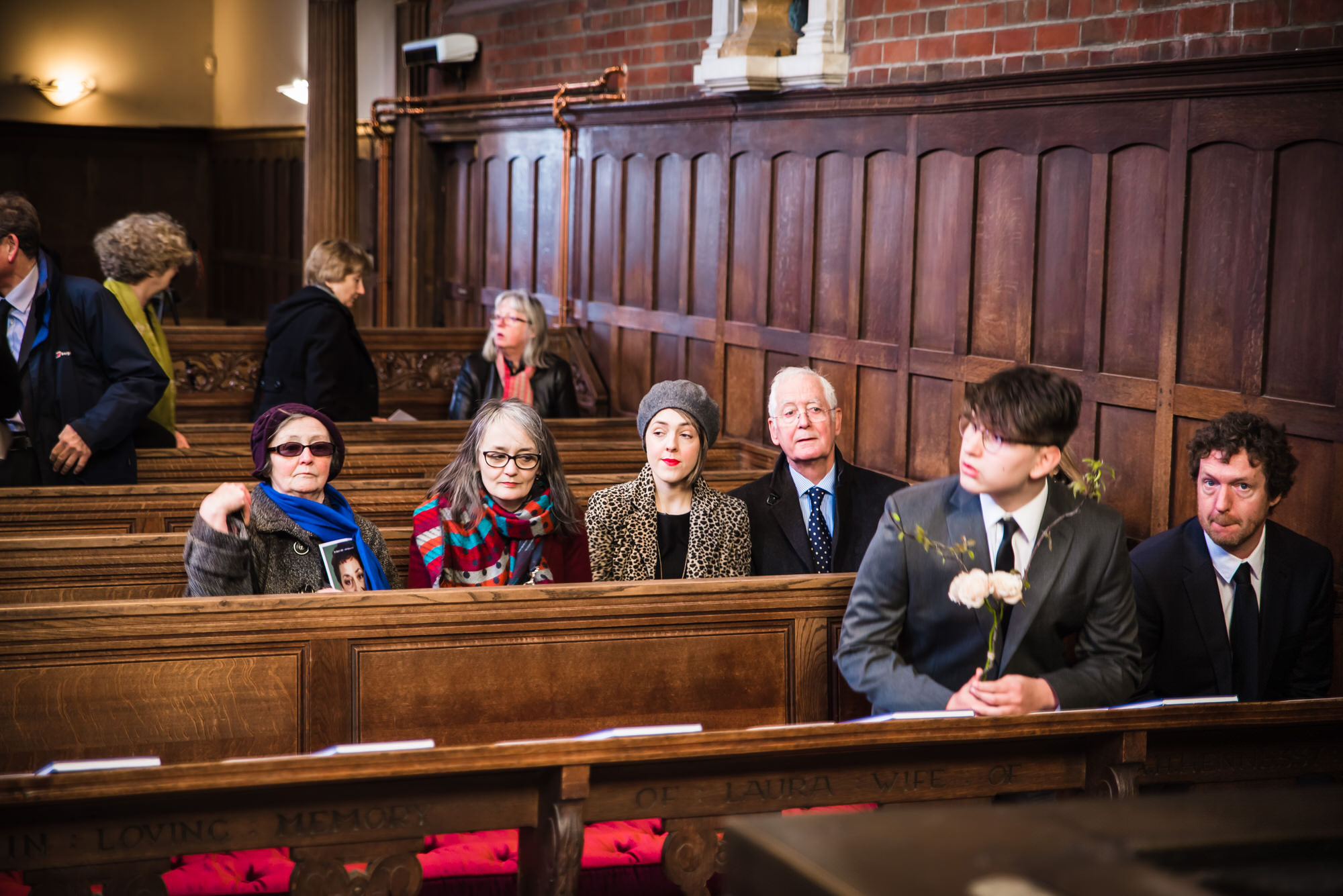
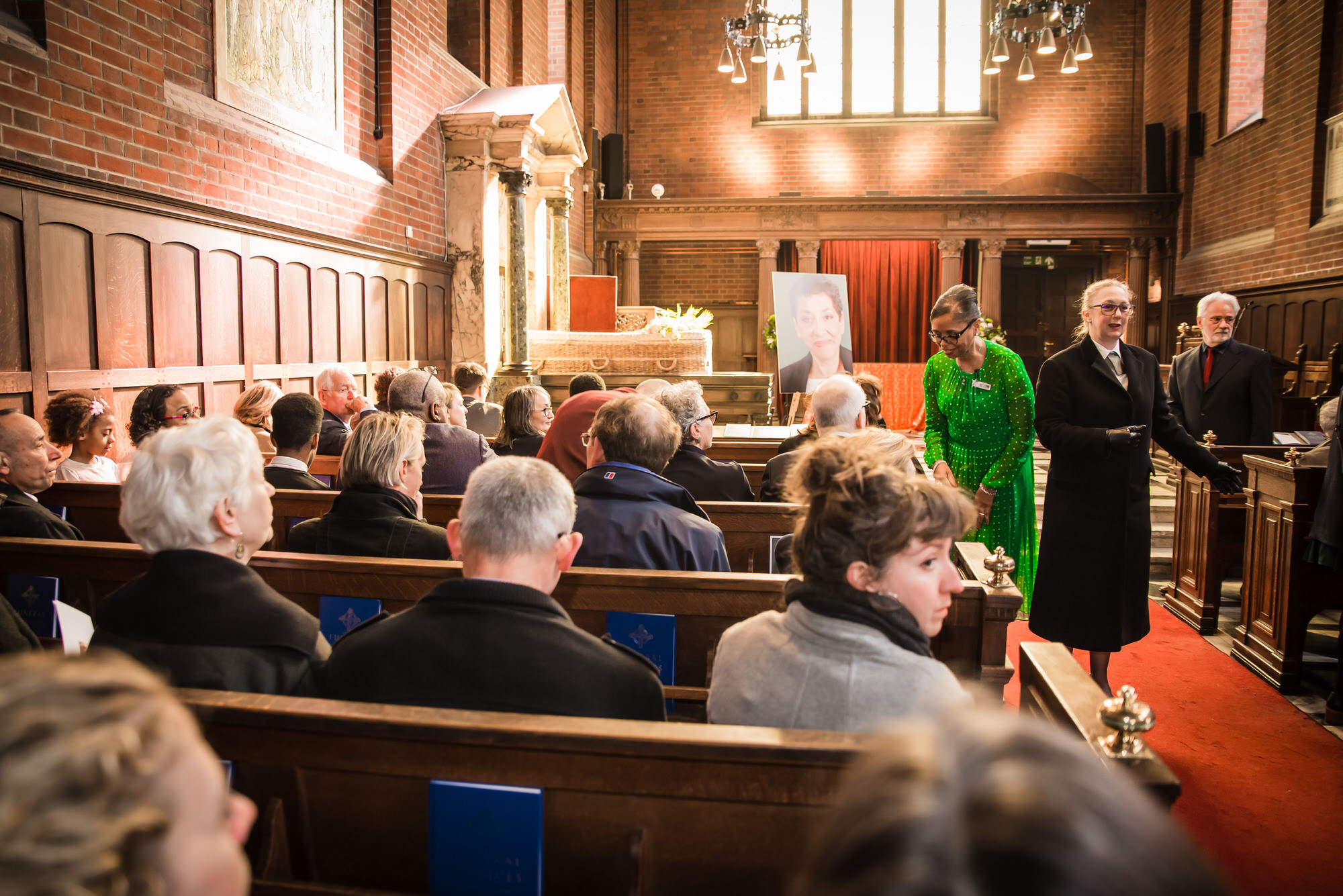
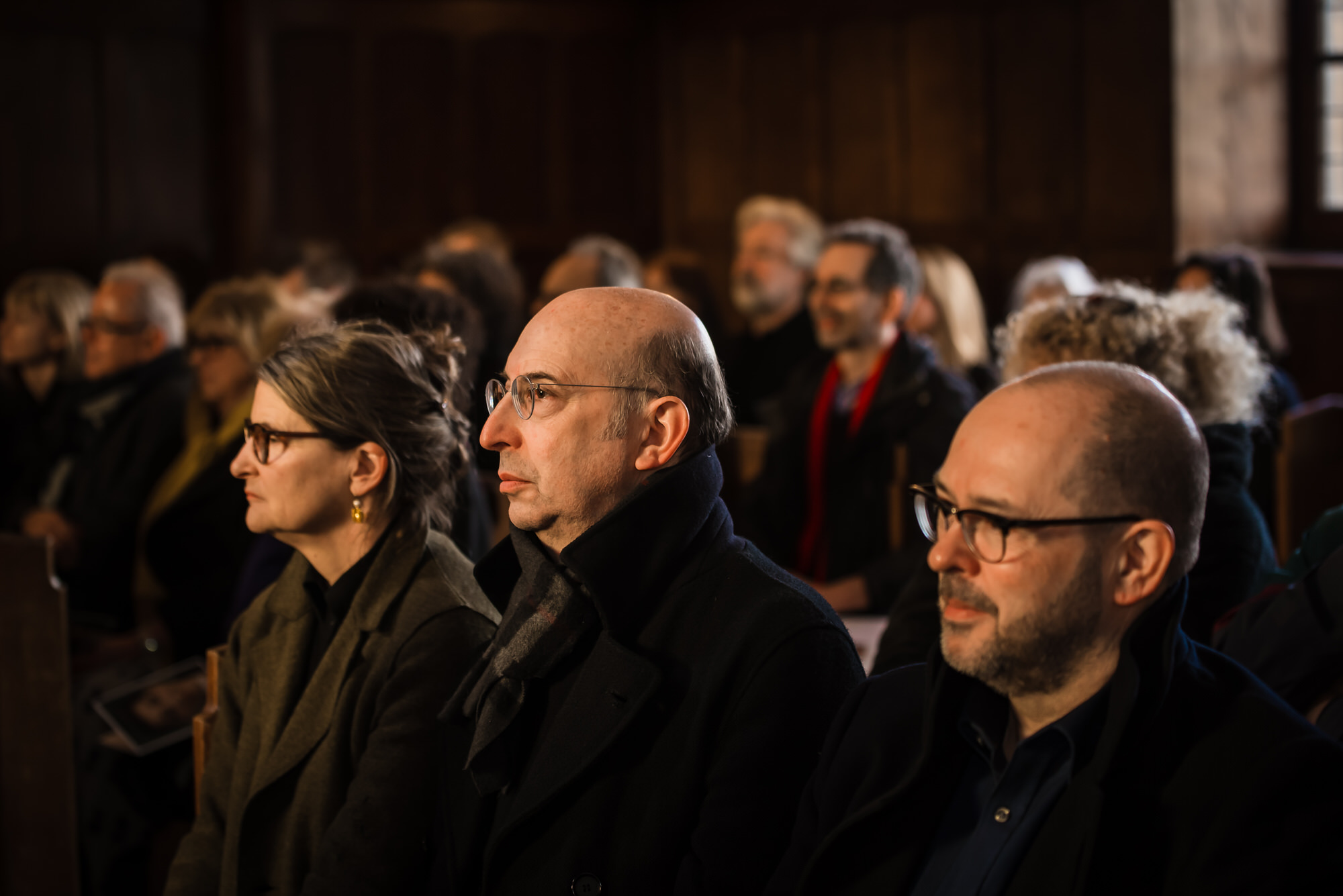
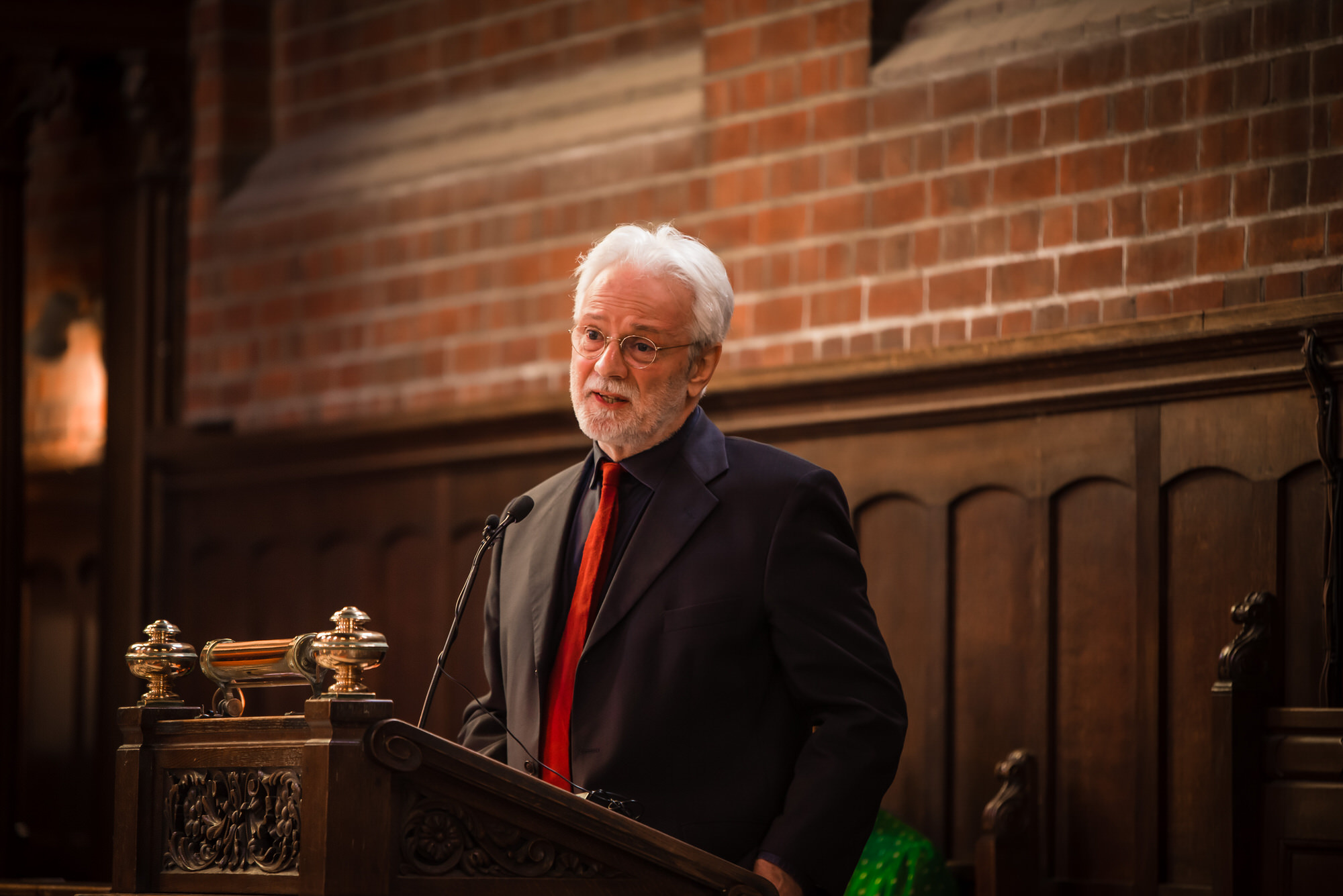
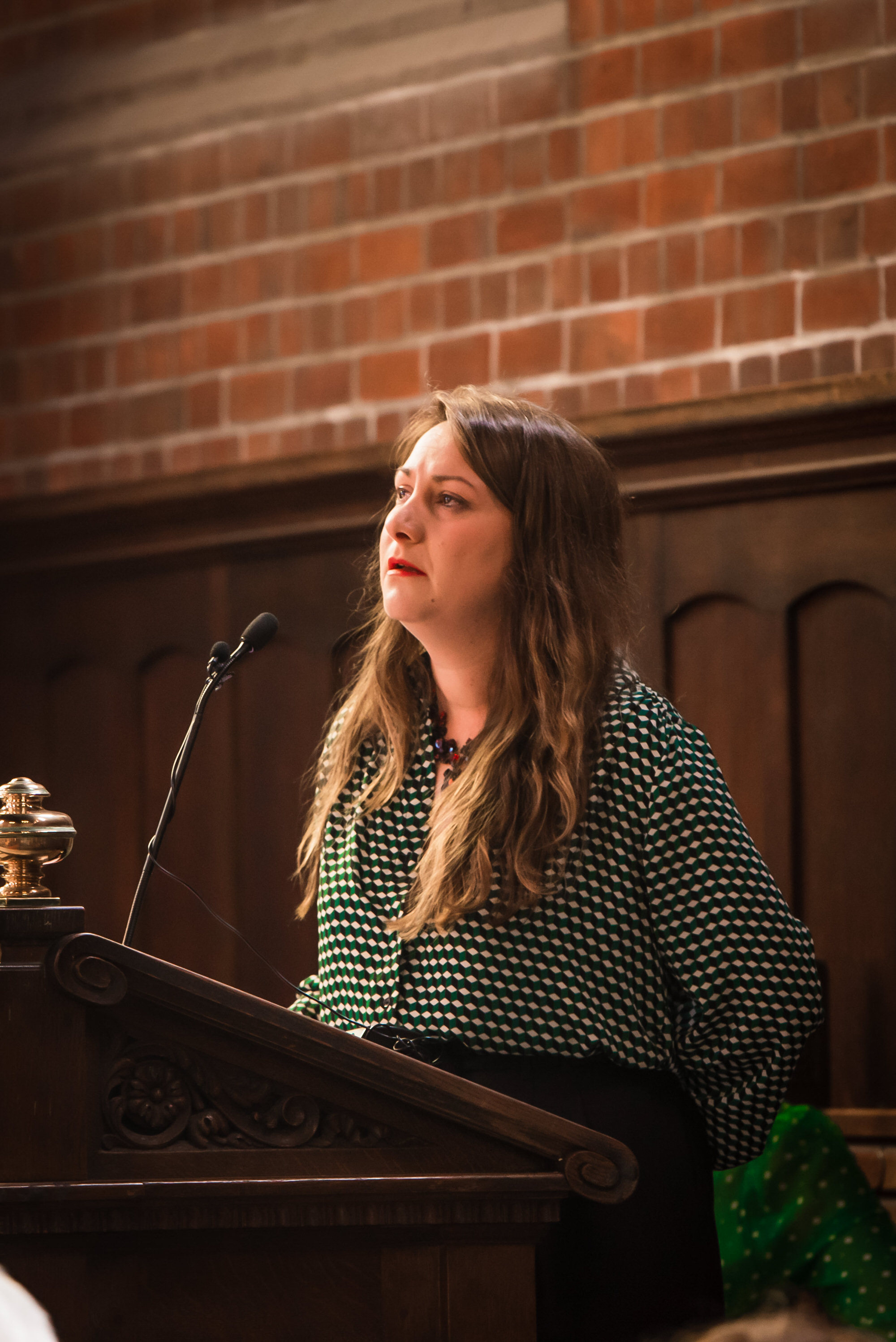
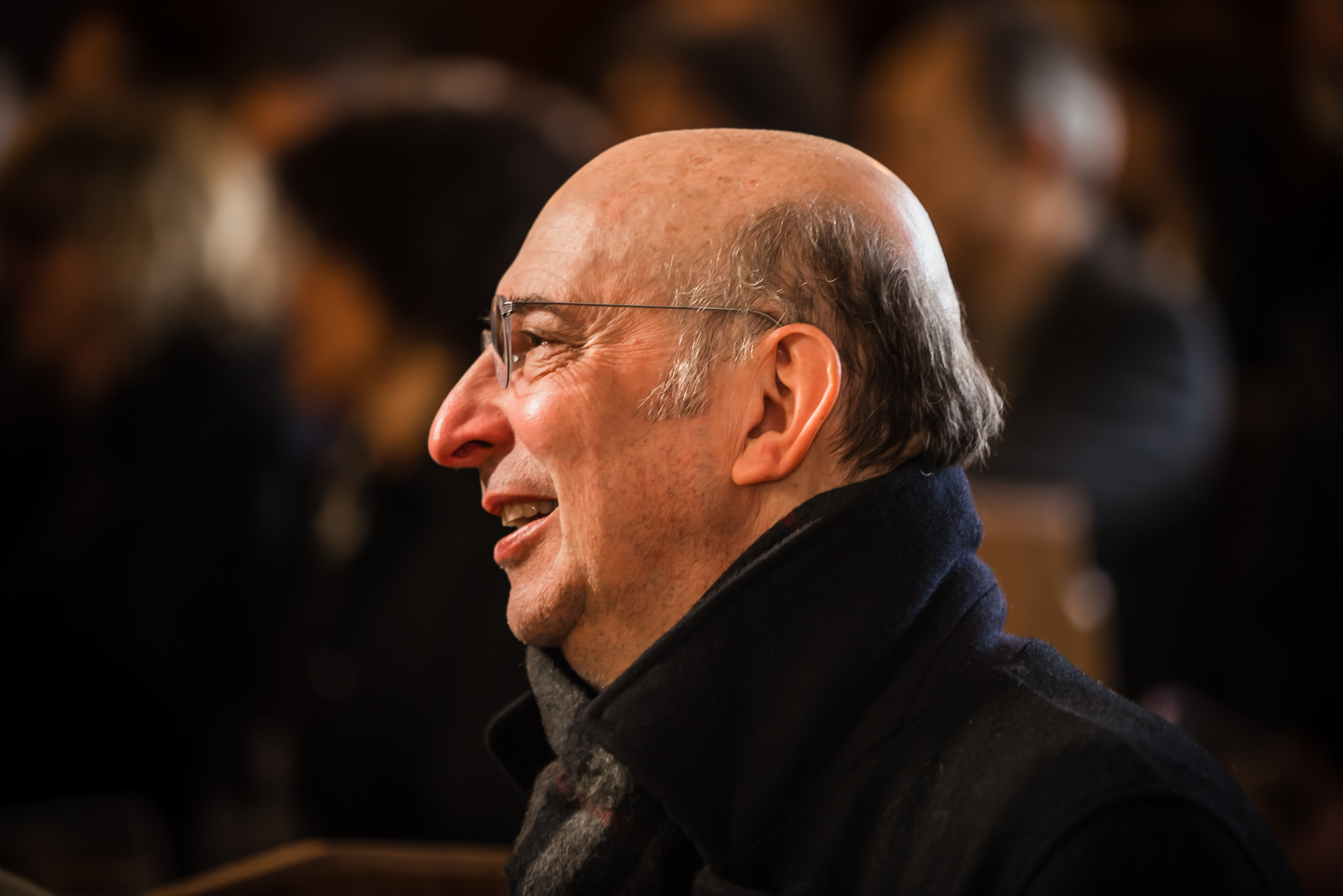
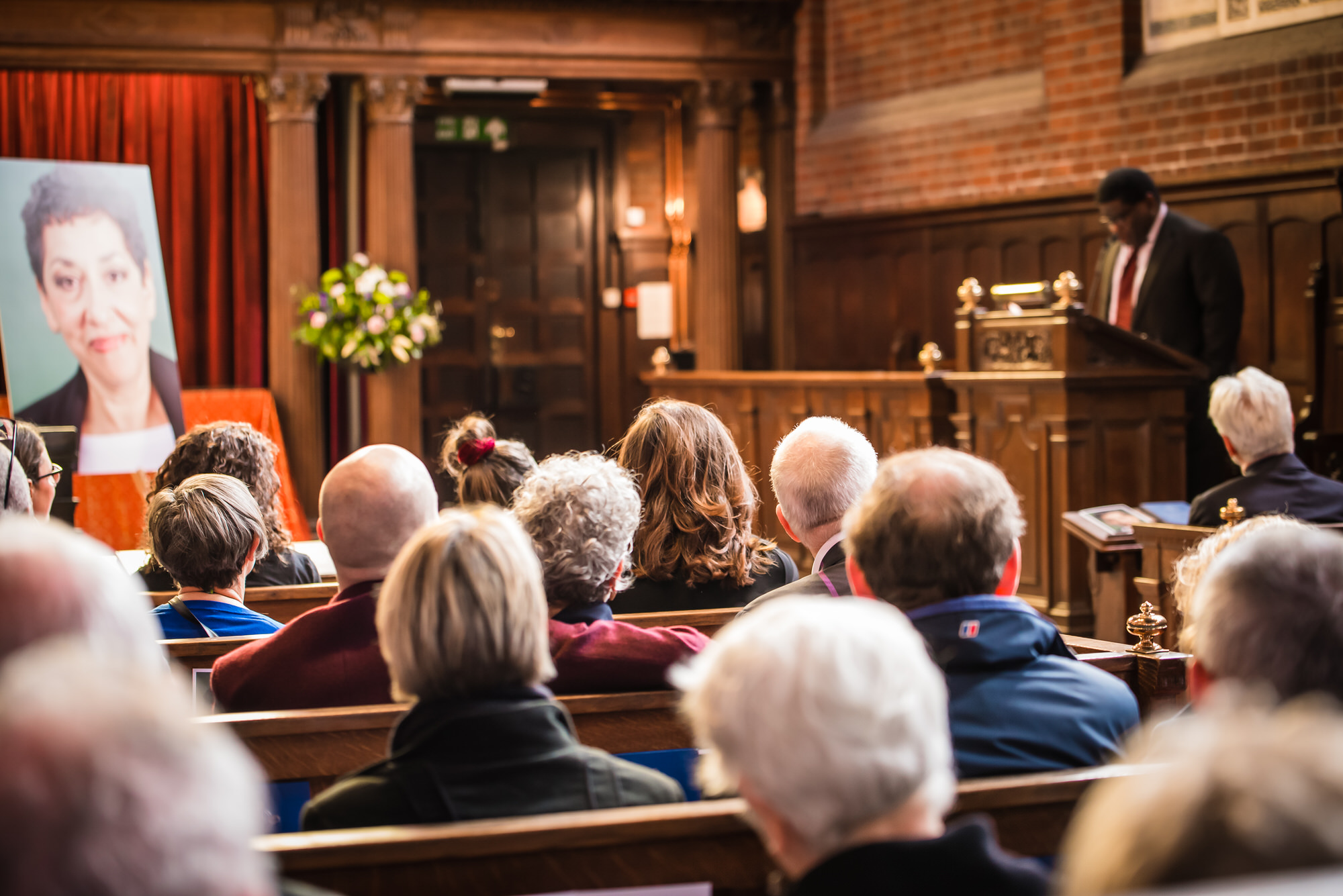
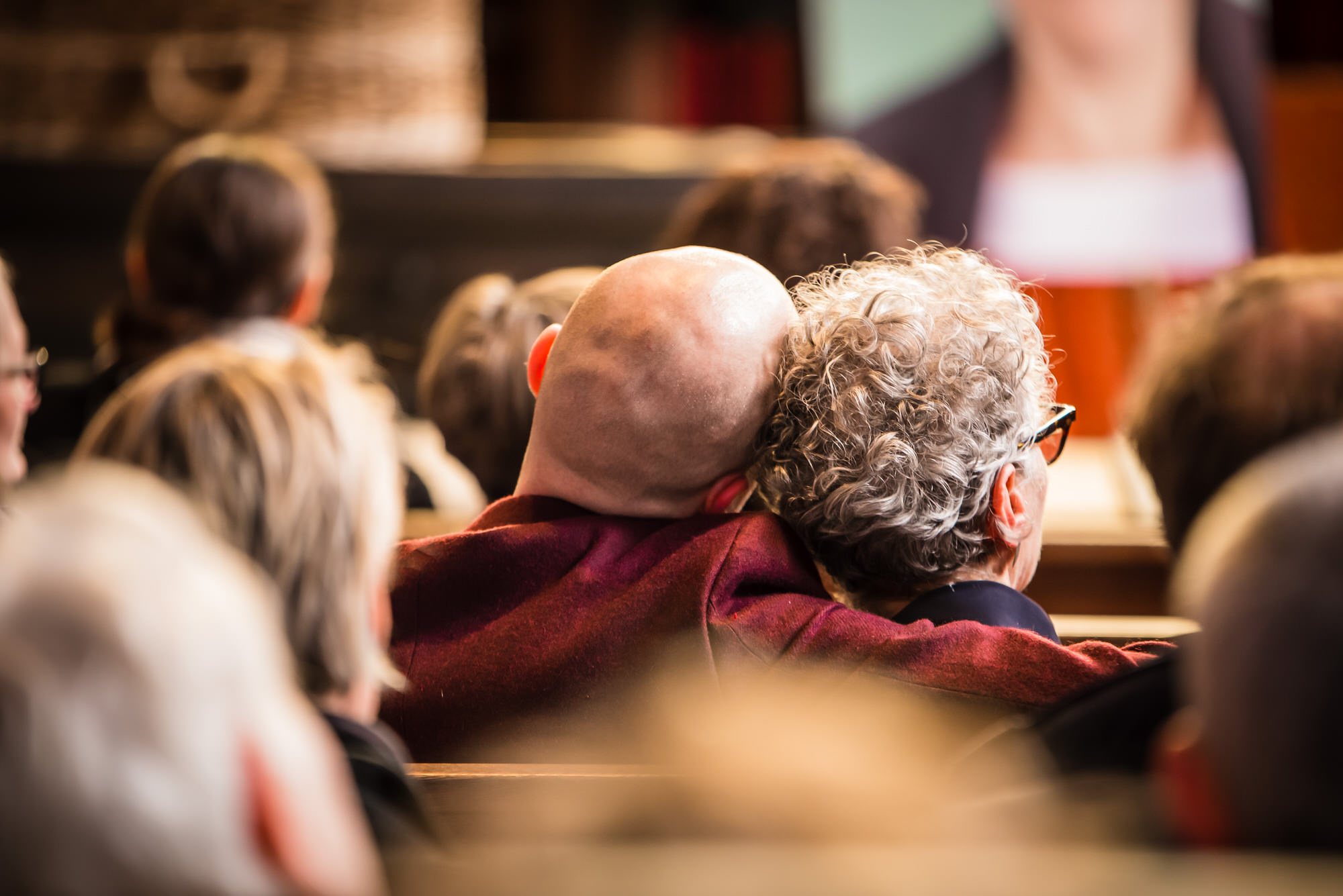
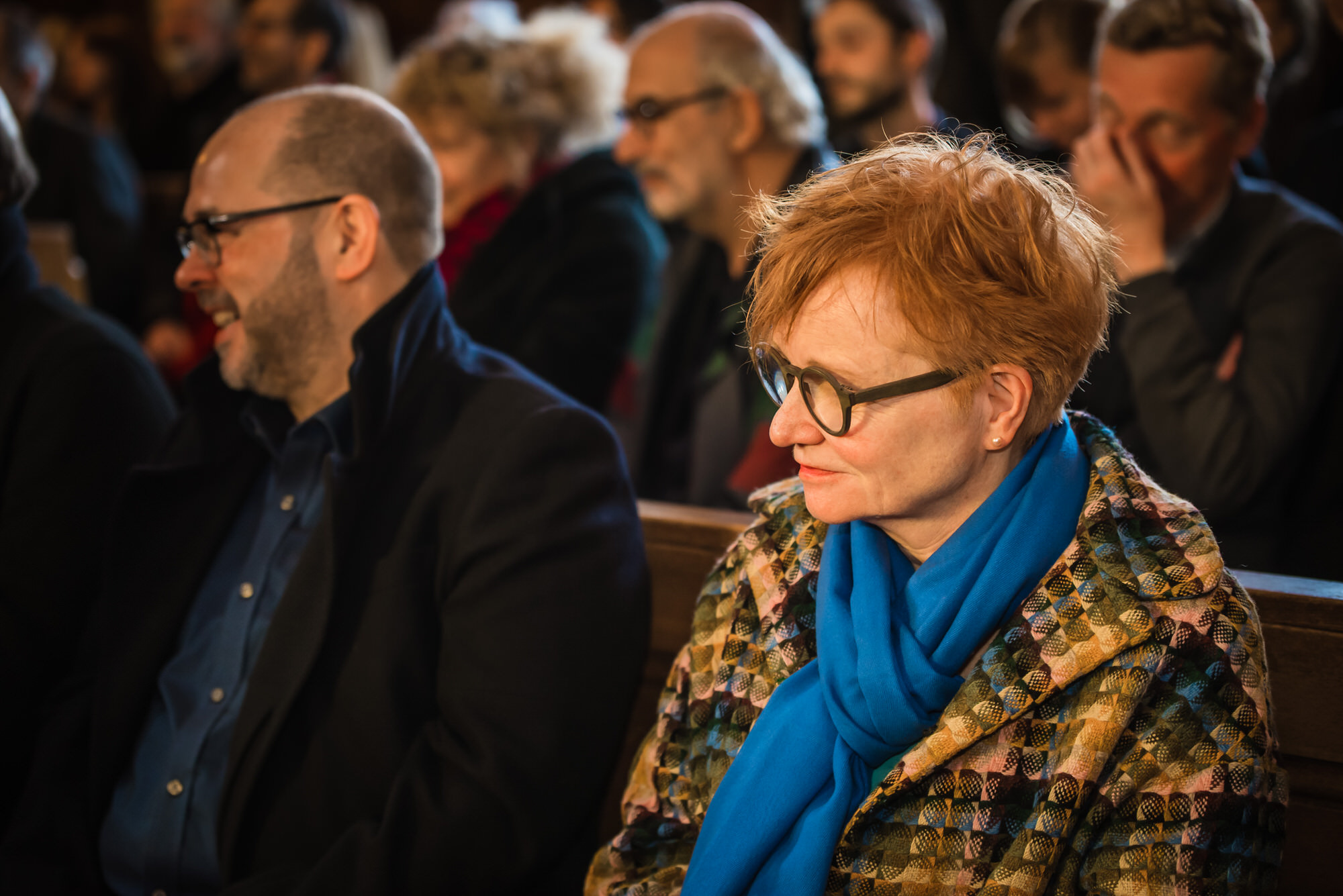
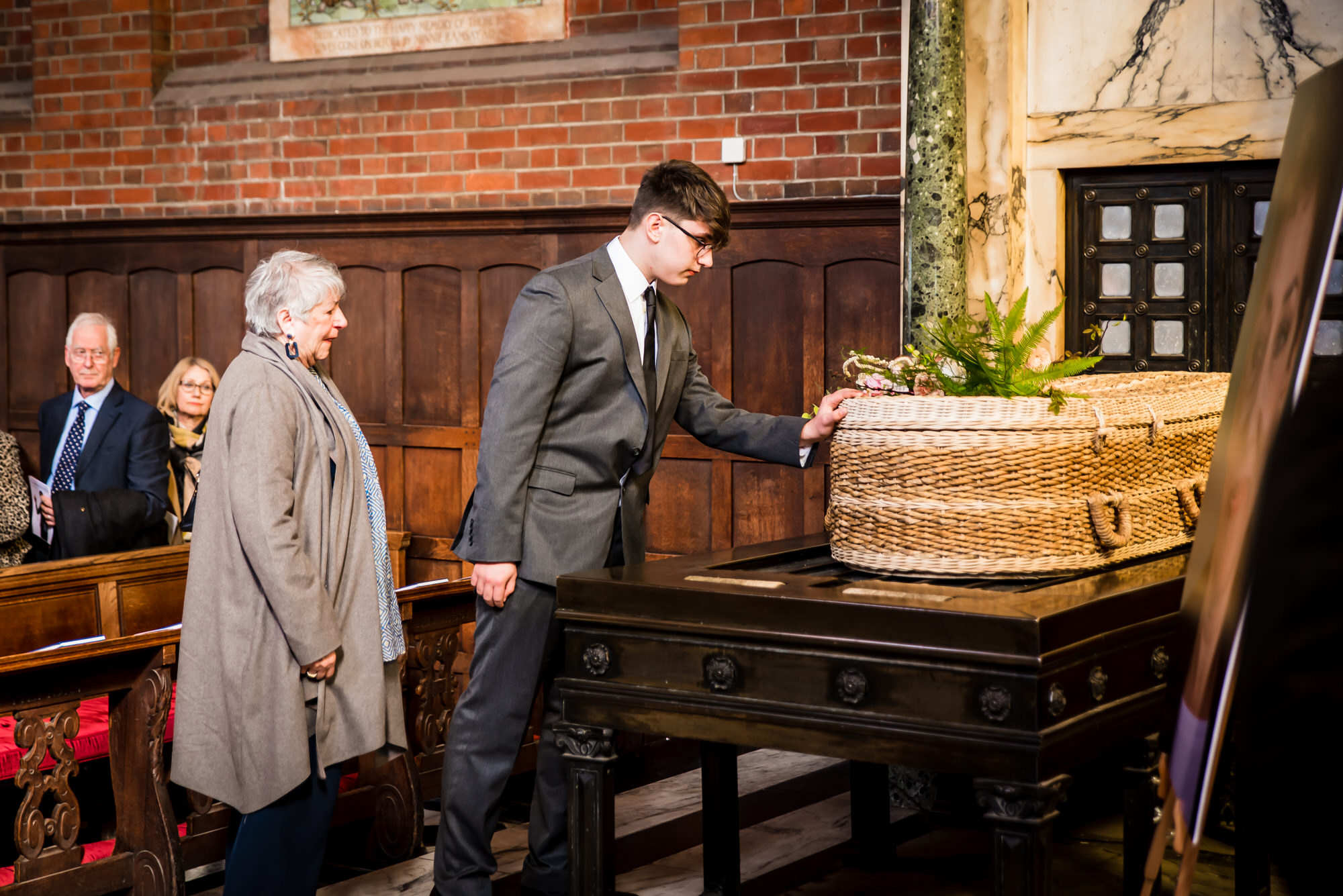
The service was arranged by Leverton & Sons, and attended by family, friends, fellow writers, and admirers who had gathered to say goodbye to someone whose voice had mattered to them deeply. My role was to document the day with the same discretion and care I bring to every service — quietly present, always respectful, capturing what unfolded rather than directing it.
Who Was Andrea Levy?
Andrea Levy was born in London in 1956, the daughter of Jamaican parents. Her father was among the passengers who arrived in Britain on the Empire Windrush in 1948 — the ship whose name now defines an entire generation and a defining chapter in British history. Her mother followed shortly after.
Levy grew up in a working-class household in North London, and did not begin writing seriously until she was in her thirties — after a creative writing course prompted her to explore what she had always known but never quite examined: the story of her family, her heritage, and what it had meant for her parents to build a life in a country that did not always want them.
Her novels did something rare in British literature — they gave the Windrush generation their own voices, told their stories from the inside, and asked white Britain to look honestly at what the experience of immigration had actually meant on both sides. She was widely regarded as the first Black British author to achieve both critical acclaim and mainstream commercial success.
Her most celebrated work, Small Island (2004), tells the story of Hortense and Gilbert — Jamaican immigrants arriving in postwar London — alongside Queenie and Bernard, the English couple in whose house they find lodgings. The novel won the Orange Prize for Fiction, the Whitbread Book of the Year, and the Commonwealth Writers' Prize. It was adapted for the BBC and later for the National Theatre. Her final novel, The Long Song (2010), set in Jamaica during the last years of slavery, was shortlisted for the Man Booker Prize and won the Walter Scott Prize for Historical Fiction.
Andrea Levy died in February 2019, aged 62, after a long illness. Her publisher said her legacy was unique and her voice would be heard for generations. That felt true in the room at Golders Green.
Golders Green Crematorium — A Place of Significance
Golders Green Crematorium is one of London's most historically significant venues for a memorial service. Opened in 1902, it is the oldest operating crematorium in London and has been the setting for the farewell services of some of the most influential cultural figures of the twentieth century — writers, musicians, artists, scientists. The gardens are beautiful, the chapels quiet and light, and the whole place carries a sense of the weight of who has passed through it.
For a writer of Andrea Levy's stature and significance — a Londoner, the daughter of Windrush passengers, whose work is now studied on academic curricula across the world — there could hardly have been a more fitting place.
The Memorial Service
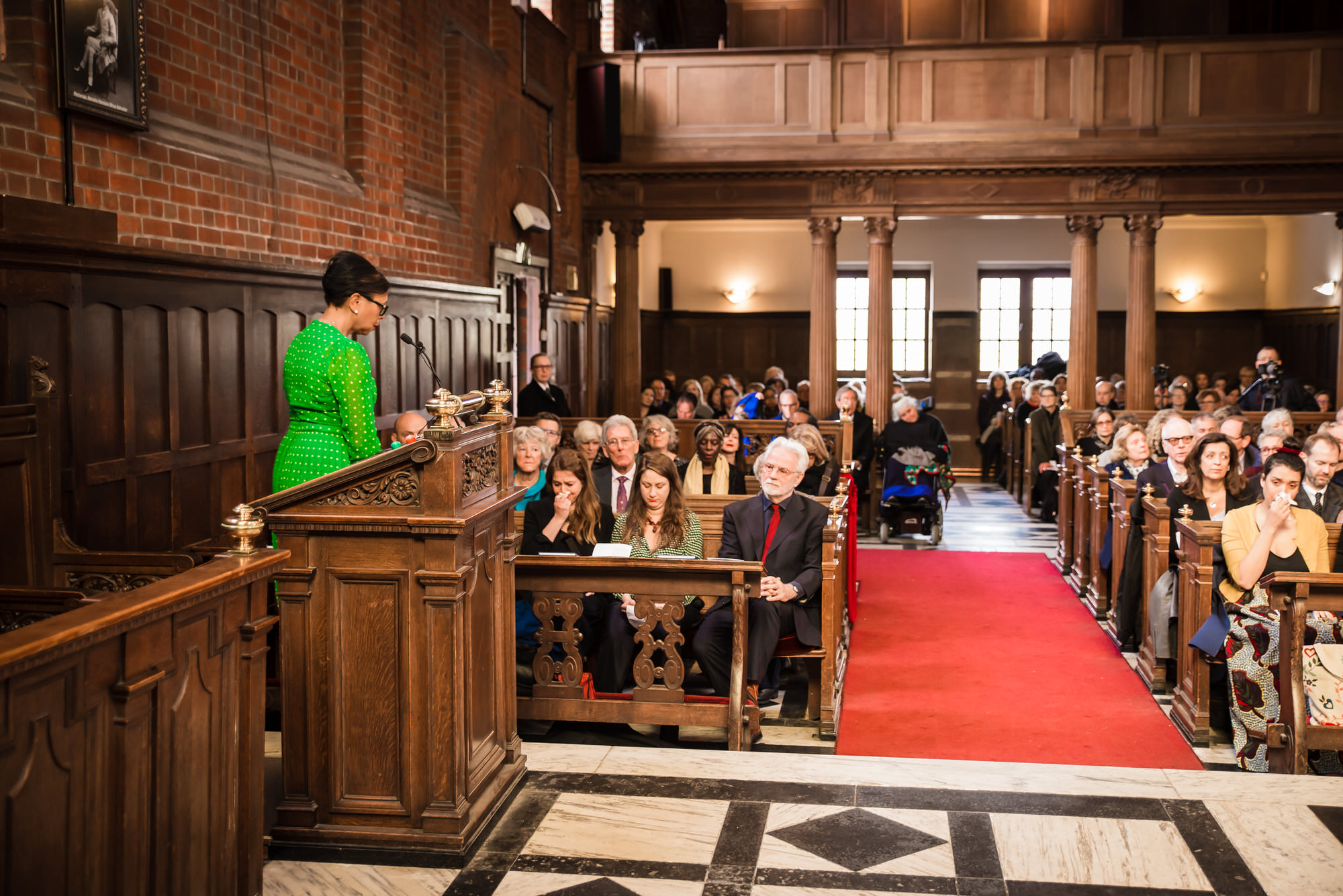
The chapel was filled with people who had loved her and been shaped by her. Family and close friends sat alongside writers, publishers, academics and readers whose lives her work had touched in different ways. The tributes reflected the range of who she had been — not just the prize-winning novelist, but the woman, the friend, the daughter of the Windrush, the person who had not picked up a book for pleasure until her twenties and then found she had everything to say.
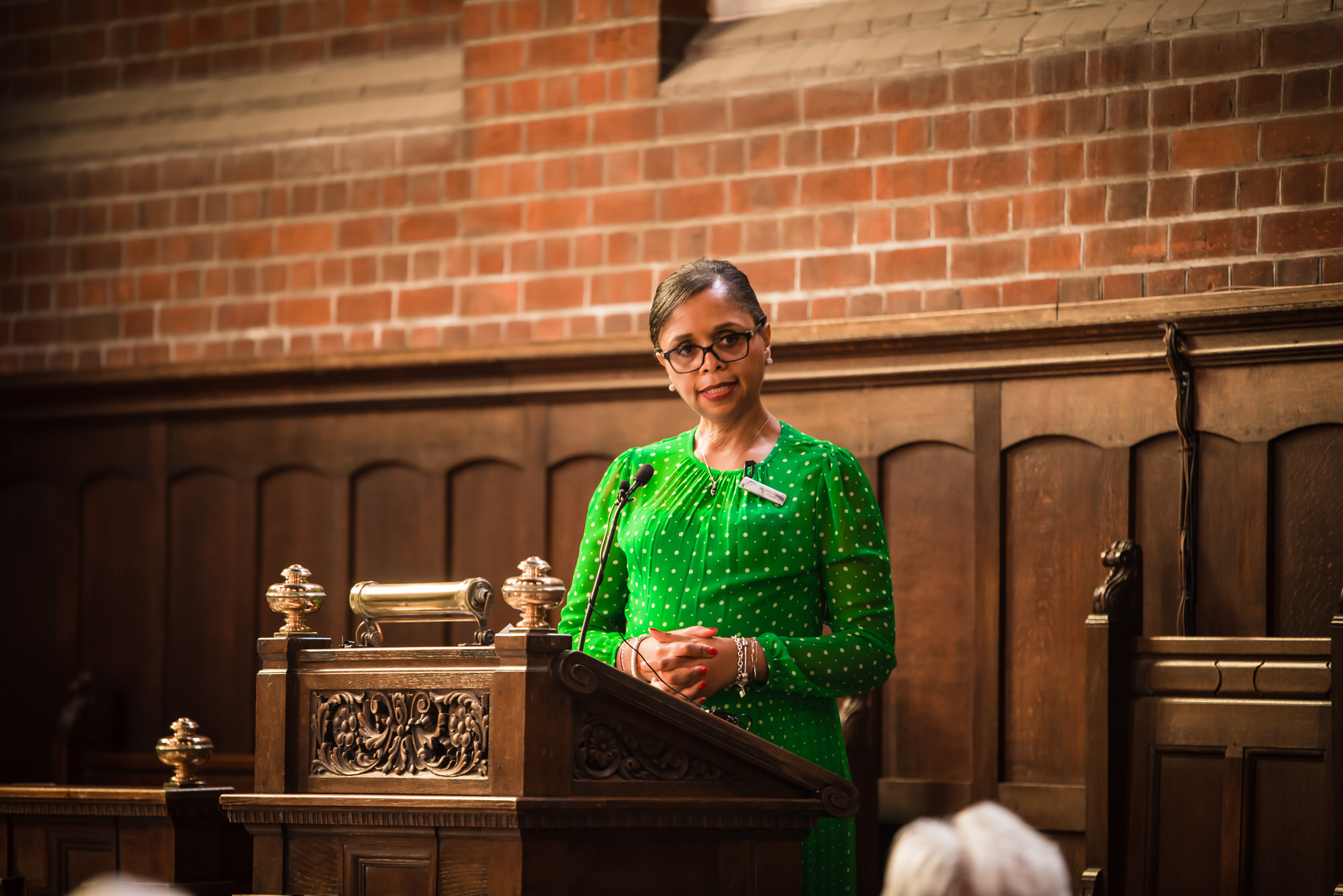
There were readings from her work — passages from Small Island and The Long Song read aloud in the space where she was being remembered. There was music that reflected her Caribbean heritage and her London life. Personal tributes spoke of her warmth, her directness, her wit, and the way she carried the weight of representing something larger than herself with both seriousness and grace.
Throughout the service I worked from positions that kept me unobtrusive — using longer lenses to stay at a respectful distance from the most private moments, moving quietly during the natural pauses in the programme, always following the service rather than interrupting it. At a gathering like this — public enough to be significant, private enough to be genuinely personal — the balance between documentation and discretion is one that has to be felt rather than calculated.
Photographing at a Literary Memorial Service
Memorial services for public figures present their own particular character. The room contains people who knew the person intimately alongside people who knew them only through their work — and both kinds of grief are real. A novelist's readers can feel a profound sense of loss for someone they never met, because the books created a relationship that felt genuine. That was especially true of Andrea Levy's work, which was so deeply rooted in personal experience and told with such specificity and warmth.
What I was photographing was not just a funeral. It was a community of people recognising what they had lost — not only a writer, but a voice that had told them something true about themselves and the country they lived in.
The photographs from this day are among the most significant in my portfolio — not because of anything I did, but because of who Andrea Levy was and what her memorial meant to the people in that room.
Funeral Photography Across London
I provide funeral photography across London and throughout the UK, working at crematoriums, churches, chapels and memorial venues of all kinds — from small, intimate family services to large public memorial gatherings. Golders Green Crematorium is one of several London venues I have worked in regularly.
If you are arranging a memorial or funeral service in London and would like to discuss photography, I'm happy to talk through what's involved.
Call or text me on 07772 509101 — available seven days a week, 9am to 10pm — or get in touch online.
Related pages and guides:

Jamaican Funeral Videography — St Mary's Church Hitchin & North Hertfordshire Memorial Park
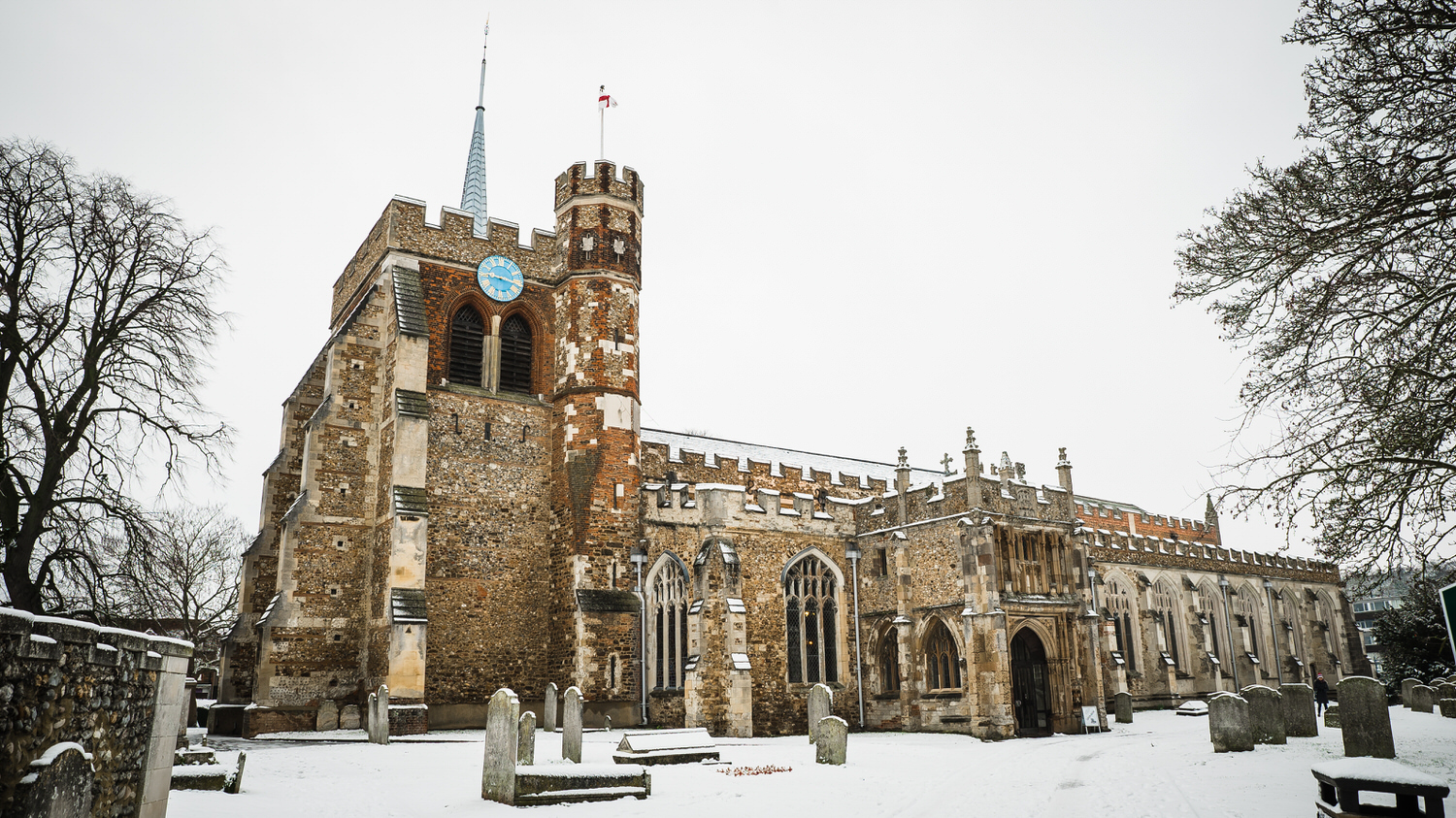
Filming a Jamaican funeral in Hertfordshire is always an honour, especially when invited into the heart of a family's farewell. On this day, I was entrusted with capturing Donovan's memorial — an unforgettable and heartfelt occasion filled with tributes, music, laughter, and tears.
The Family Home and the Hearse Arriving in Hitchin
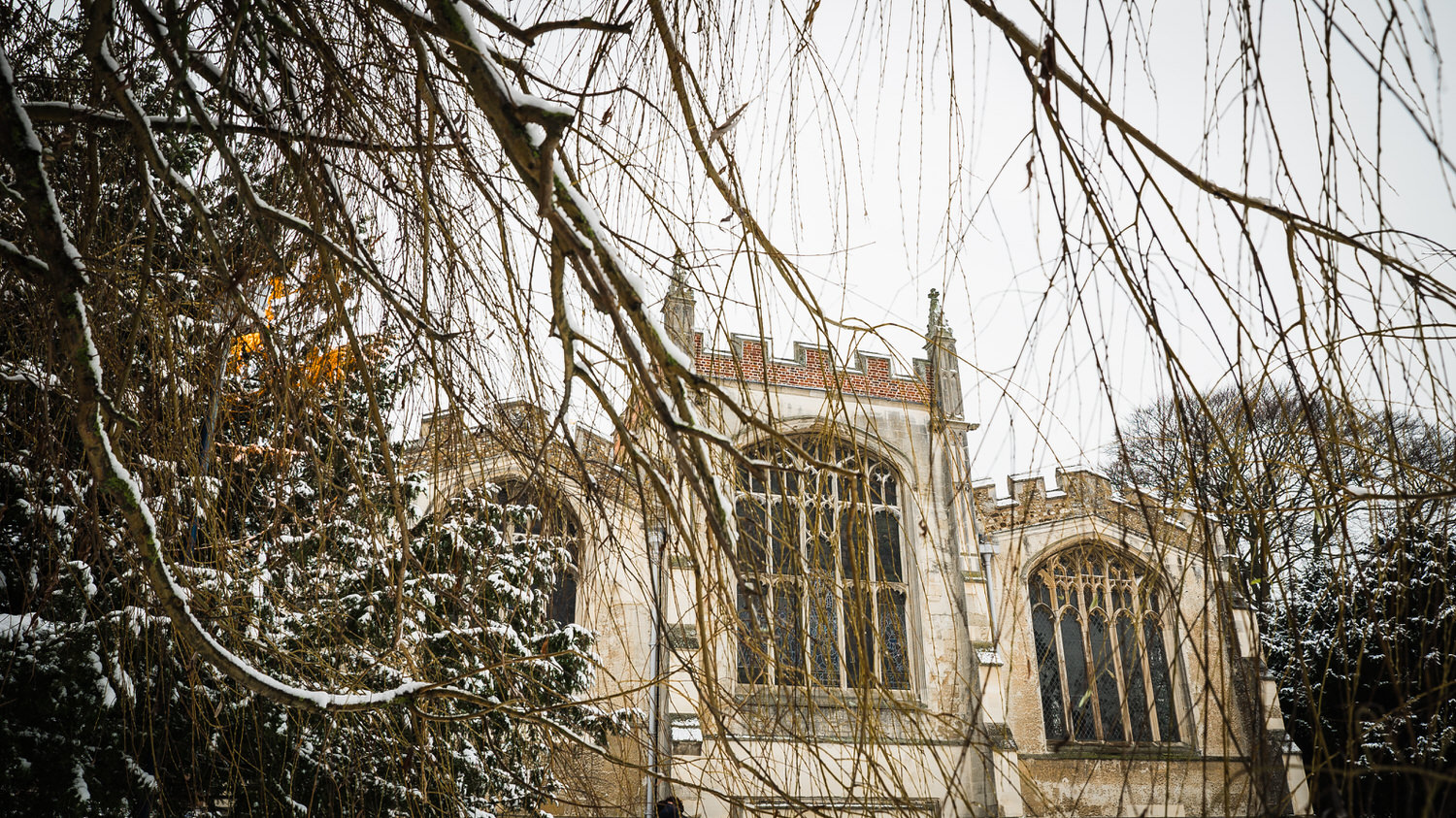
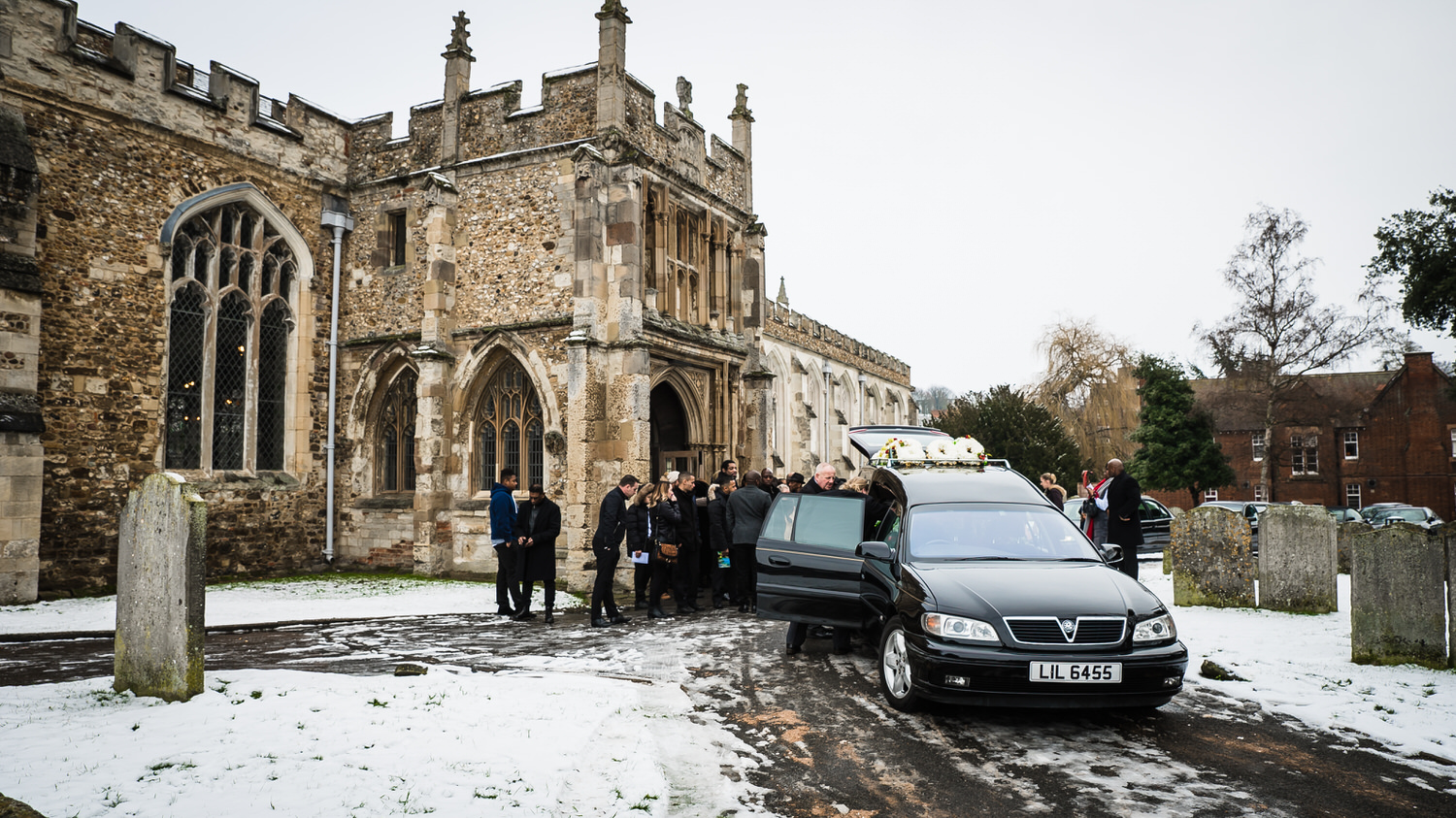
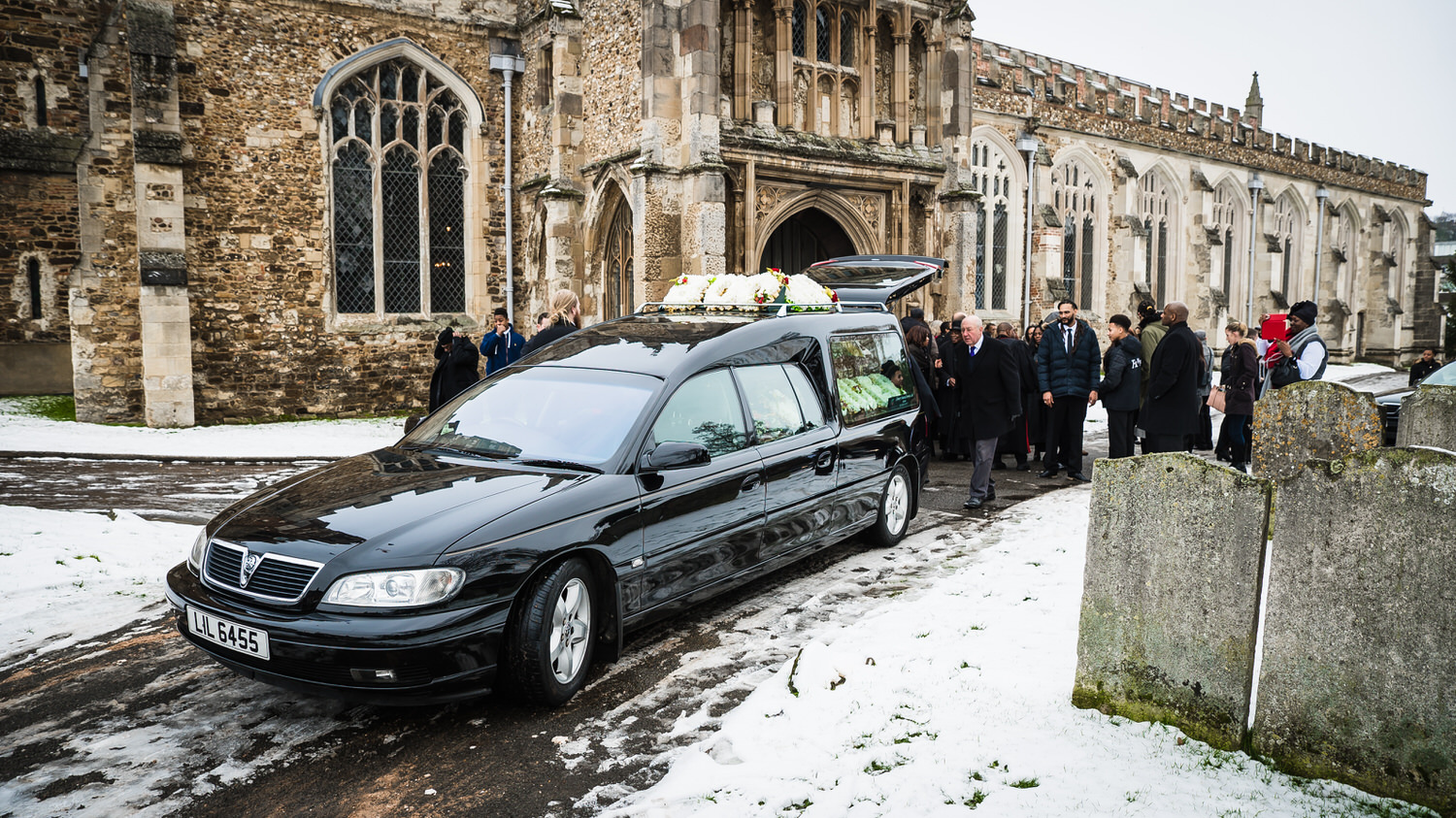
The day began at the family home in Hitchin, where I filmed the arrival of the hearse and the gathering of close family. These early morning moments — quiet, private, full of the weight of what is about to happen — are ones families often value most when they watch the film back. The day hasn't yet taken on its full shape; people are still arriving, still holding each other. There is something irreplaceable about having that recorded.From there the procession moved to St Mary's Church, Hitchin — a beautiful historic church in the heart of the town, and the right setting for a service of this warmth and scale.
The Service at St Mary's Church, Hitchin
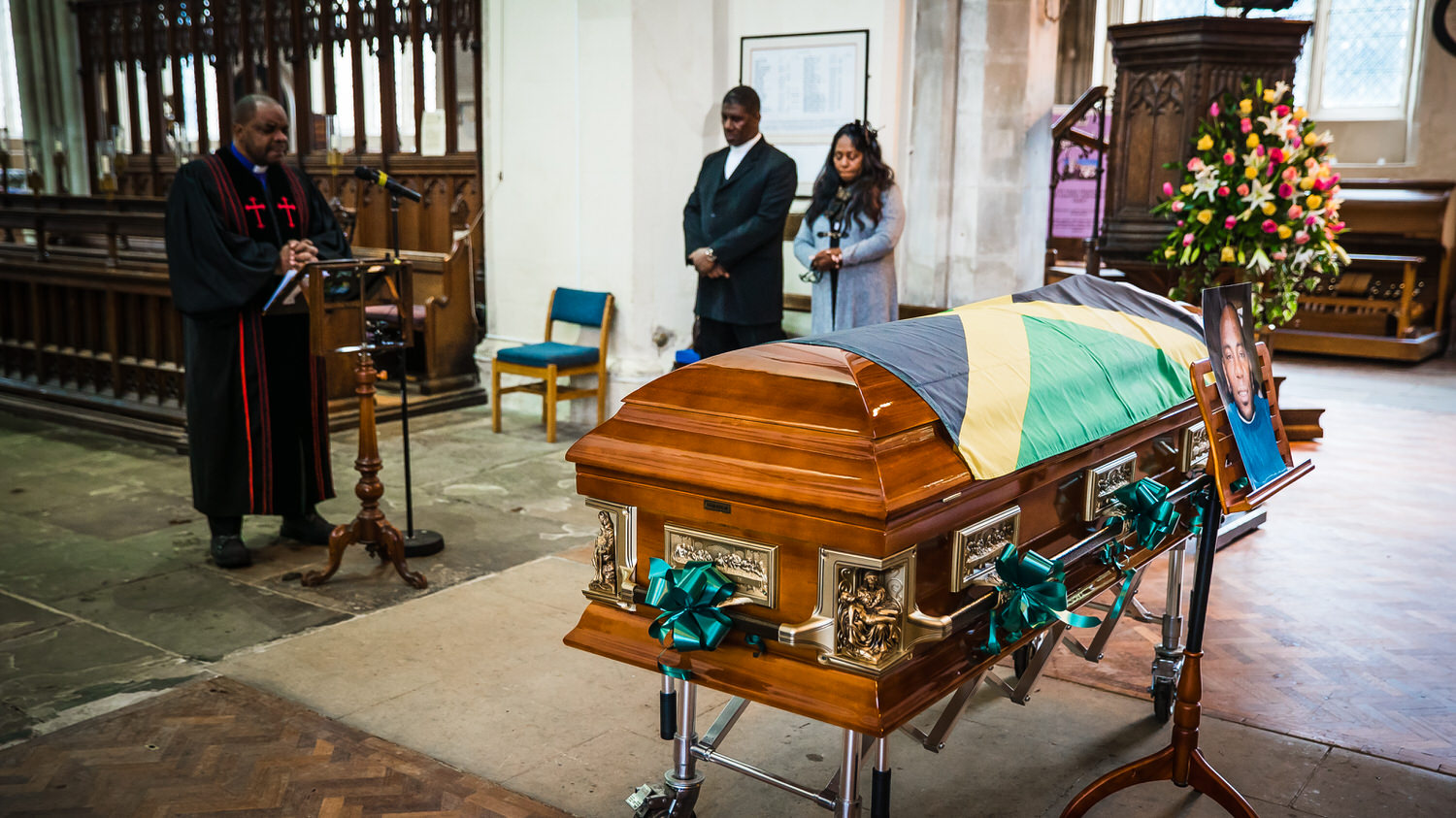
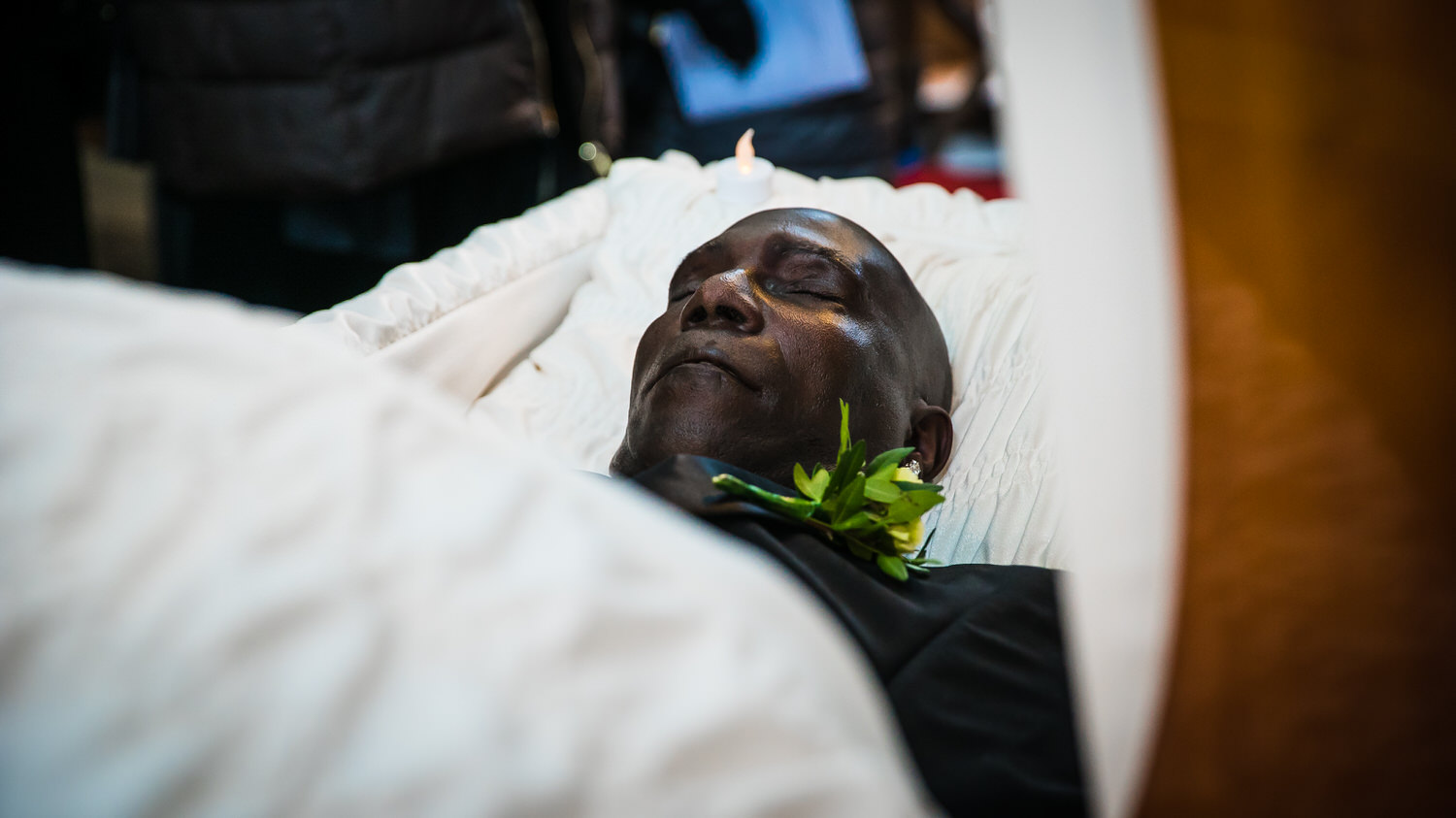
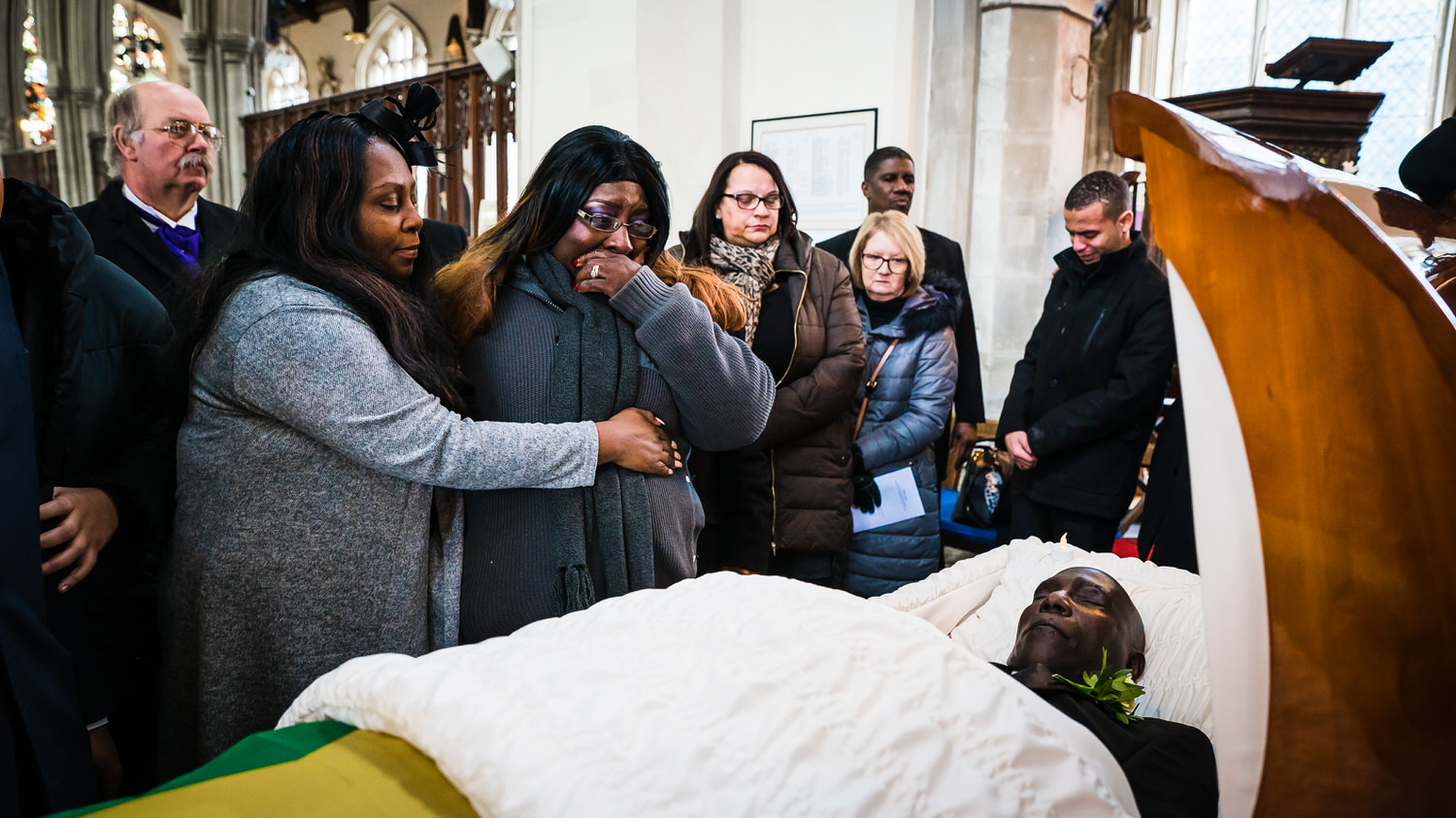
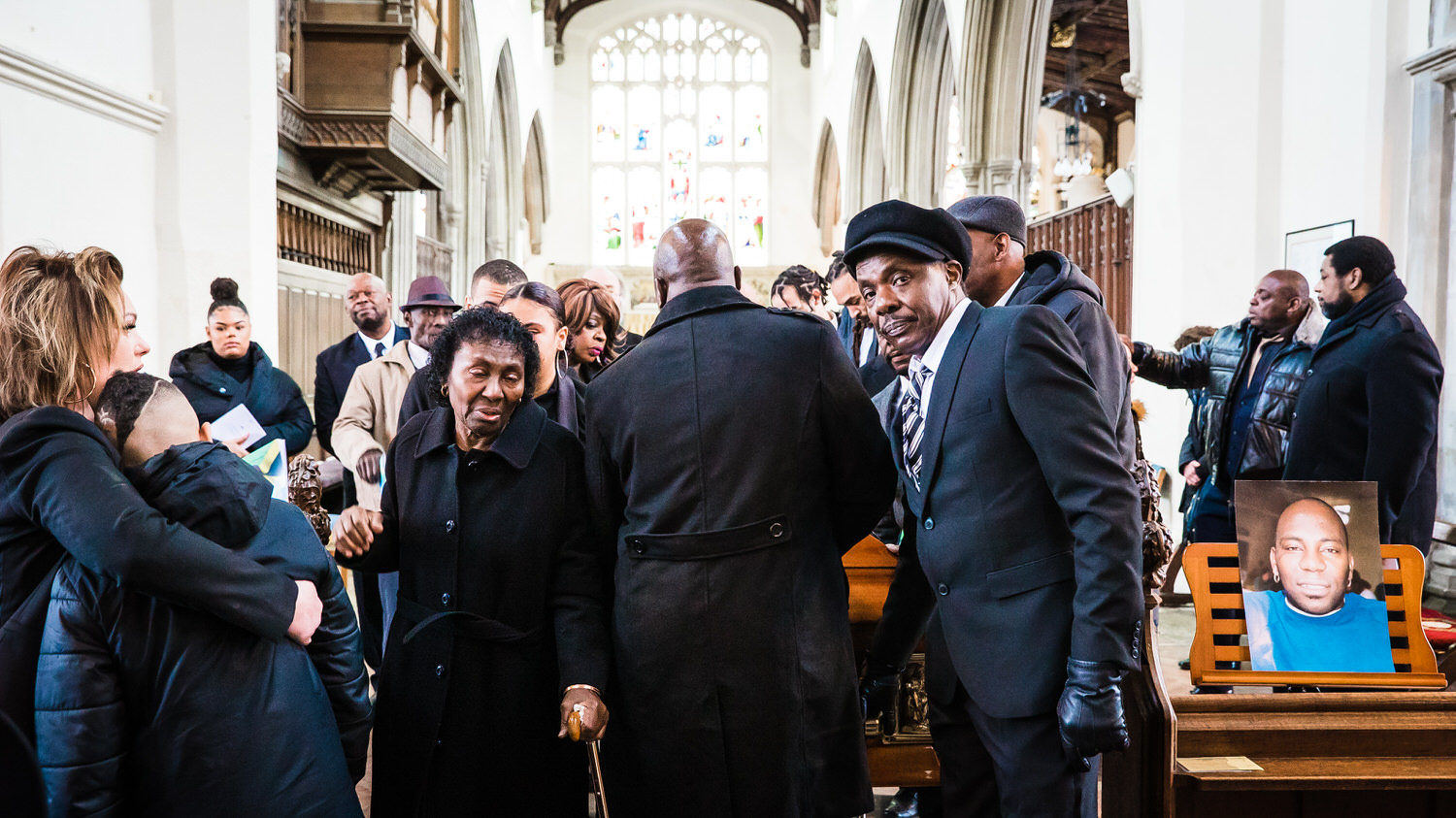
The church service was filled with warmth, energy and soul. Friends and family delivered readings, poetry, and shared stories that celebrated Donovan's life in full colour and depth. This is what Jamaican funerals do particularly well — the tributes are genuine and personal, the music carries real feeling, and the congregation responds. There is grief here, but there is also celebration, laughter, and an unmistakable sense of a community coming together to honour someone they loved.
I filmed throughout from positions that kept the camera unobtrusive — using longer lenses to capture expressions and moments from a respectful distance, moving only when the flow of the service allowed it.
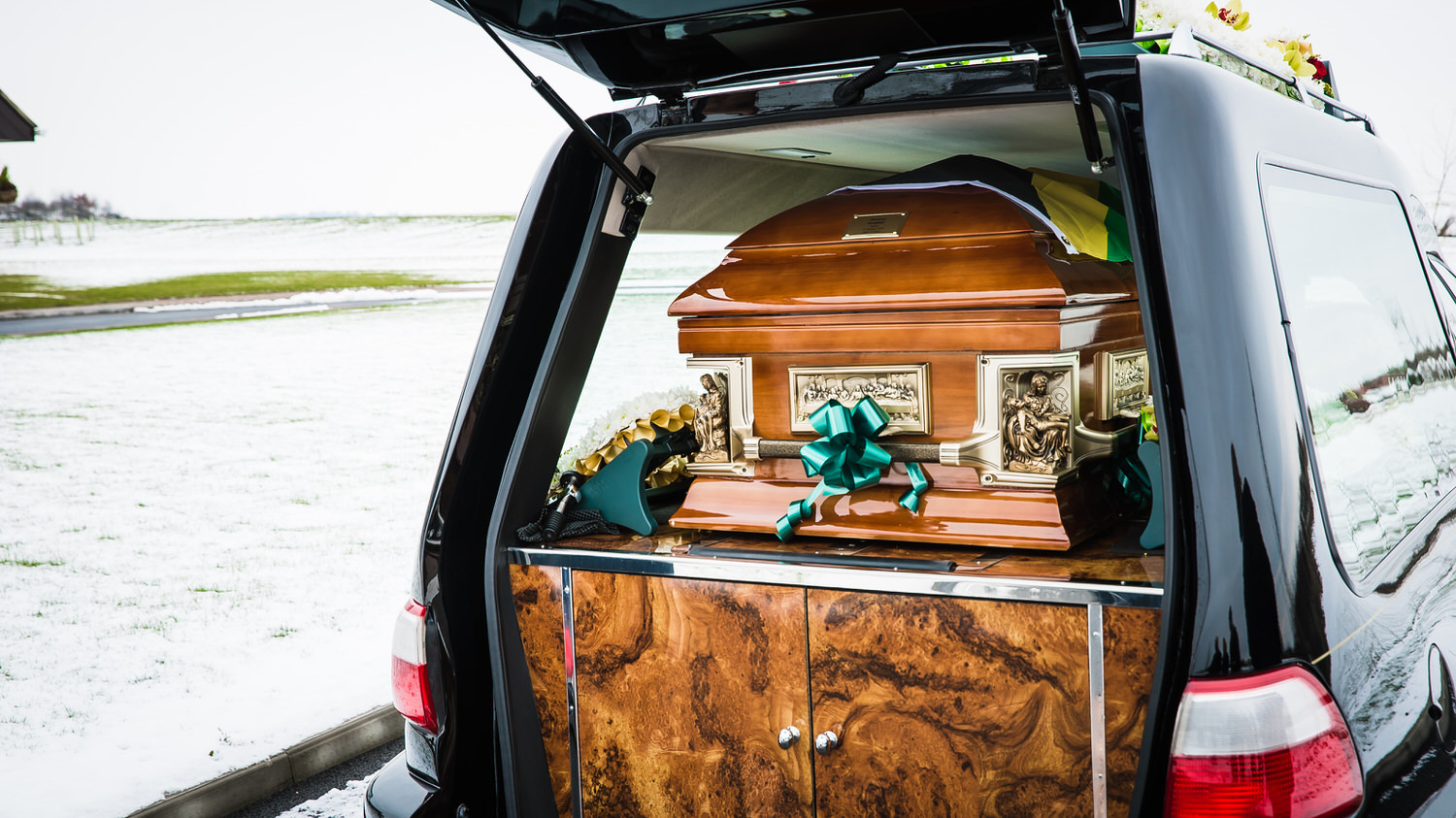
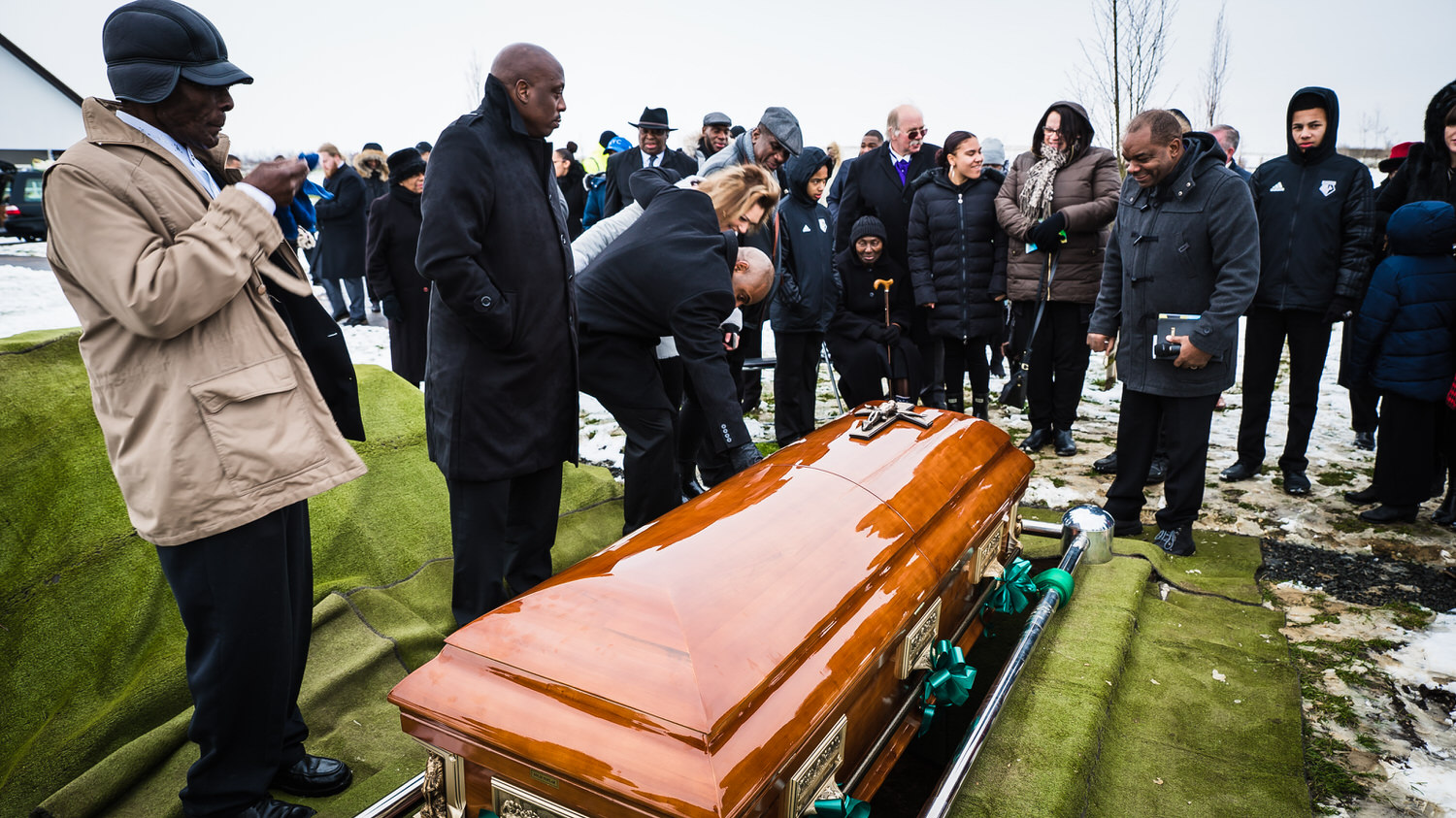
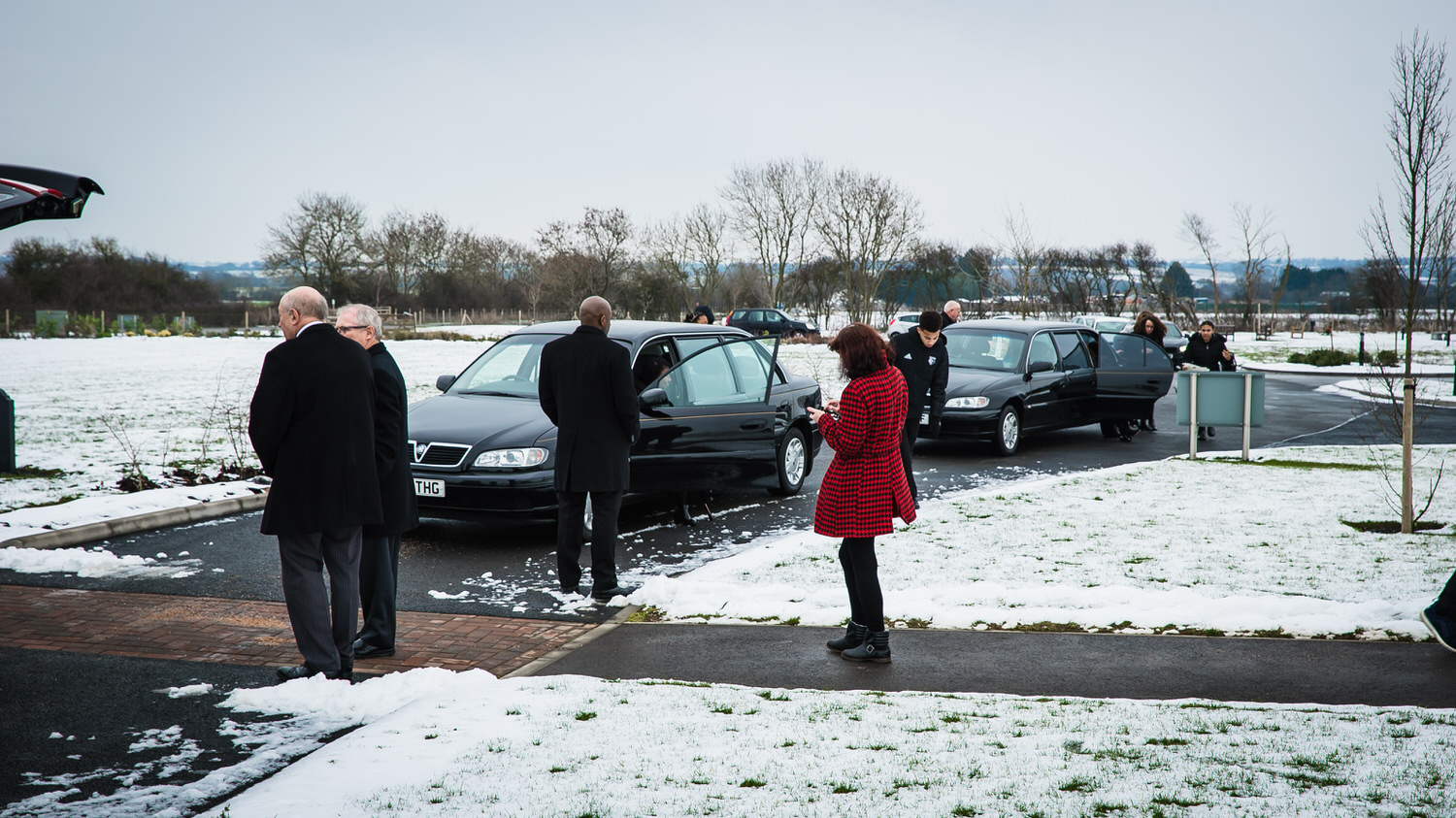
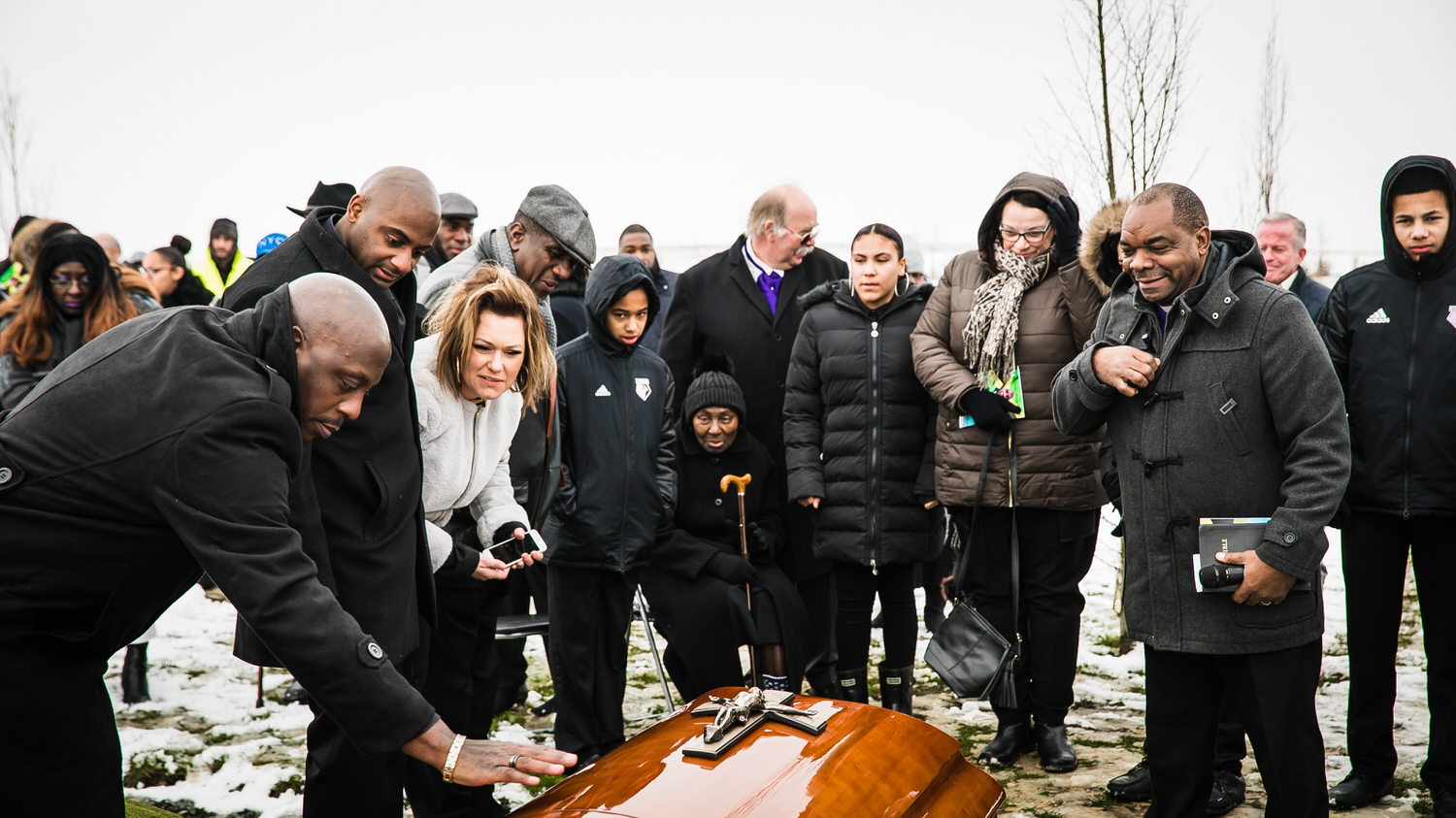
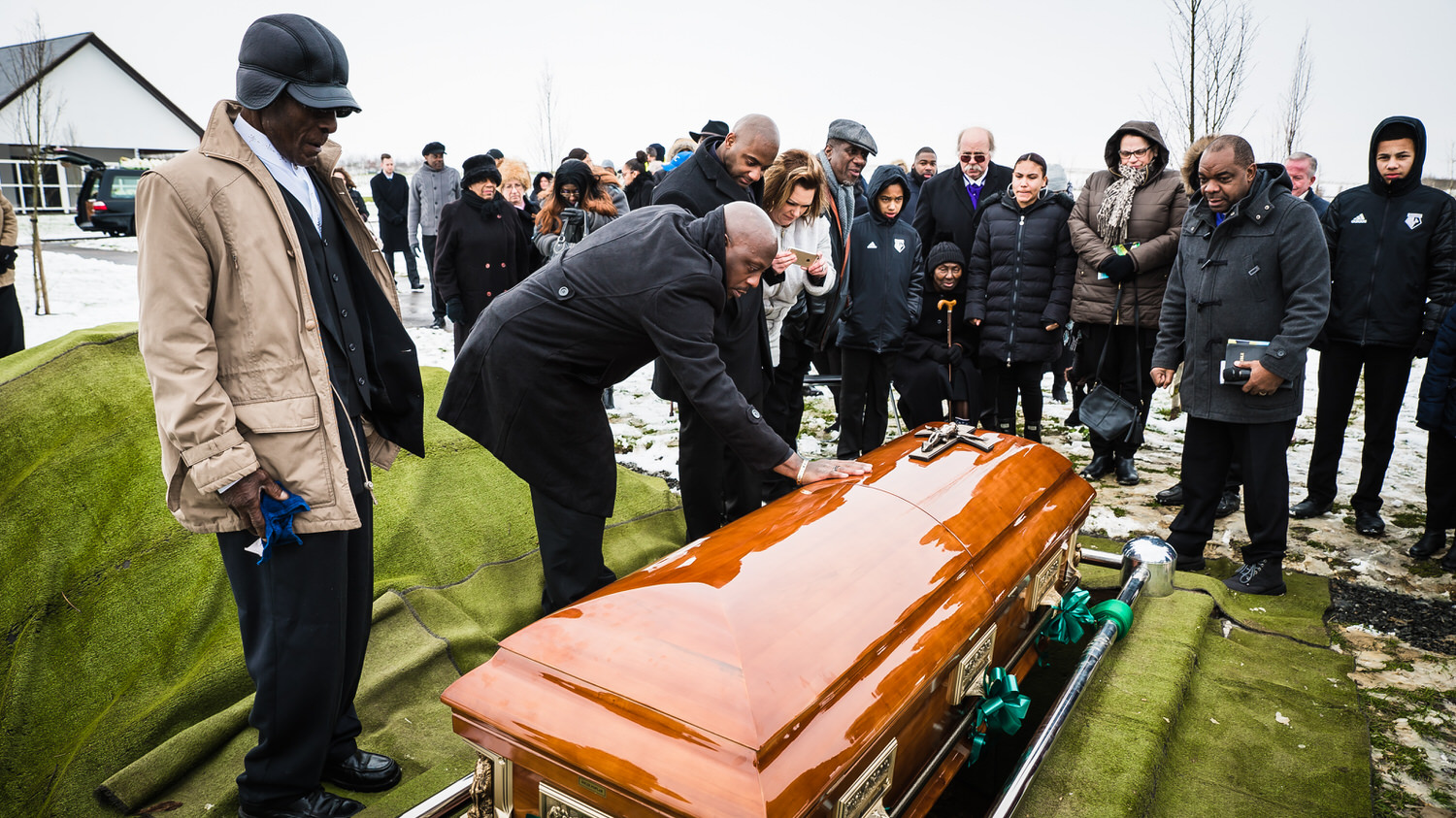
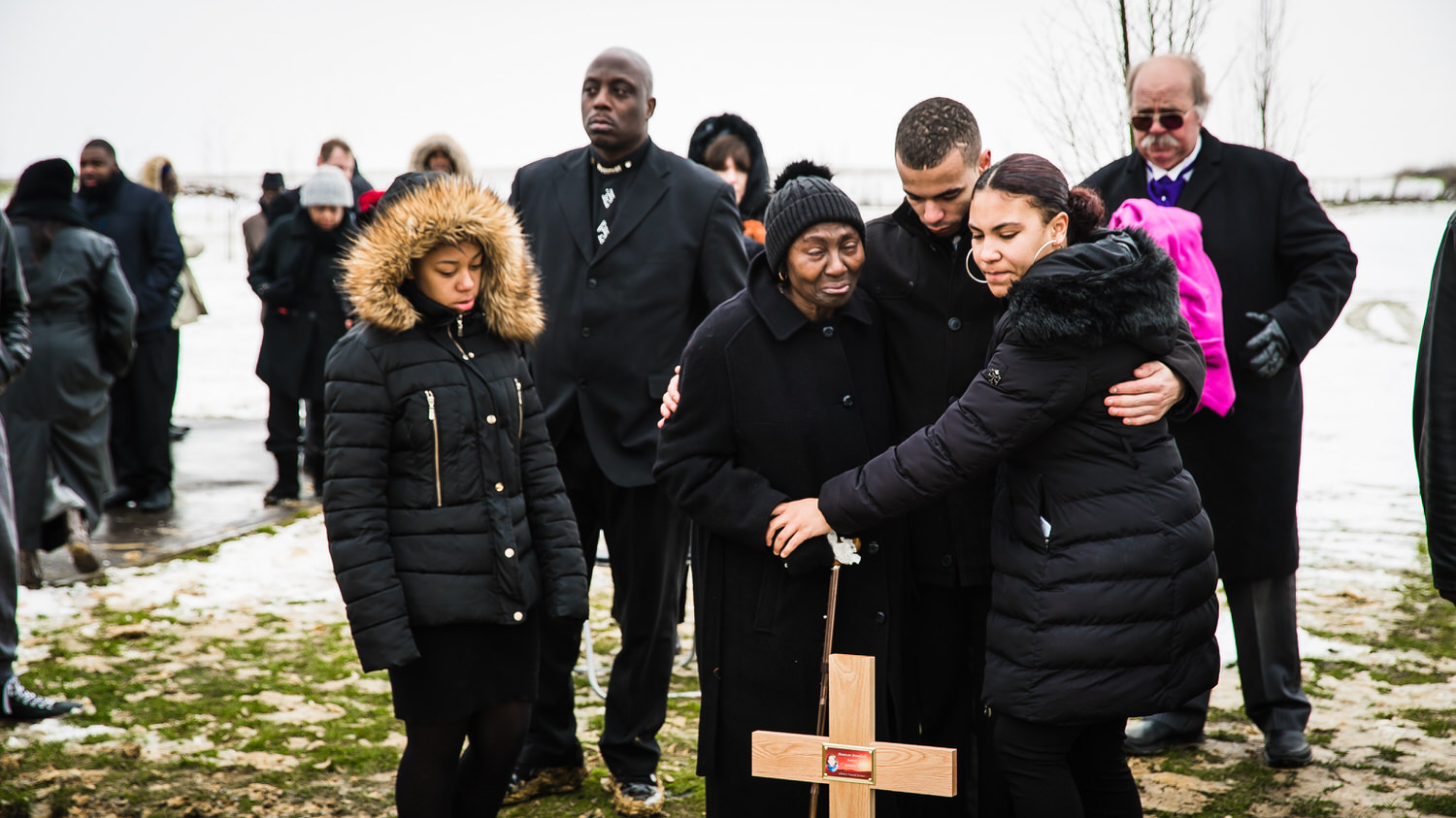
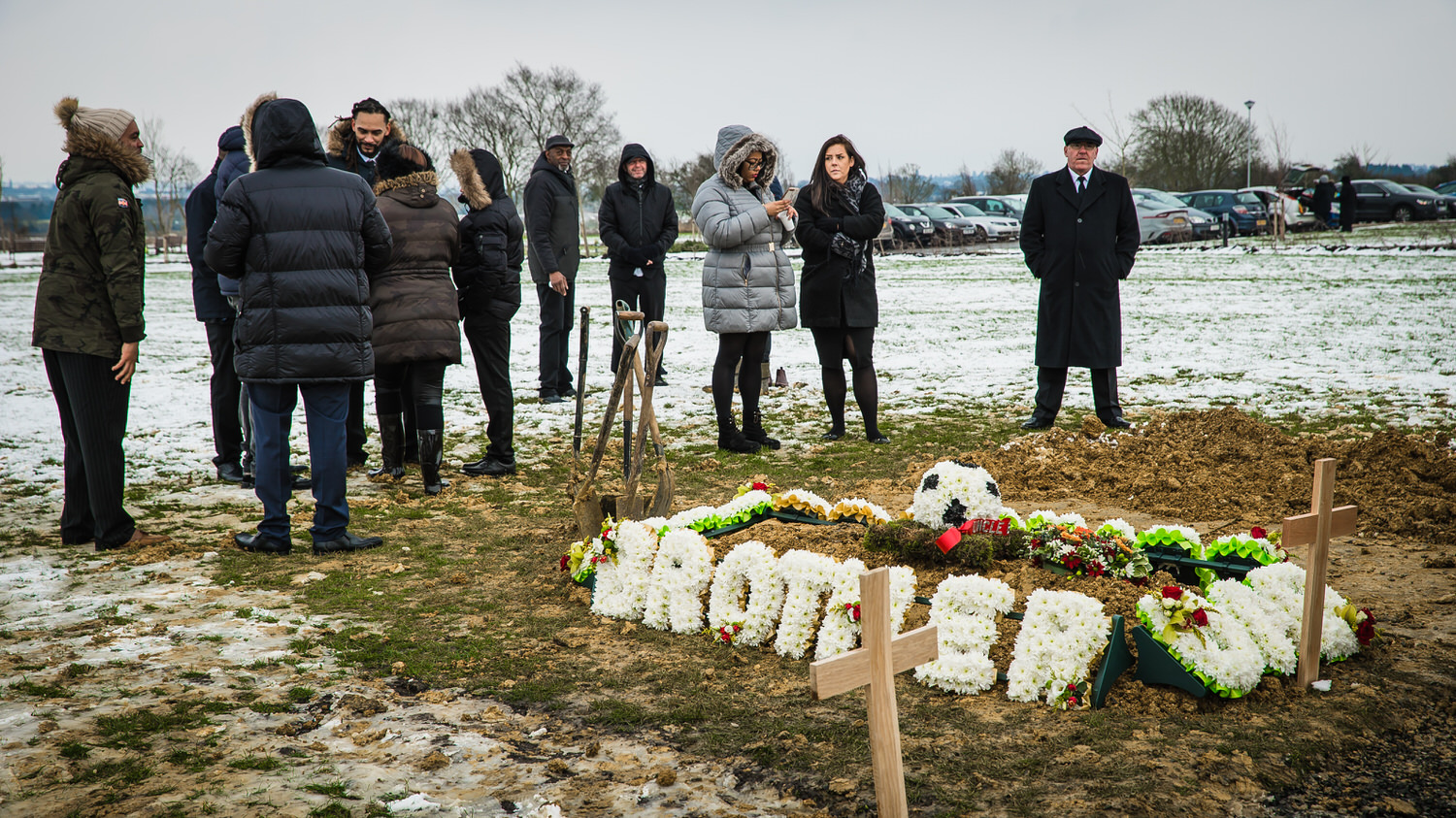
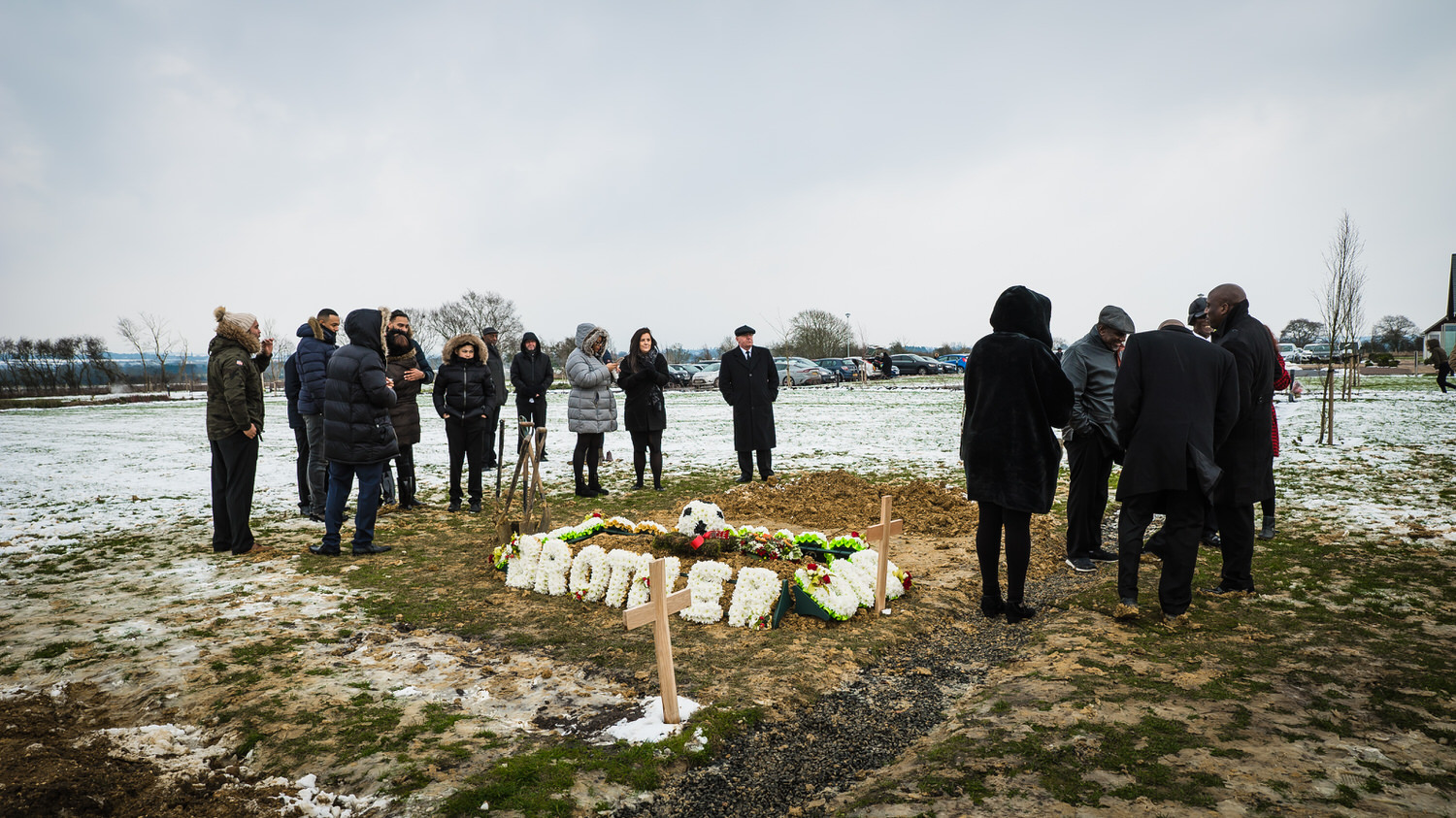
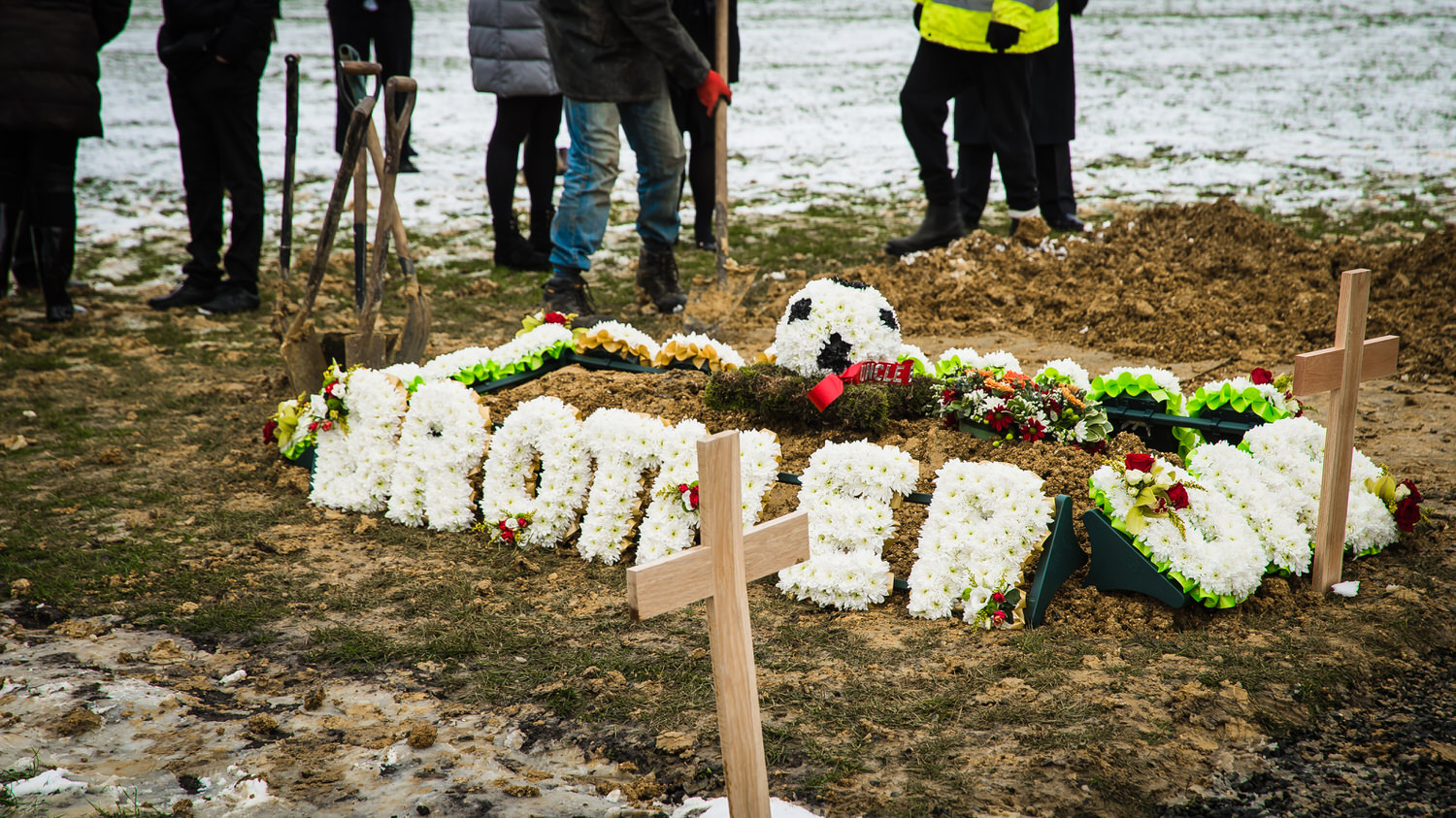
Snow at the Graveside — North Hertfordshire Memorial Park
I had originally been booked only for the church service. At the end of it, the family asked if I could also cover the burial. I'm always happy to be flexible when it matters — and thankfully I had brought my gloves.
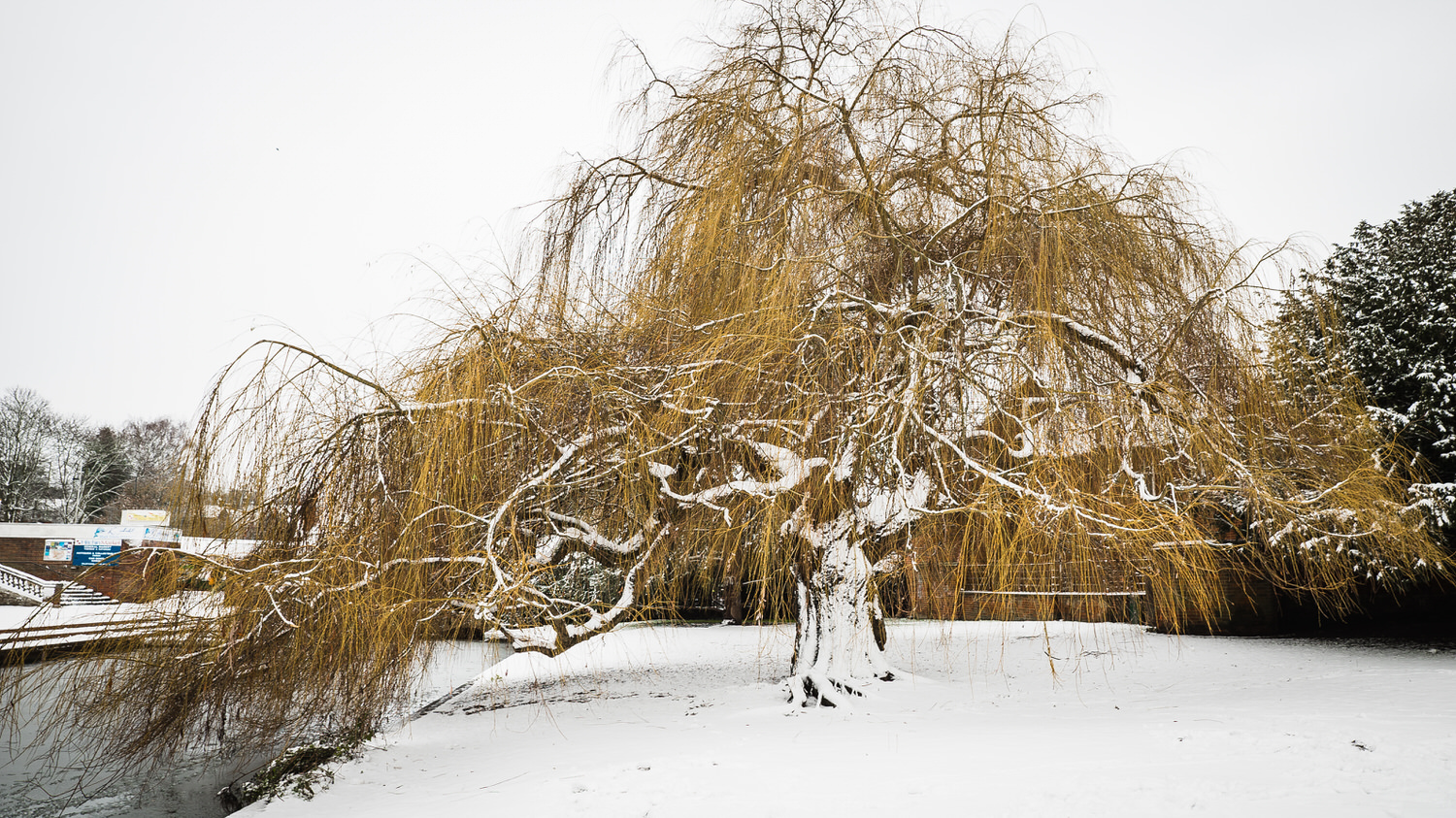
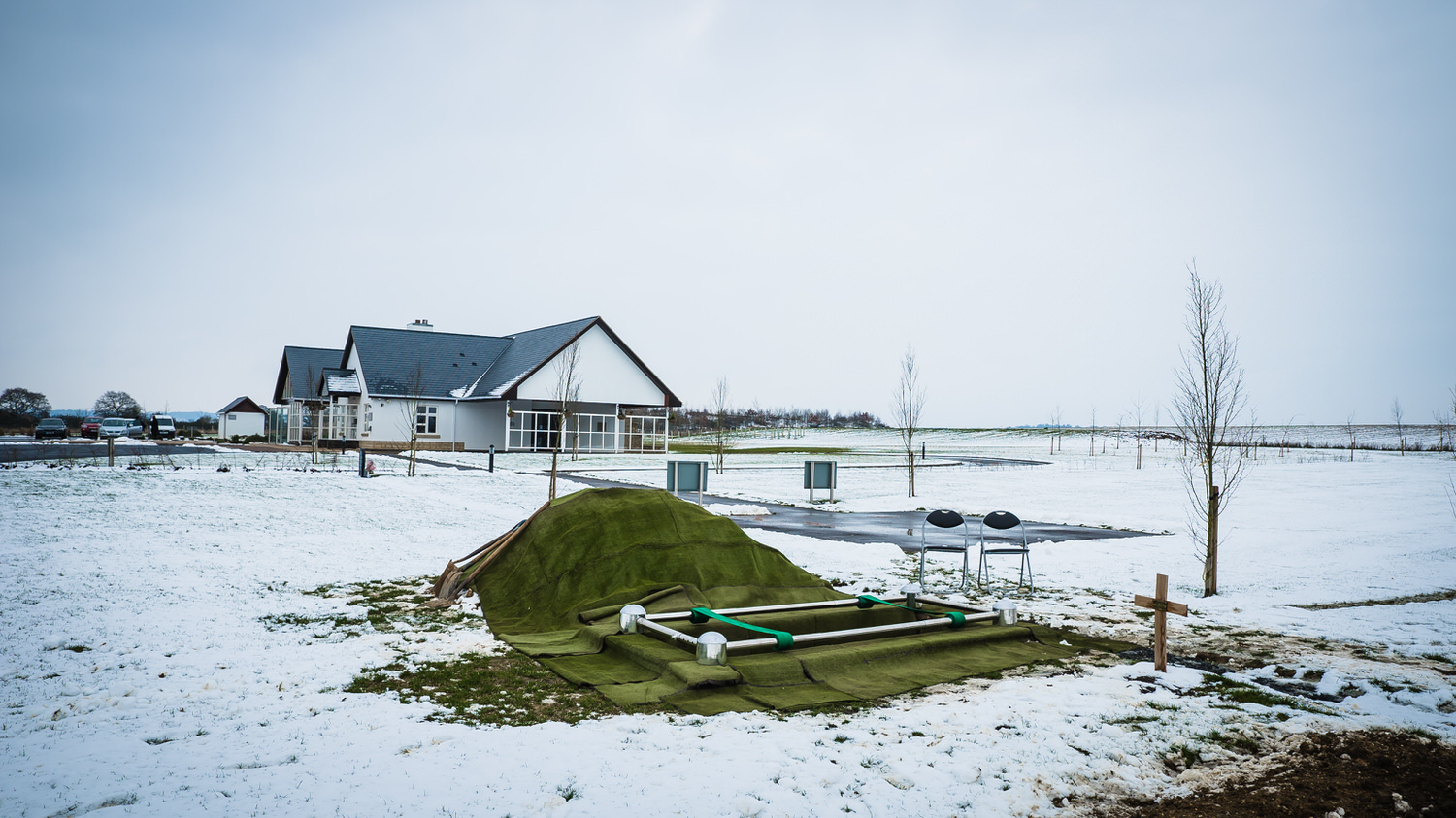
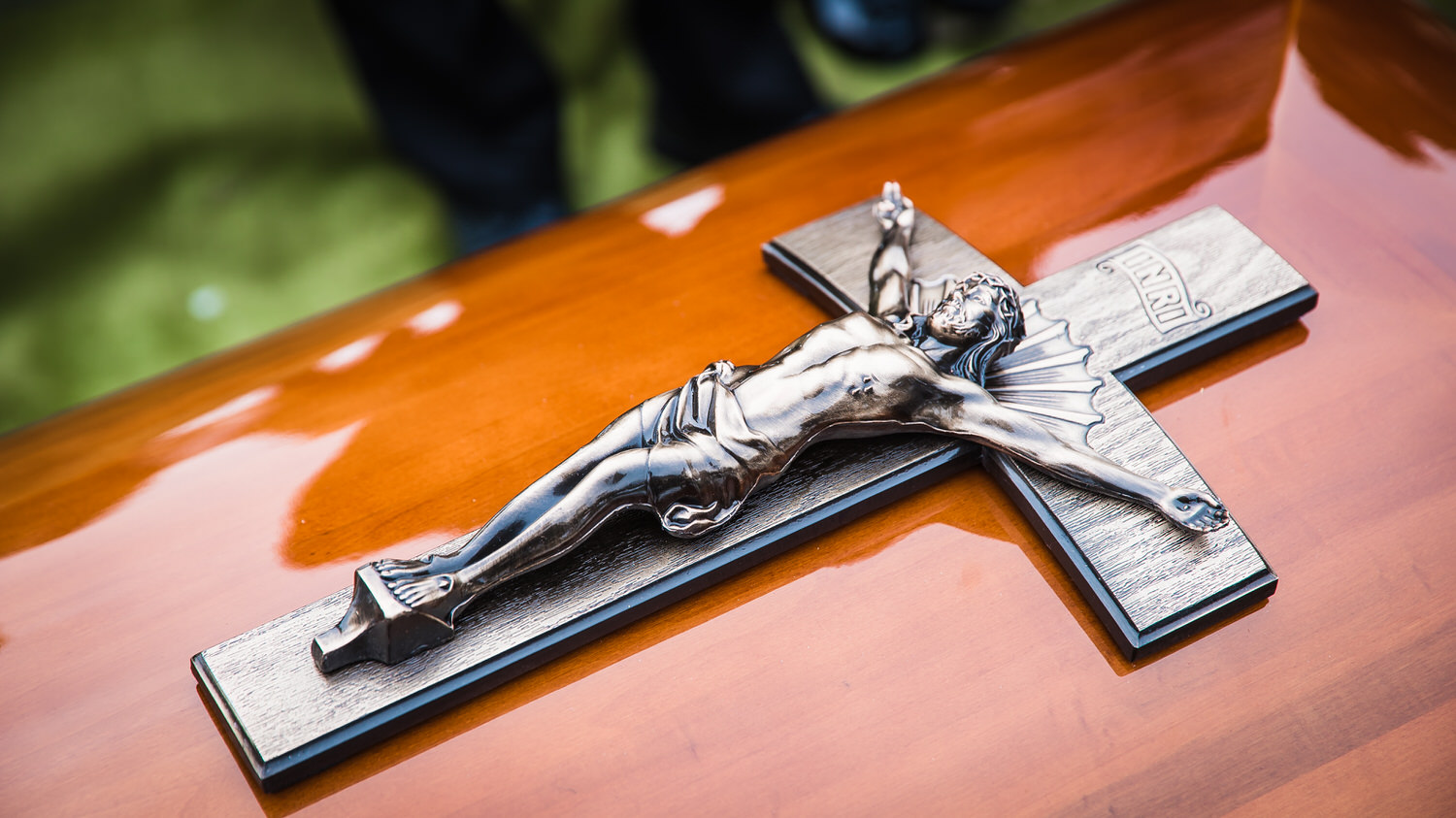
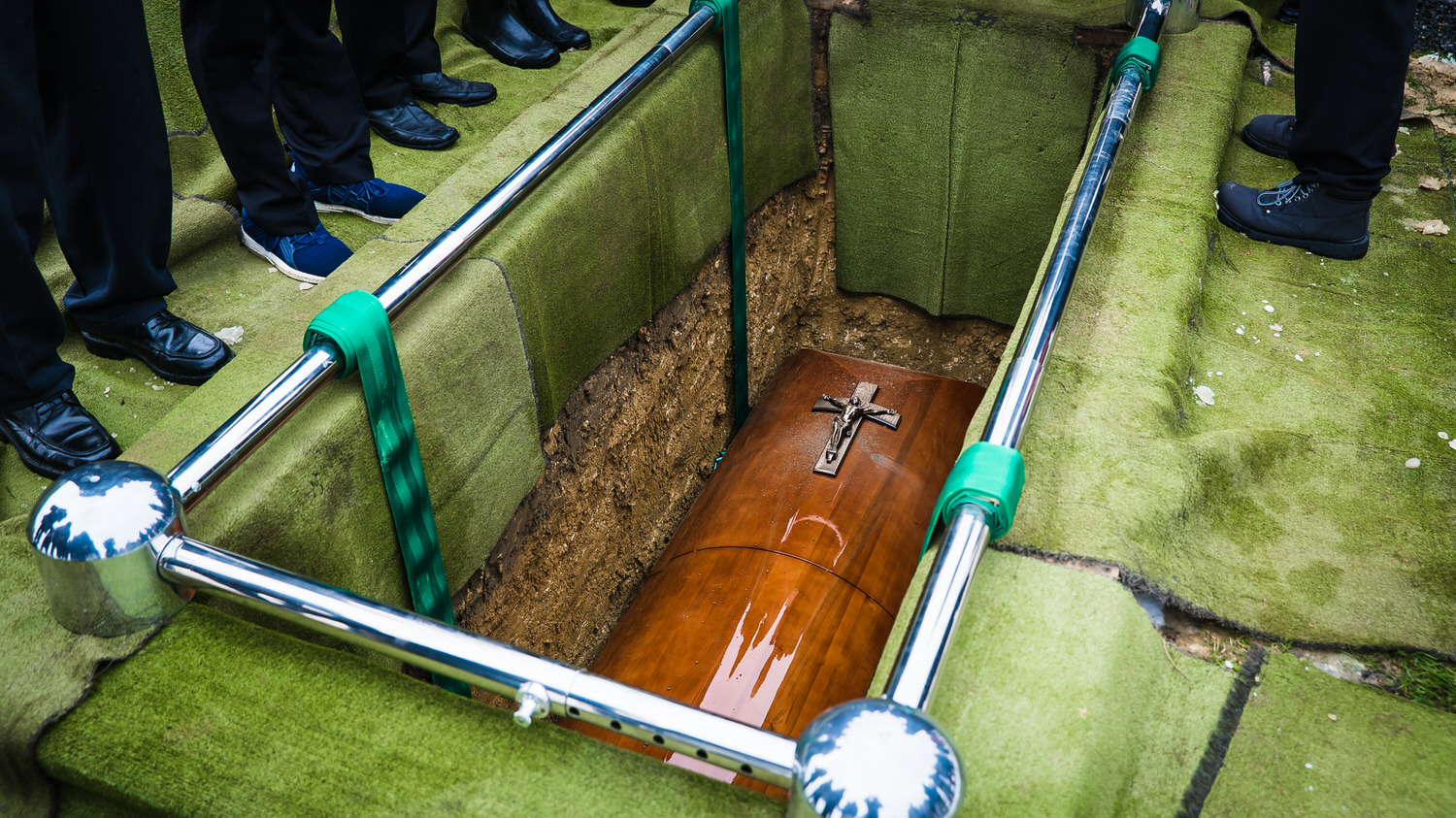
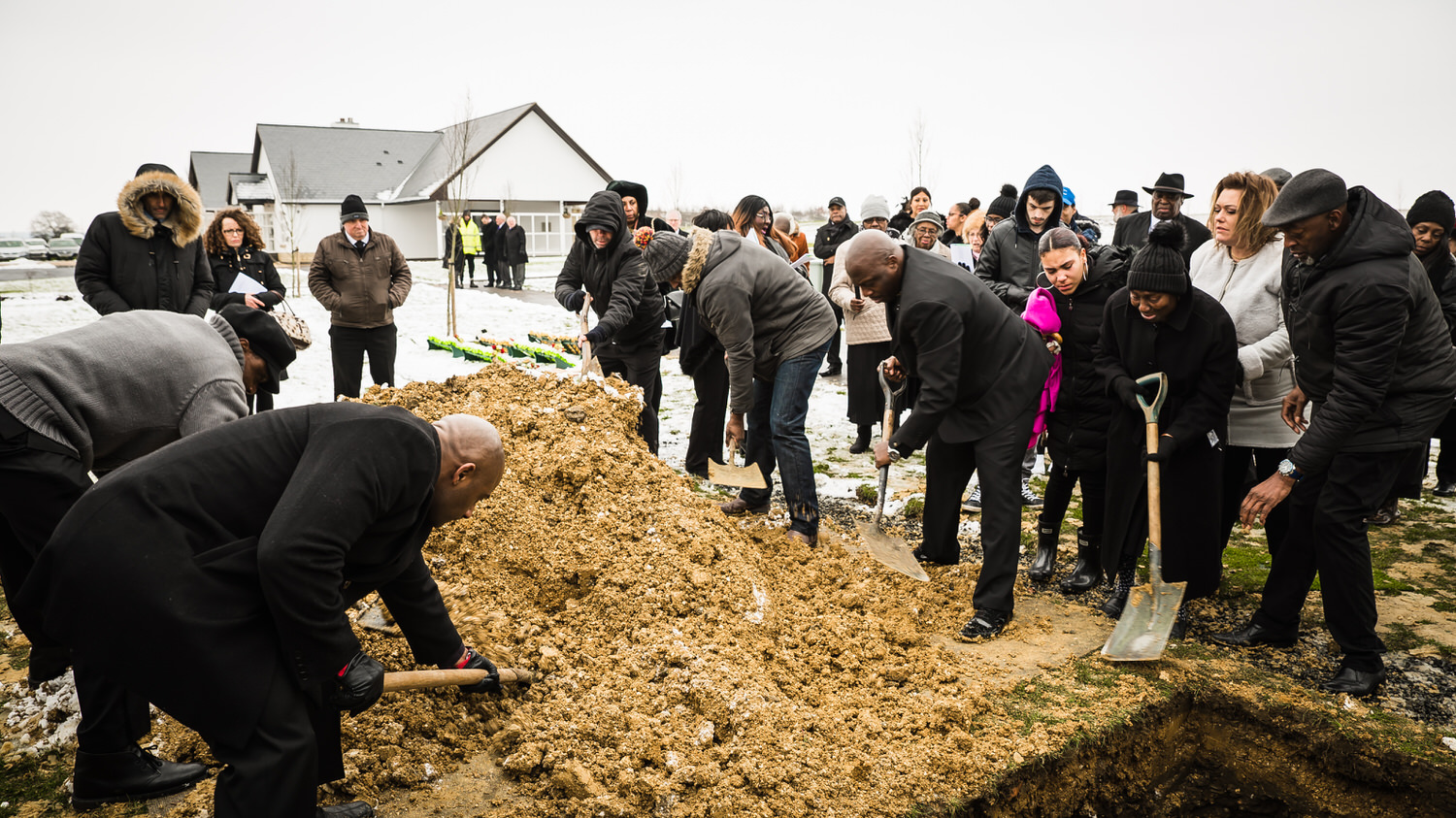
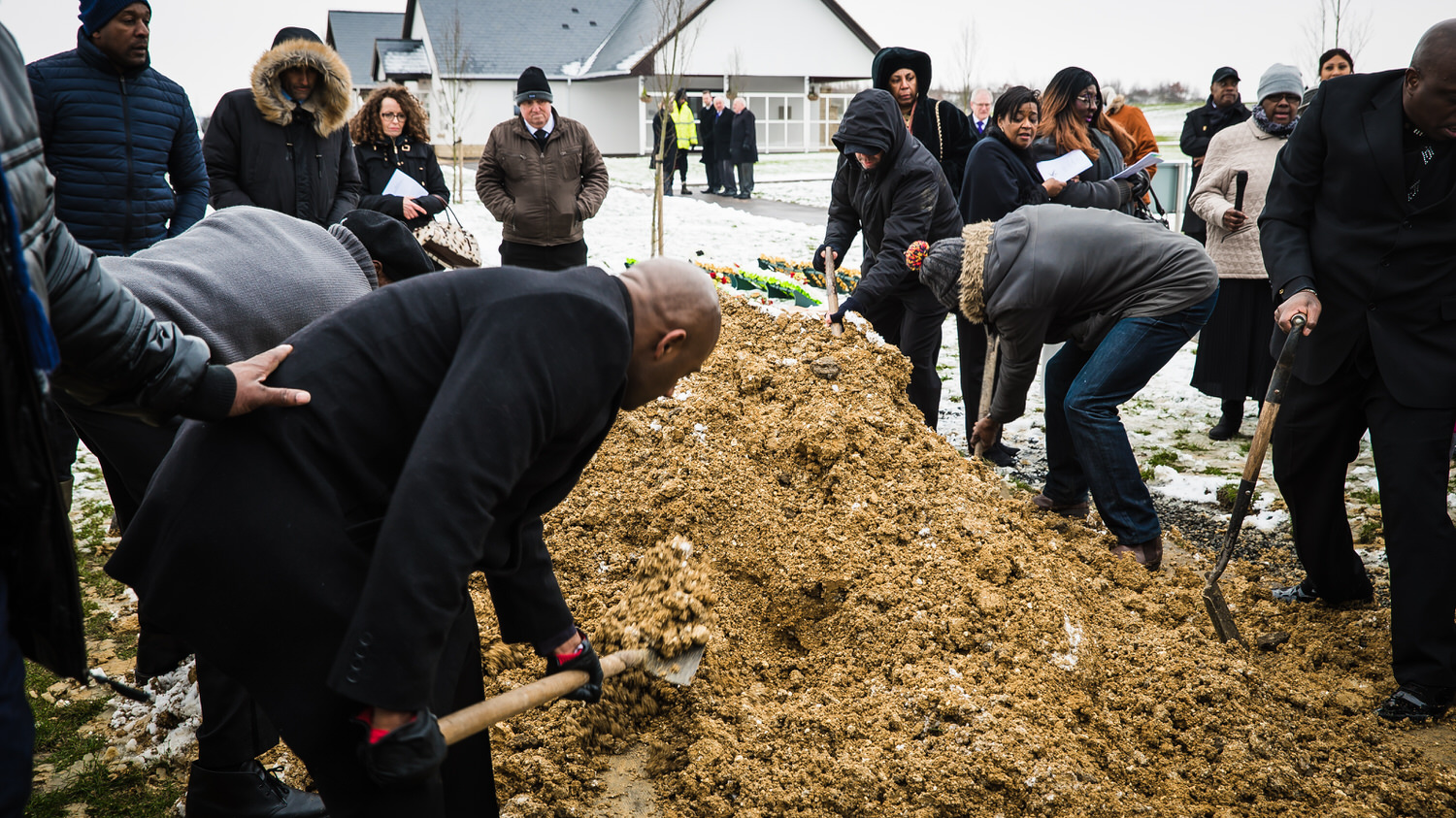
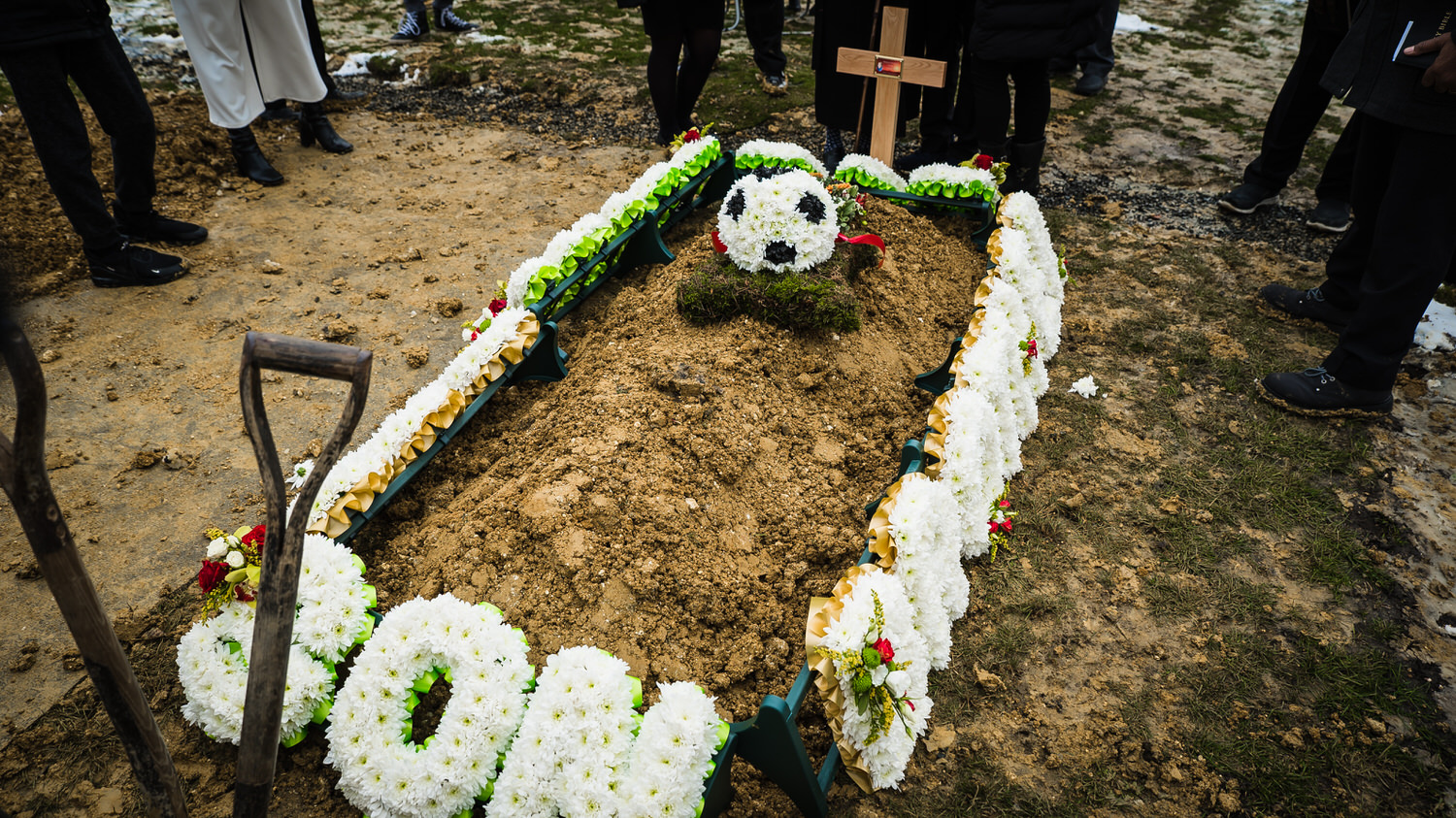
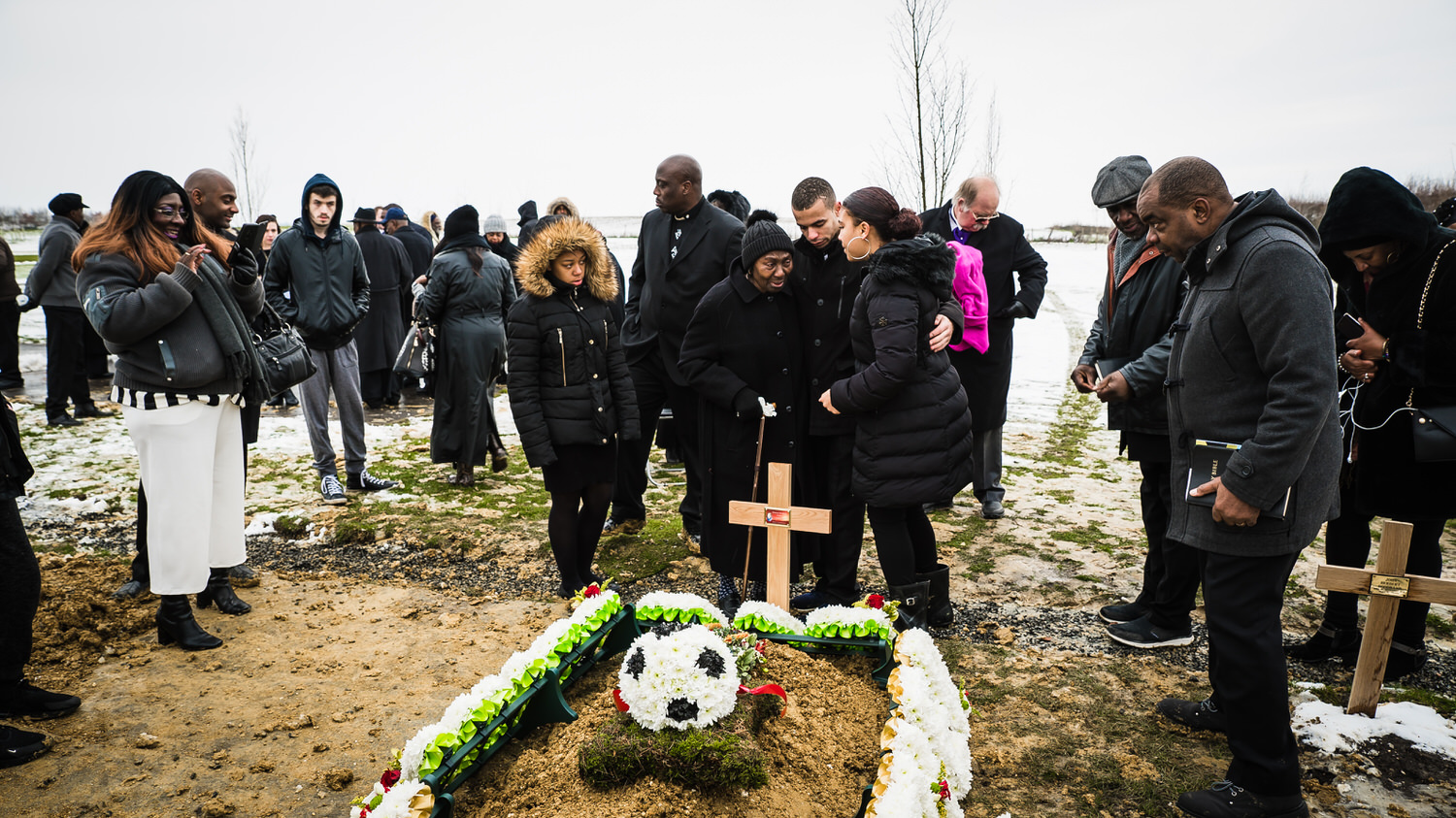
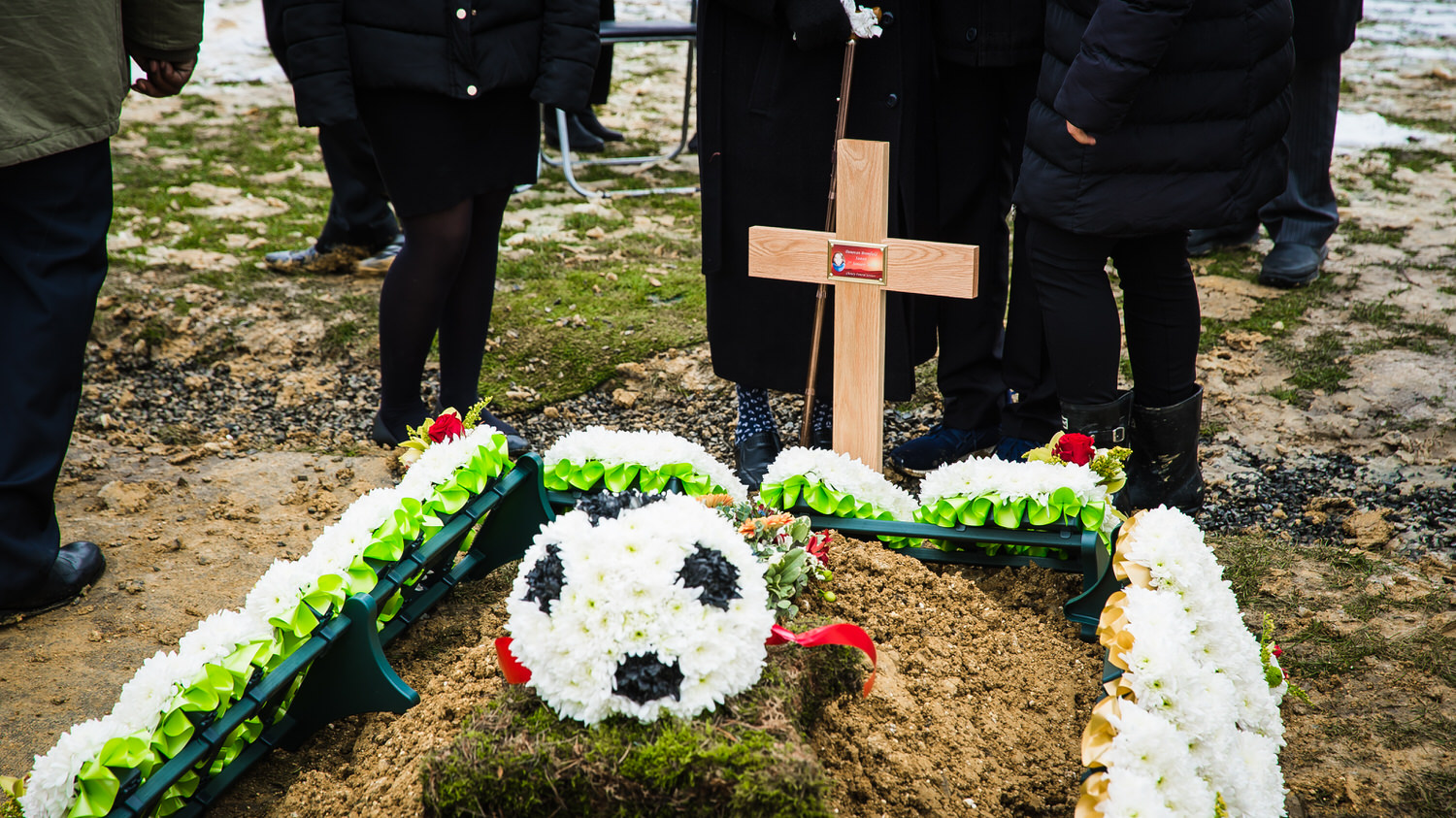
We continued to North Hertfordshire Memorial Park & Crematorium for the committal. The scene that greeted us was completely unexpected and entirely beautiful — fresh snow on the ground, the landscape white and still, the sky a flat winter grey. The family gathered at the graveside and, as the coffin was lowered, began to sing. Gospel singing, together, in the snow, as they backfilled the grave. Floral tributes were placed lovingly on top.
It was one of the most visually striking and emotionally powerful graveside moments I have witnessed in over ten years of this work. The contrast between the warmth inside the church and the cold stillness of the winter cemetery — and then the singing rising up through it — created something I will not forget.
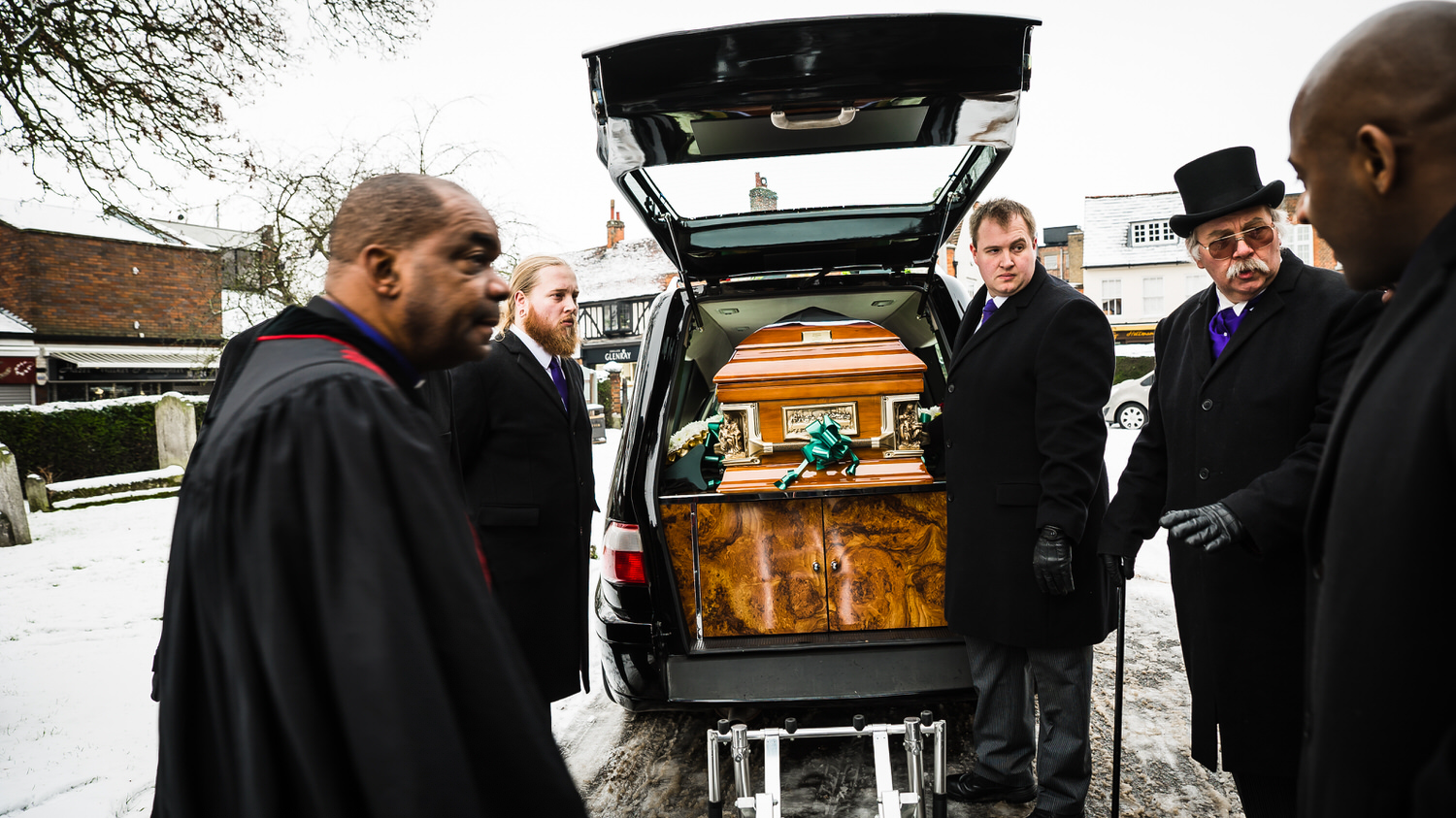
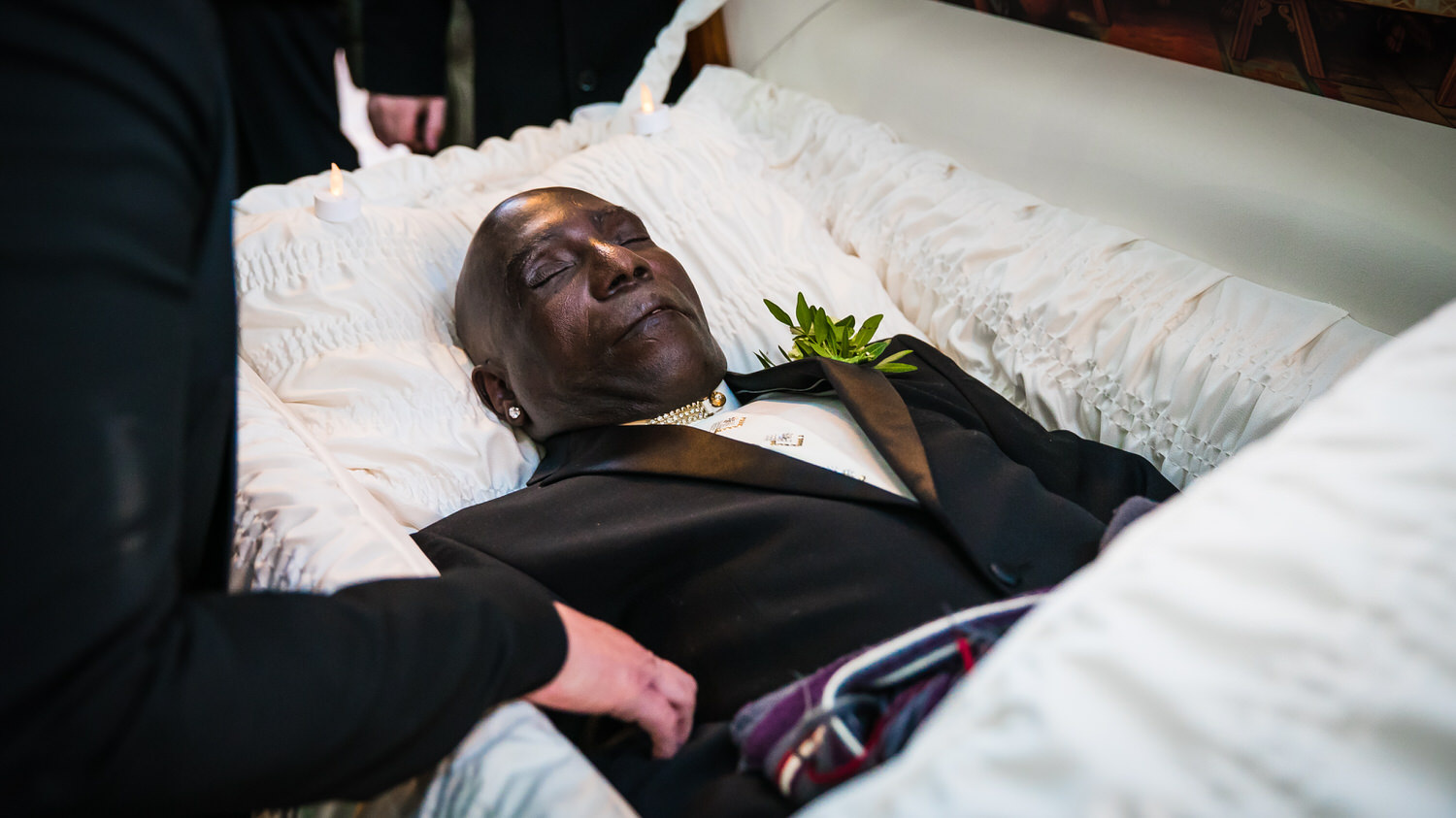
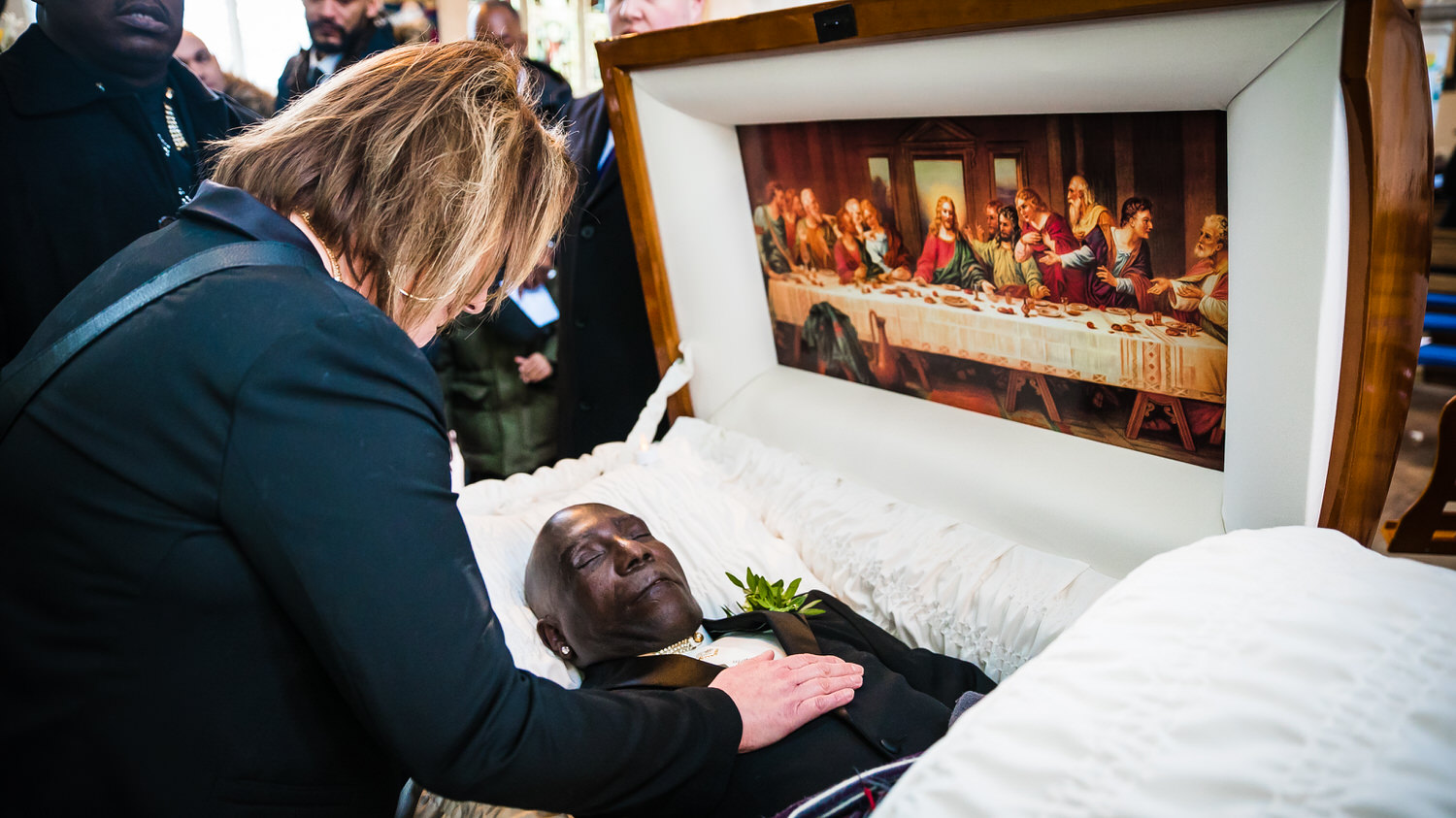
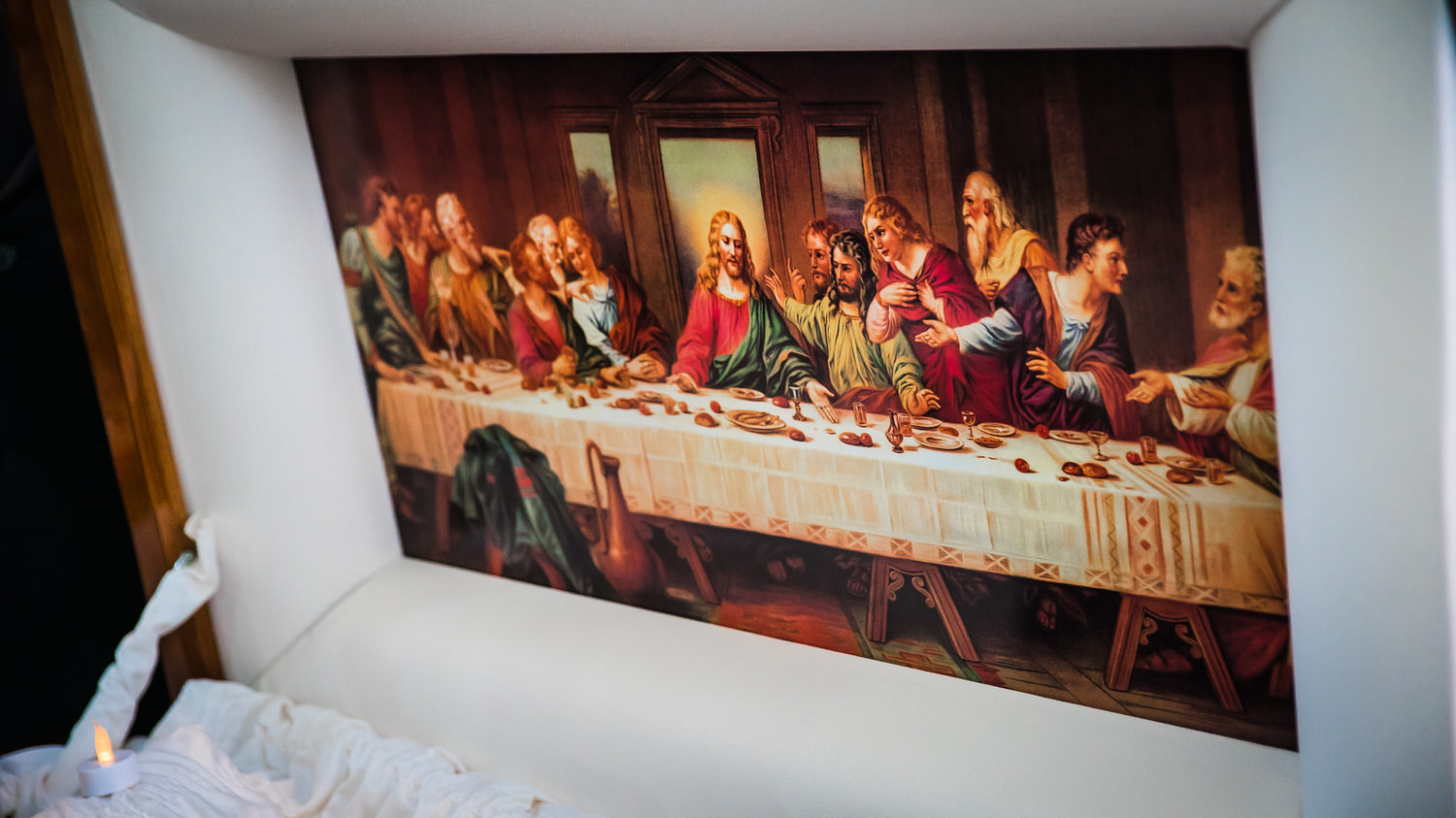
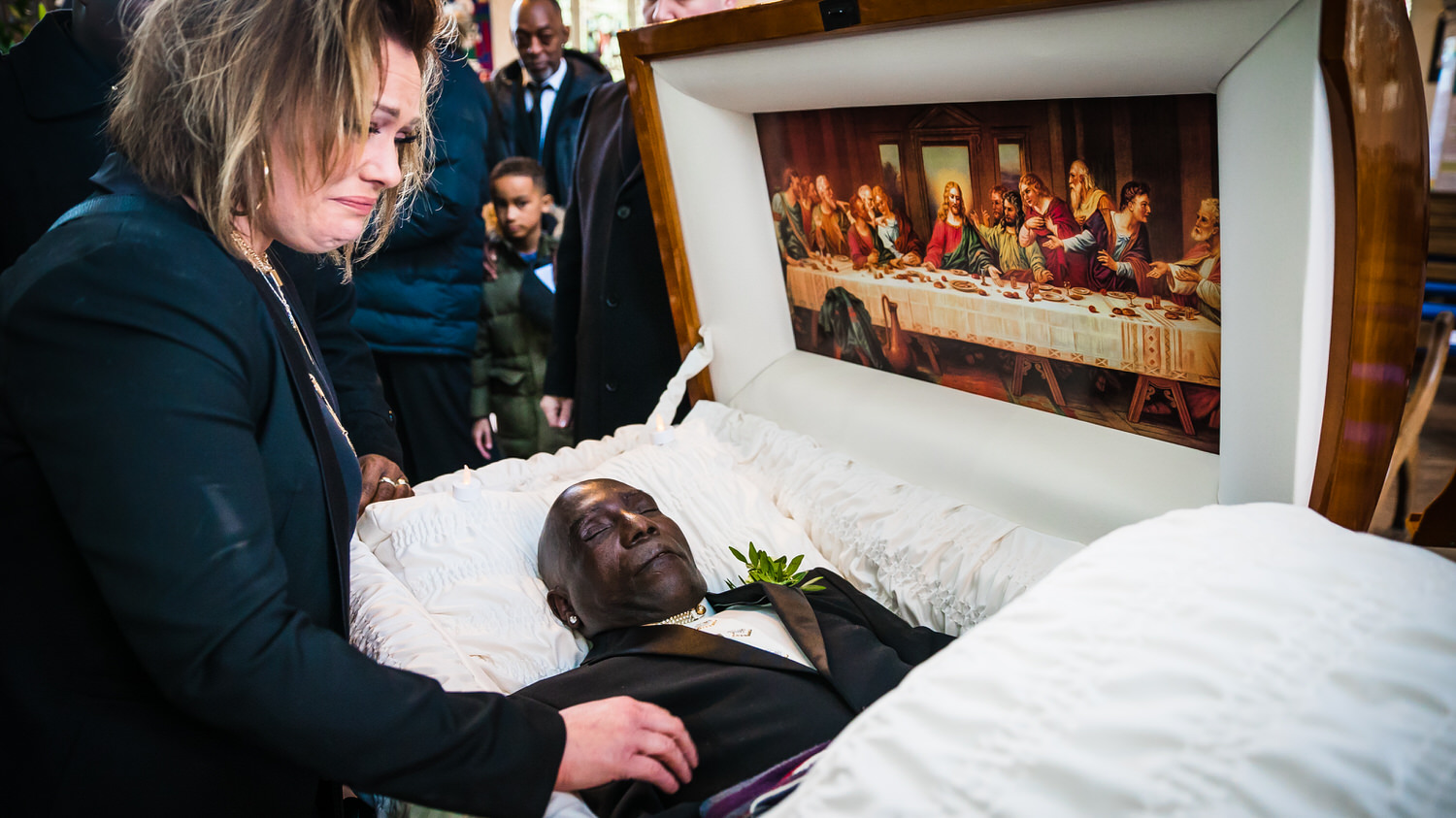
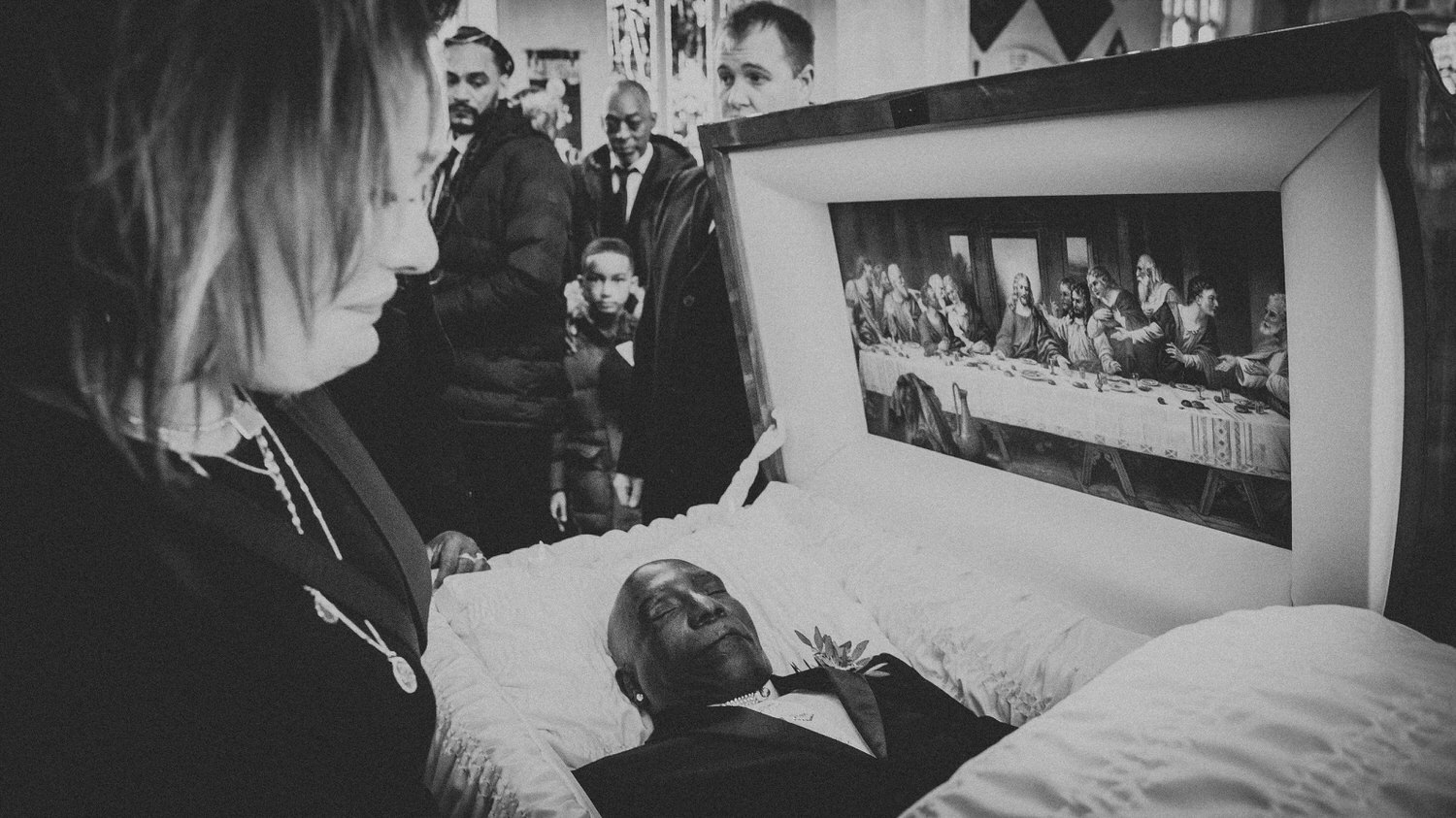
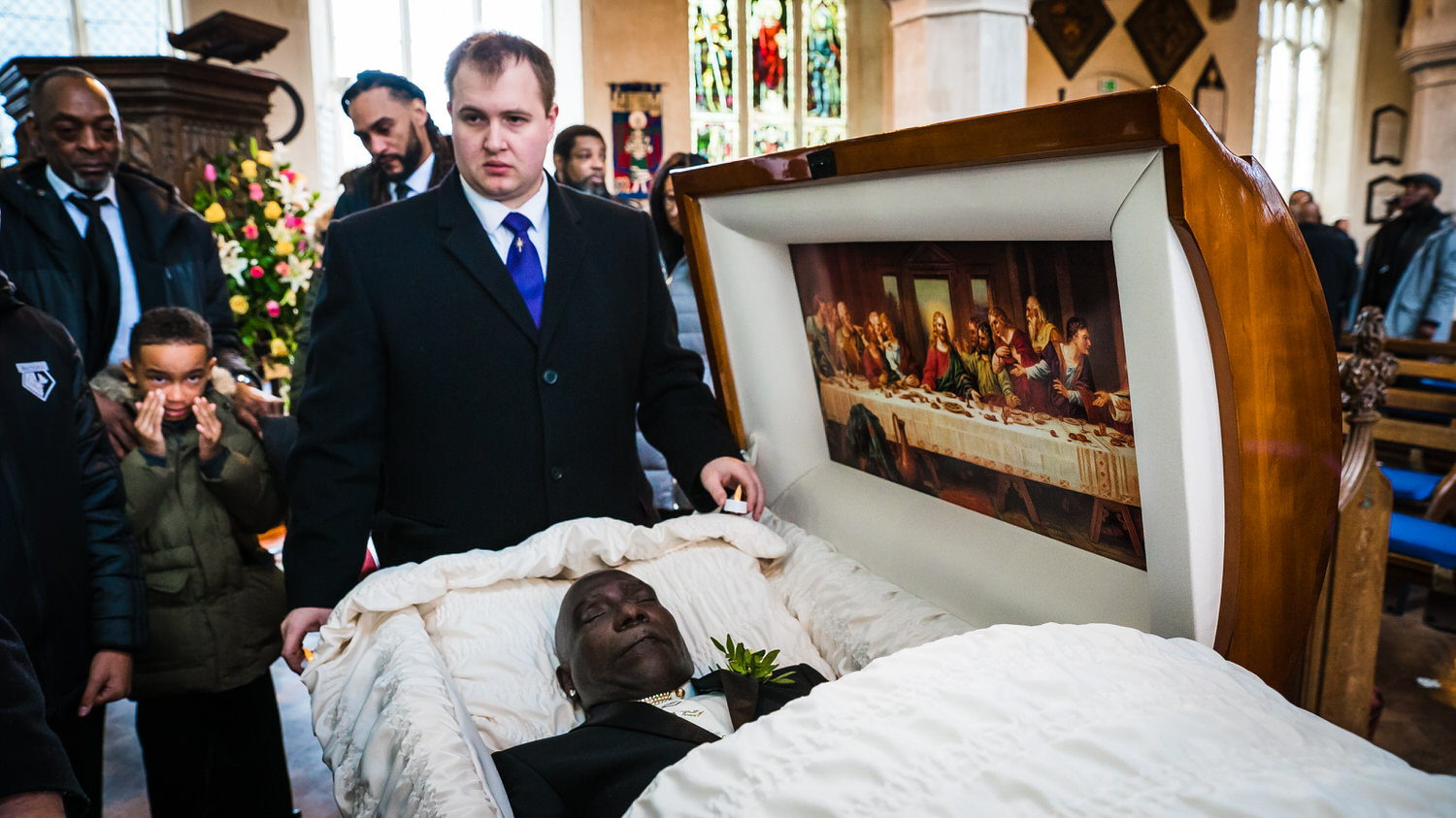
Throughout the day I maintained a discreet and respectful distance while capturing moments both powerful and intimate. Though I was hired as a funeral videographer, I also took a handful of still images for the family to cherish.

What Jai and the Family Said
"A million thank you's to this amazing man! This is the last time we would see his body and we will always want to remember him. Shaun made that possible for us. He was very kind, sympathetic, discreet and respectful. Thank you, Shaun, from the bottom of our hearts."
— Jai & Family ⭐️⭐️⭐️⭐️⭐️
Jamaican and Caribbean Funeral Videography, Streaming and Photography Across the UK
If you are planning a Jamaican or Caribbean funeral in Hertfordshire or anywhere across the UK, I am available to sensitively document your loved one's farewell with care and dignity. Whether you need funeral videography, funeral photography or funeral live streaming — or a combination of all three — it would be an honour to help.
For Caribbean funerals in particular, live streaming is often as important as the filming itself, allowing family in Jamaica, Barbados, Trinidad and elsewhere to be present in real time. You can read more about how this works in my guide to live streaming a graveside or outdoor funeral, and in my Caribbean funeral case study from Bedford where over 1,900 viewers joined live from 7 countries.
Call or text me on 07772 509101 — available seven days a week, 9am to 10pm — or get in touch online.
Related pages and guides:

Hindu Funeral Photography — Body Preparation, Horse-Drawn Cortege & Cremation, Barrow-in-Furness, Cumbria


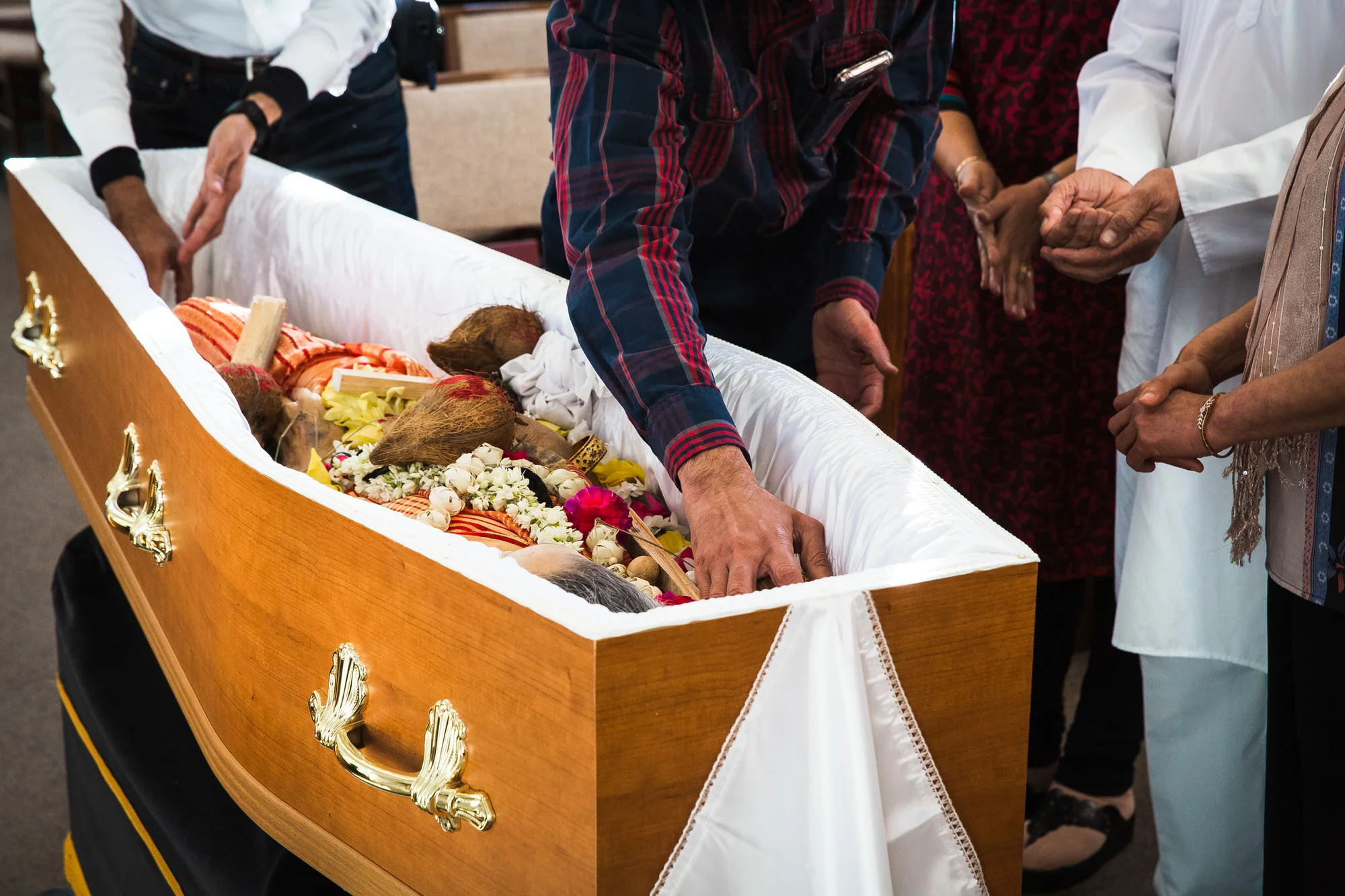


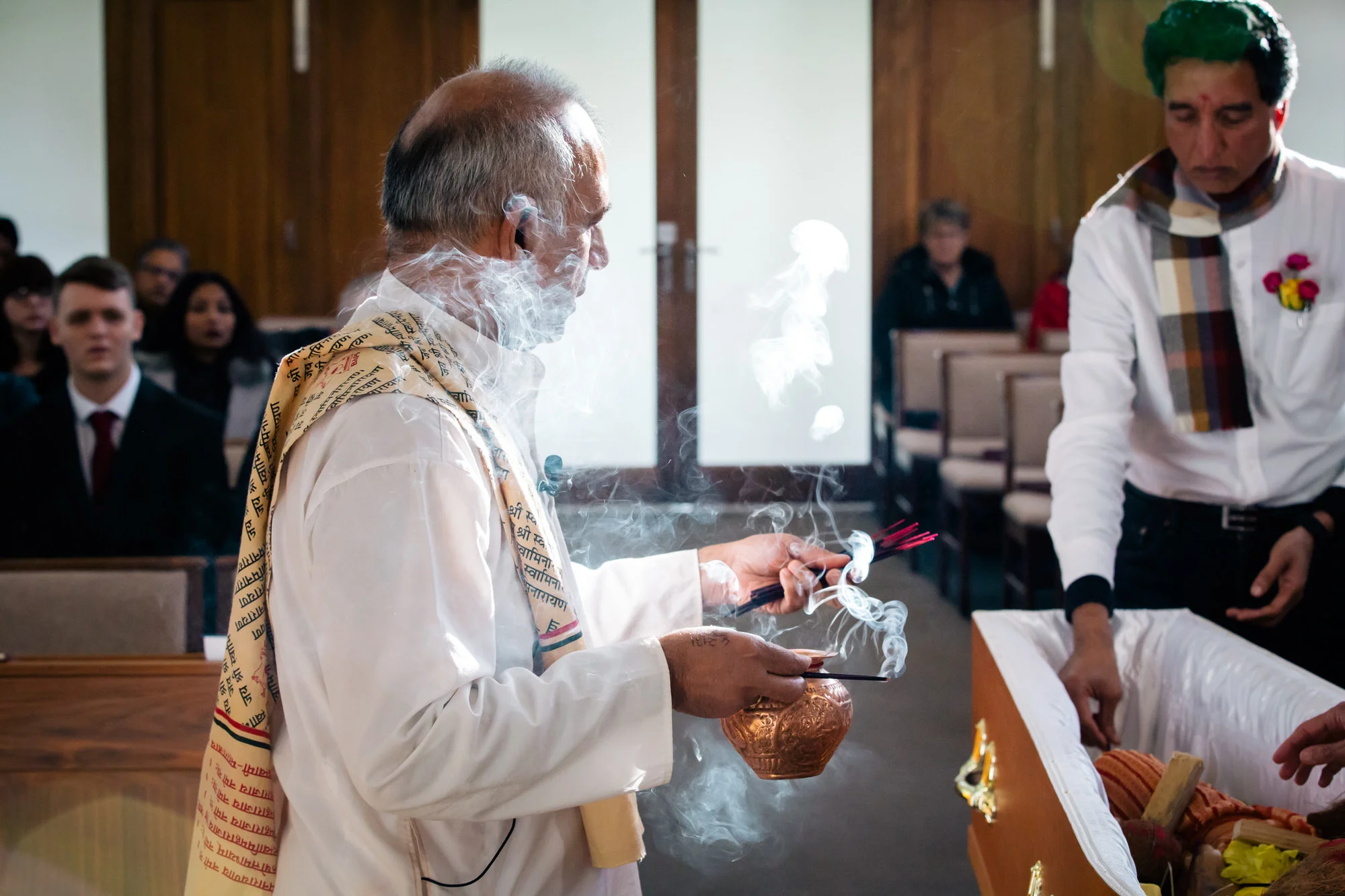


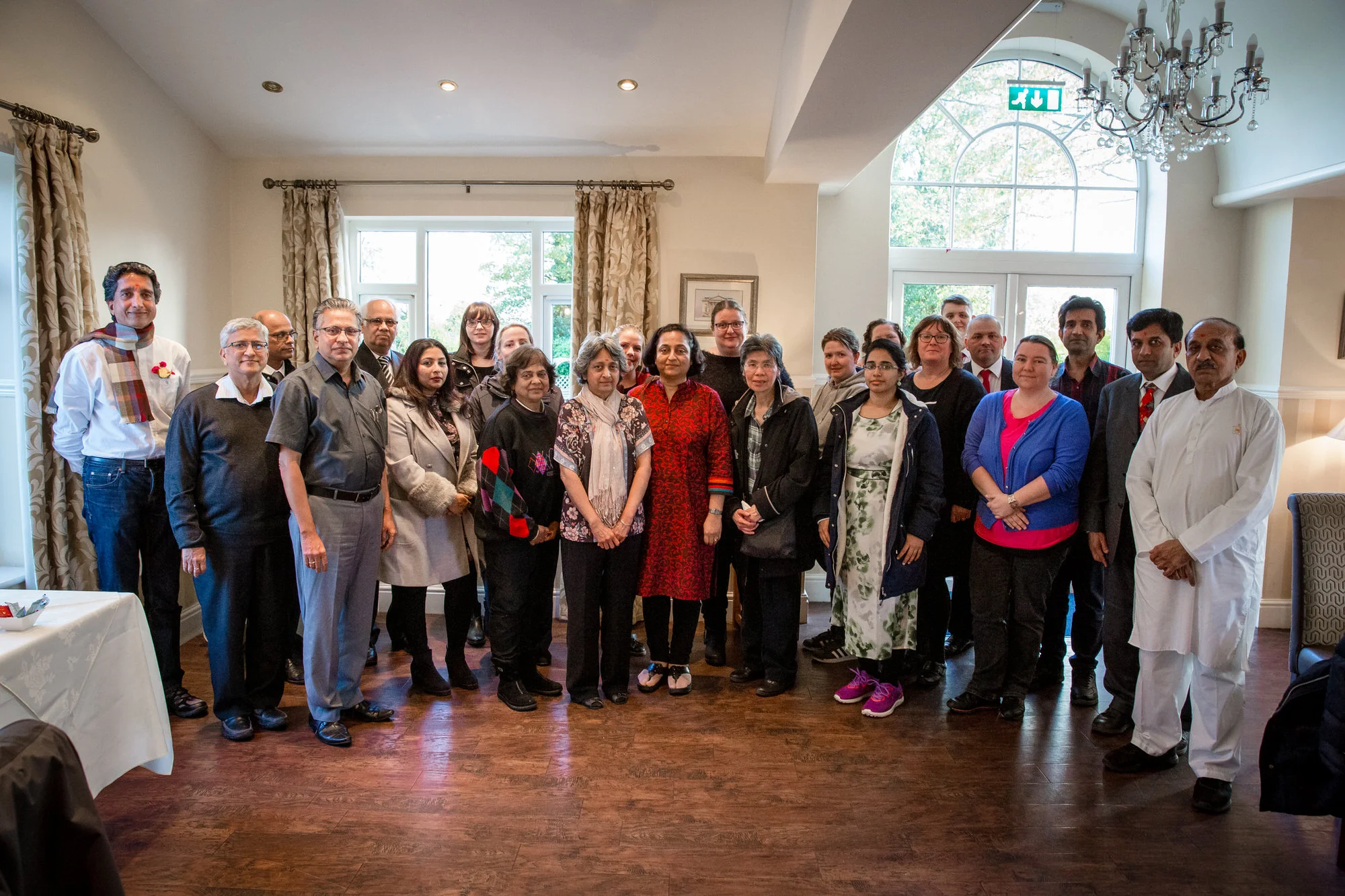


Thank you to the family for the extraordinary trust they placed in me on this day to be their funeral photographer — and for giving their permission to share these images. Their generosity in allowing others to see what they experienced is an act of love, and I hope it helps other Hindu families understand what funeral photography at this level can look like.
Travelling to Cumbria — Why This Family Found Me
Barrow-in-Furness is a long way from my base, and not a journey I make lightly. But this family had seen my work, and they knew what they wanted — a photographer whose approach was built around storytelling rather than posing. No stopping. No staging. No directing people to stand here or look that way. Just honest, documentary coverage of the day as it actually unfolded.
That is exactly how I work, and it is why they asked me to make the journey. From the very first moment at Co-op Funeralcare Barrow to the final images at The Chetwynde Hotel, my job was to follow, observe and record — never to interrupt what was happening in front of me.
The Funeral Directors — Photographing the Preparation of the Body
The day began at Co-op Funeralcare in Barrow, where the family gathered to prepare the body before the journey to the crematorium. I was invited to be present for this — something that is not asked of many photographers, and which I did not take lightly.
In Hindu tradition, the preparation of the body is a sacred act — the Antyesti, or last rites, begins here. The body is washed and anointed with ghee (clarified butter), milk, honey and oils, each substance carrying its own spiritual significance. For women, turmeric is traditionally applied to the head; for men, sandalwood. The body is then dressed — in white for most, or red for a married woman — and placed in the open coffin surrounded by flowers. Rice balls, known as pinda, may be placed beside the body. A lamp is lit near the head. These are not decorative gestures. Each one is an act of preparation for the soul's journey toward moksha — liberation and release from the cycle of rebirth.
The family replaced bangles on her hands and placed flowers with care around her. These moments — intimate, tender, purposeful — are exactly the kind of thing that passes invisibly unless someone is there to record them.
I worked very slowly and very quietly. Longer lenses kept me at a respectful physical distance. I followed the family's lead entirely, lowering the camera without question at any moment that felt too private. The images from this part of the day are among the most beautiful I have ever taken — the care in every gesture, the love in every placement of a flower.
The Horse-Drawn Carriage — Capturing the Cortege from Funeral Directors to Crematorium
When the time came to leave for Thorncliffe Cemetery and Crematorium, the coffin was carried from the funeral directors onto a horse-drawn carriage. Red roses were placed on the coffin as it was settled onto the carriage — a moment of such simple, quiet beauty that it stopped me.
Capturing the horse and carriage properly was important. I positioned myself to show the full length of the cortege — the horses, the carriage, the family following — while also moving in closer for the details: the roses on the lid, the hands of the people carrying, the expression of the man guiding the horses.
In Hindu tradition, cremation should ideally take place as soon as possible after death, within 24 hours where possible, so that the soul's journey is not delayed. The procession to the crematorium is not incidental — it is part of the ritual itself, a final passage through the world the person inhabited. Photographing it as such, rather than simply as a transport arrangement, is what storytelling means in practice.
The Open Coffin Service at Thorncliffe Crematorium
At Thorncliffe Crematorium, the family held an open coffin service — central to Hindu funeral practice and one of the most visually significant parts of the day.
The family carried her into the crematorium together. The coffin was open, surrounded by flowers and garlands — marigold and rose are traditional, symbols of the transience of life and the beauty of what is released. Inside the coffin, alongside her, coconuts and ghee had been placed as offerings.
Both carry deep significance in Hindu ritual. The coconut is considered a symbol of the ego — its hard outer shell representing the individual self, and the breaking of it symbolising the releasing of the soul from the body. Ghee, made from clarified butter, is one of the most sacred substances in Hinduism, used in puja and yajna (fire offerings) for thousands of years. Offering it with the body is an act of purification, a way of honouring the transition the soul is making.
The Pandit led the family through mantras and prayers in Sanskrit. The sound of those ancient prayers filling the crematorium chapel created an atmosphere of complete spiritual focus — something entirely unlike any other service I have attended.
Family members were invited to circle the coffin and make their own offerings and farewells. In some crematoriums, Hindu families are also able to witness the charging — the moment the coffin enters the cremator — as a final act of the mukhagni, traditionally the lighting of the funeral pyre by the eldest son. Thorncliffe's arrangements on the day were guided by the family's wishes and the crematorium's own facilities.
Throughout all of this I worked from positions agreed with the family and the funeral director, moving quietly between wider shots of the congregation and closer coverage of the rituals. I never drew attention to the camera. I never crossed in front of the coffin. The family knew I was there, and I aimed to be invisible in practice.
The Reception at The Chetwynde Hotel
After the cremation, the family hosted a reception at The Chetwynde Hotel in Barrow-in-Furness. Family and friends gathered to share stories, memories and a warm meal — the community aspect of Hindu mourning that is just as important as the ceremony itself.
I continued coverage through the reception — the conversations, the food, the older relatives sitting together, the smaller moments that only show up in photographs taken by someone who was paying attention throughout the whole day rather than arriving for the service and leaving.
Why the Family Chose to Share These Images
The family made a considered decision to allow these photographs to be shared publicly. They wanted other Hindu families to know that this kind of photography exists — and that it can be done with the care and respect it deserves.
Many Hindu families in the UK have never considered having a professional photographer present at the body preparation or the open coffin service. Some worry it would feel intrusive. This family's decision to share their images shows what it actually looks like when it is done with genuine sensitivity and a photographer who understands the difference between documenting a story and interrupting one.
Hindu Funeral Photography Across the UK
I photograph Hindu funerals across the UK — at crematoriums, family homes and community centres, for families from Gujarat, Punjab, Maharashtra, Tamil Nadu and many other regions, each with their own specific customs. If you are arranging a Hindu funeral and would like to discuss whether photography might be right for your family, I'm happy to have that conversation.
You can also read more about my approach in my complete guide to funeral photography and my guide on is funeral photography right for our family?
Call or text me on 07772 509101 — available seven days a week, 9am to 10pm — or get in touch online.
Related pages and guides:
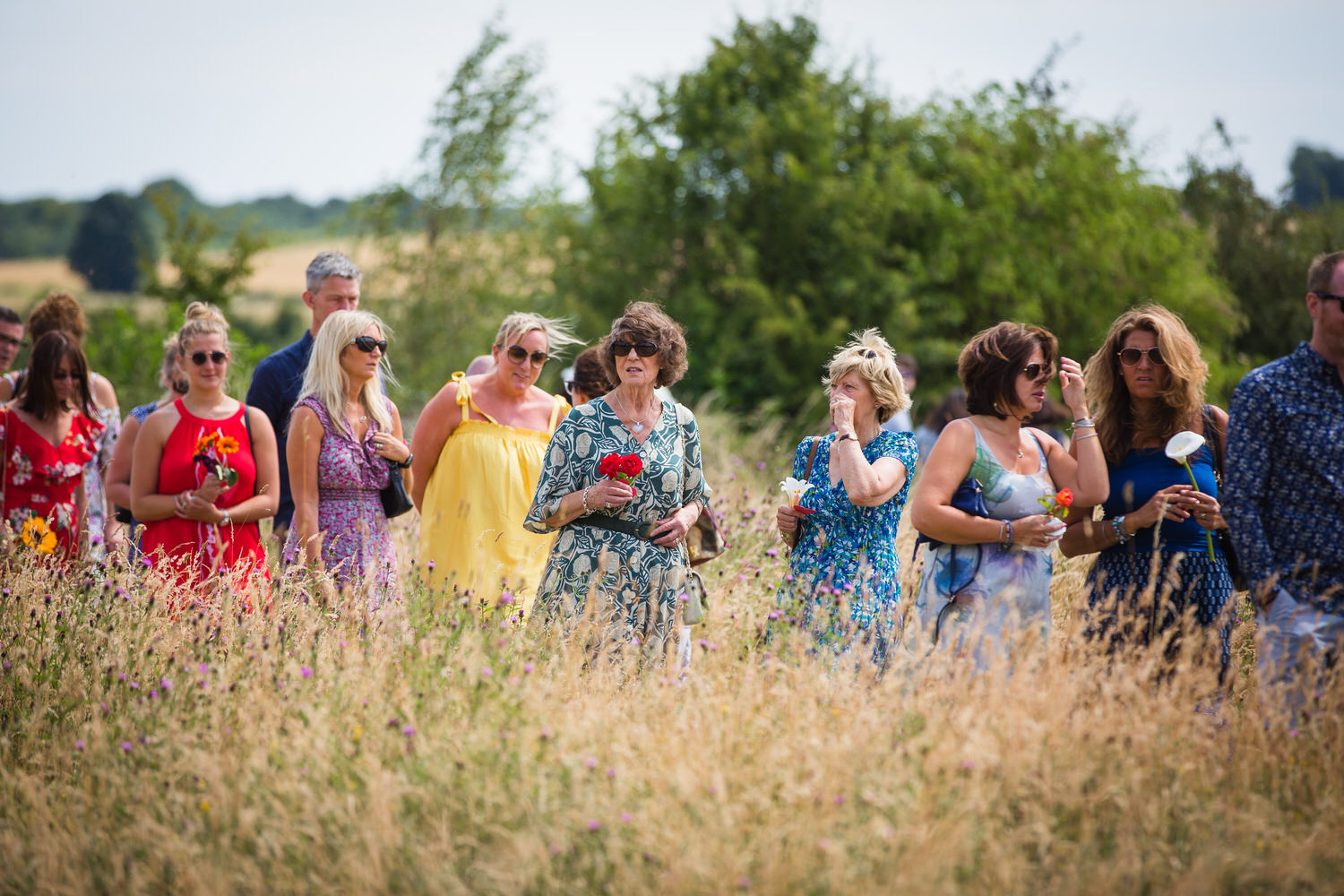
“My dear friend George Richmond, the Director of Photography for the Marvel movie Deadpool, took on the responsibility of selecting a videographer for my husband's funeral. He chose you out of everyone he looked at, and I am immensely grateful for that decision.
Your work is truly remarkable - from the beautiful opening shots to the impeccable sound quality and the finer details throughout. The way you captured the vibrant blue sky was touching, especially since my husband had such an affection for blue skies. My heartfelt thanks for everything you've done.”
— Lady M ⭐️⭐️⭐️⭐️⭐️