Hindu Funeral Photography — Body Preparation, Horse-Drawn Cortege & Cremation, Barrow-in-Furness, Cumbria








Thank you to the family for the extraordinary trust they placed in me on this day to be their funeral photographer — and for giving their permission to share these images. Their generosity in allowing others to see what they experienced is an act of love, and I hope it helps other Hindu families understand what funeral photography at this level can look like.
Travelling to Cumbria — Why This Family Found Me
I travel all over the UK for families, and this family asked me to make the journey to Barrow-in-Furness because they had seen my work and knew what they wanted: a photographer whose approach was built around storytelling rather than posing. No stopping. No staging. No directing people to stand here or look that way. Just honest, documentary coverage of the day as it actually unfolded.
That is exactly how I work, and it is why they asked me to make the journey. From the very first moment at Co-op Funeralcare Barrow to the final images at The Chetwynde Hotel, my job was to follow, observe and record — never to interrupt what was happening in front of me.
The Funeral Directors — Photographing the Preparation of the Body
The day began at Co-op Funeralcare in Barrow, where the family gathered to prepare the body before the journey to the crematorium. I was invited to be present for this — something that is not asked of many photographers, and which I did not take lightly.
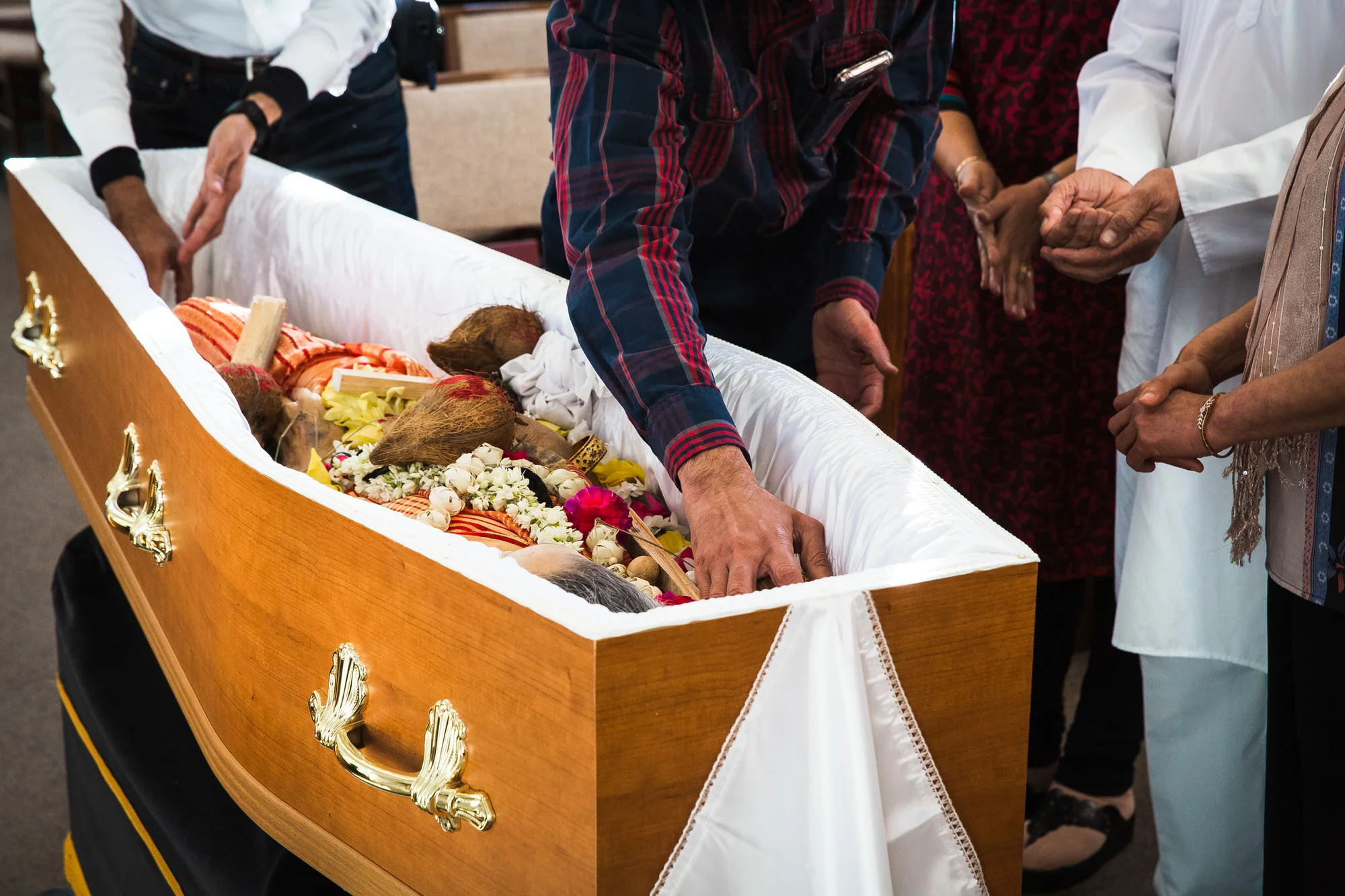
In Hindu tradition, the preparation of the body is a sacred act — the Antyesti, or last rites, begins here. The body is washed and anointed with ghee (clarified butter), milk, honey and oils, each substance carrying its own spiritual significance. For women, turmeric is traditionally applied to the head; for men, sandalwood. The body is then dressed — in white for most, or red for a married woman — and placed in the open coffin surrounded by flowers. Rice balls, known as pinda, may be placed beside the body. A lamp is lit near the head. These are not decorative gestures. Each one is an act of preparation for the soul's journey toward moksha — liberation and release from the cycle of rebirth.
The family replaced bangles on her hands and placed flowers with care around her. These moments — intimate, tender, purposeful — are exactly the kind of thing that passes invisibly unless someone is there to record them.
I worked very slowly and very quietly. Longer lenses kept me at a respectful physical distance. I followed the family's lead entirely, lowering the camera without question at any moment that felt too private. The images from this part of the day are among the most beautiful I have ever taken — the care in every gesture, the love in every placement of a flower.
The Horse-Drawn Carriage — Capturing the Cortege from Funeral Directors to Crematorium
When the time came to leave for Thorncliffe Cemetery and Crematorium, the coffin was carried from the funeral directors onto a horse-drawn carriage. Red roses were placed on the coffin as it was settled onto the carriage — a moment of such simple, quiet beauty that it stopped me.
Capturing the horse and carriage properly was important. I positioned myself to show the full length of the cortege — the horses, the carriage, the family following — while also moving in closer for the details: the roses on the lid, the hands of the people carrying, the expression of the man guiding the horses.
In Hindu tradition, cremation should ideally take place as soon as possible after death, within 24 hours where possible, so that the soul's journey is not delayed. The procession to the crematorium is not incidental — it is part of the ritual itself, a final passage through the world the person inhabited. Photographing it as such, rather than simply as a transport arrangement, is what storytelling means in practice.
The Open Coffin Service at Thorncliffe Crematorium
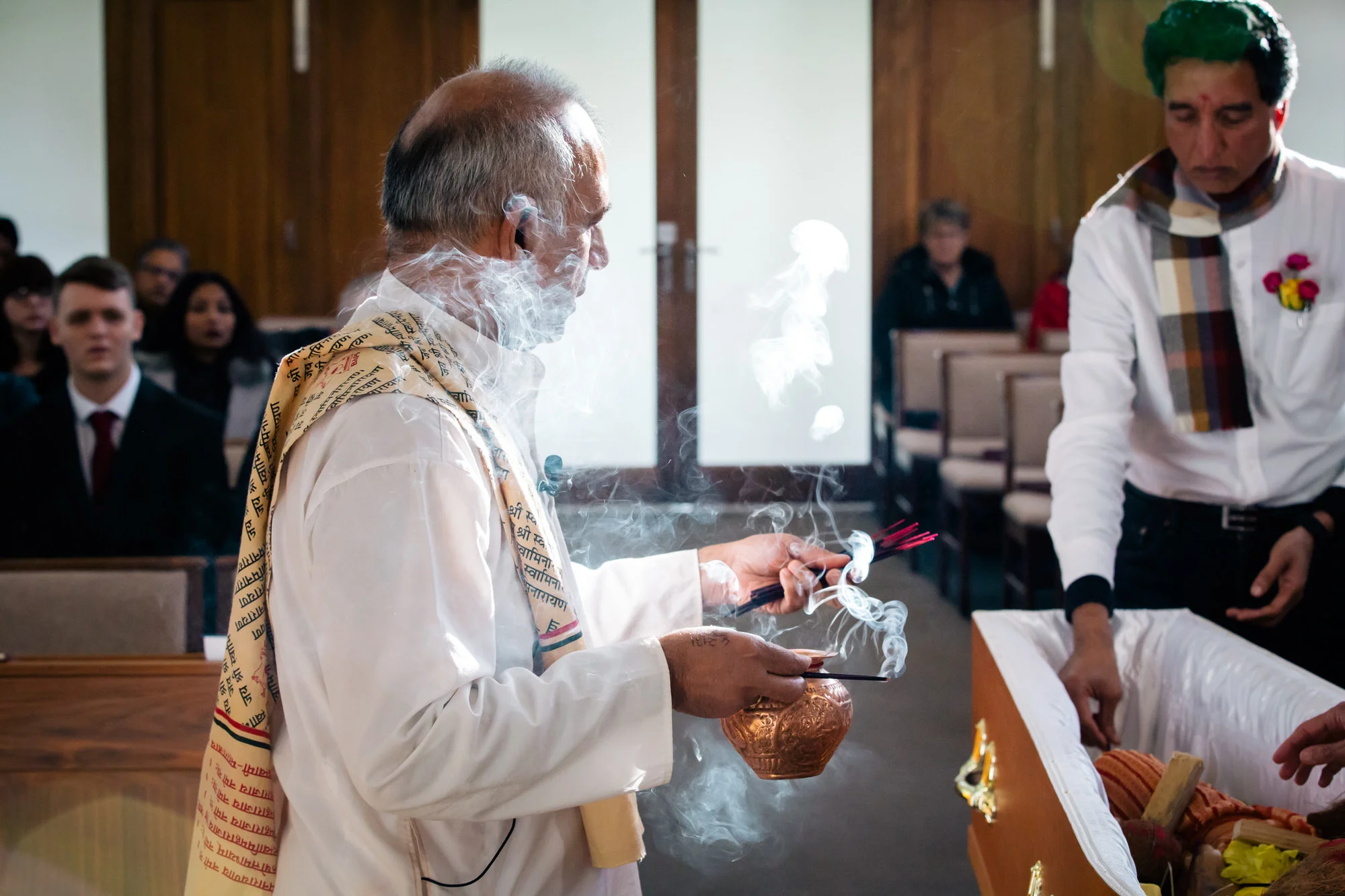
At Thorncliffe Crematorium, the family held an open coffin service — central to Hindu funeral practice and one of the most visually significant parts of the day.
The family carried her into the crematorium together. The coffin was open, surrounded by flowers and garlands — marigold and rose are traditional, symbols of the transience of life and the beauty of what is released. Inside the coffin, alongside her, coconuts and ghee had been placed as offerings.
Both carry deep significance in Hindu ritual. The coconut is considered a symbol of the ego — its hard outer shell representing the individual self, and the breaking of it symbolising the releasing of the soul from the body. Ghee, made from clarified butter, is one of the most sacred substances in Hinduism, used in puja and yajna (fire offerings) for thousands of years. Offering it with the body is an act of purification, a way of honouring the transition the soul is making.
The Pandit led the family through mantras and prayers in Sanskrit. The sound of those ancient prayers filling the crematorium chapel created an atmosphere of complete spiritual focus — something entirely unlike any other service I have attended.
Family members were invited to circle the coffin and make their own offerings and farewells. In some crematoriums, Hindu families are also able to witness the charging — the moment the coffin enters the cremator — as a final act of the mukhagni, traditionally the lighting of the funeral pyre by the eldest son. Thorncliffe's arrangements on the day were guided by the family's wishes and the crematorium's own facilities.
Throughout all of this I worked from positions agreed with the family and the funeral director, moving quietly between wider shots of the congregation and closer coverage of the rituals. I never drew attention to the camera. I never crossed in front of the coffin. The family knew I was there, and I aimed to be invisible in practice.
The Reception at The Chetwynde Hotel
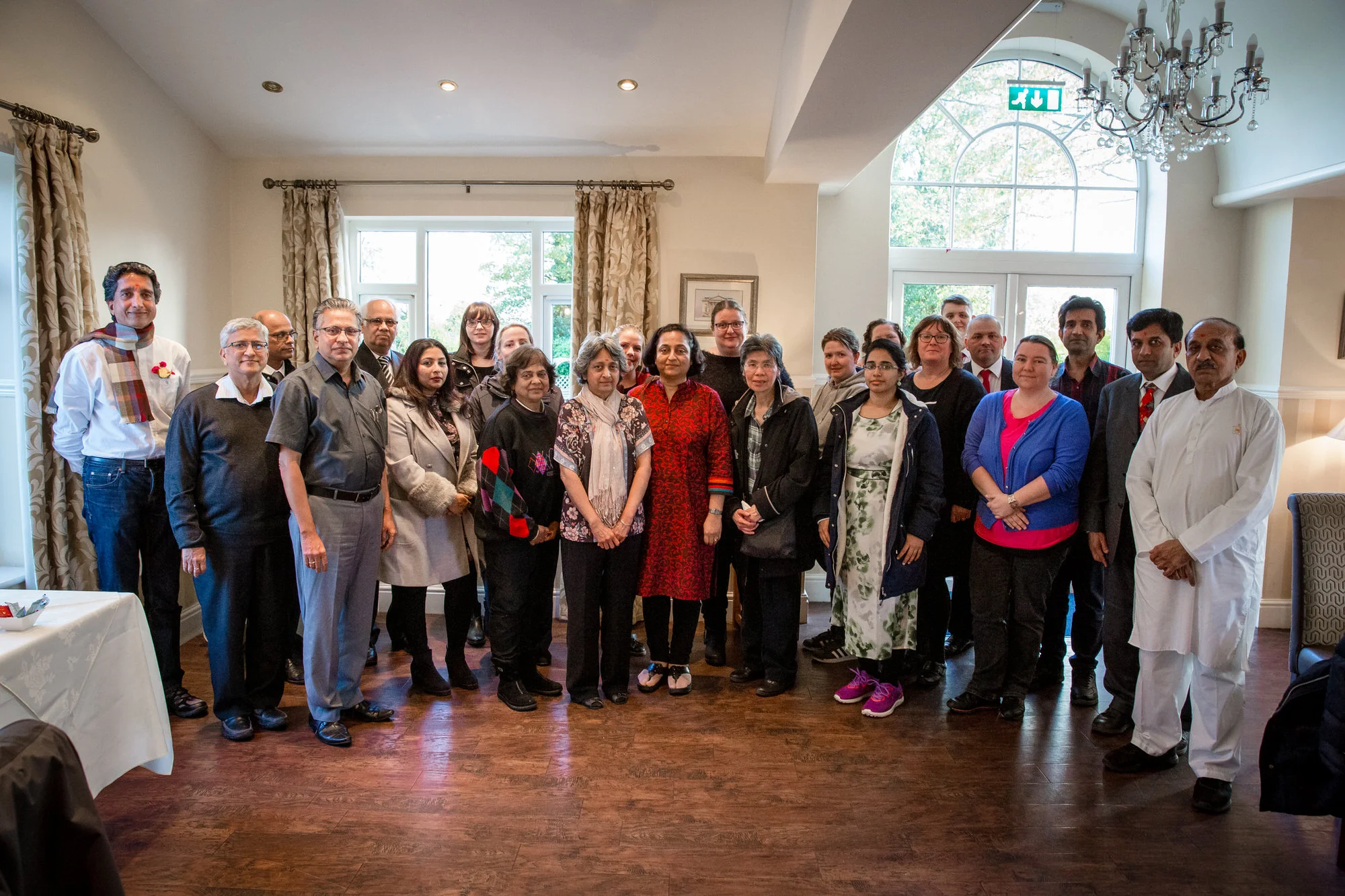
After the cremation, the family hosted a reception at The Chetwynde Hotel in Barrow-in-Furness. Family and friends gathered to share stories, memories and a warm meal — the community aspect of Hindu mourning that is just as important as the ceremony itself.
I continued coverage through the reception — the conversations, the food, the older relatives sitting together, the smaller moments that only show up in photographs taken by someone who was paying attention throughout the whole day rather than arriving for the service and leaving.
Why the Family Chose to Share These Images
The family made a considered decision to allow these photographs to be shared publicly. They wanted other Hindu families to know that this kind of photography exists — and that it can be done with the care and respect it deserves.
Many Hindu families in the UK have never considered having a professional photographer present at the body preparation or the open coffin service. Some worry it would feel intrusive. This family's decision to share their images shows what it actually looks like when it is done with genuine sensitivity and a photographer who understands the difference between documenting a story and interrupting one.
Hindu Funeral Photography Across the UK
I photograph Hindu funerals across the UK — at crematoriums, family homes and community centres, for families from Gujarat, Punjab, Maharashtra, Tamil Nadu and many other regions, each with their own specific customs. If you are arranging a Hindu funeral and would like to discuss whether photography might be right for your family, I'm happy to have that conversation.
You can also read more about my approach in my complete guide to funeral photography and my guide on is funeral photography right for our family?
Call or text me on 07772 509101 — available seven days a week, 9am to 10pm — or get in touch online.
Related pages and guides: